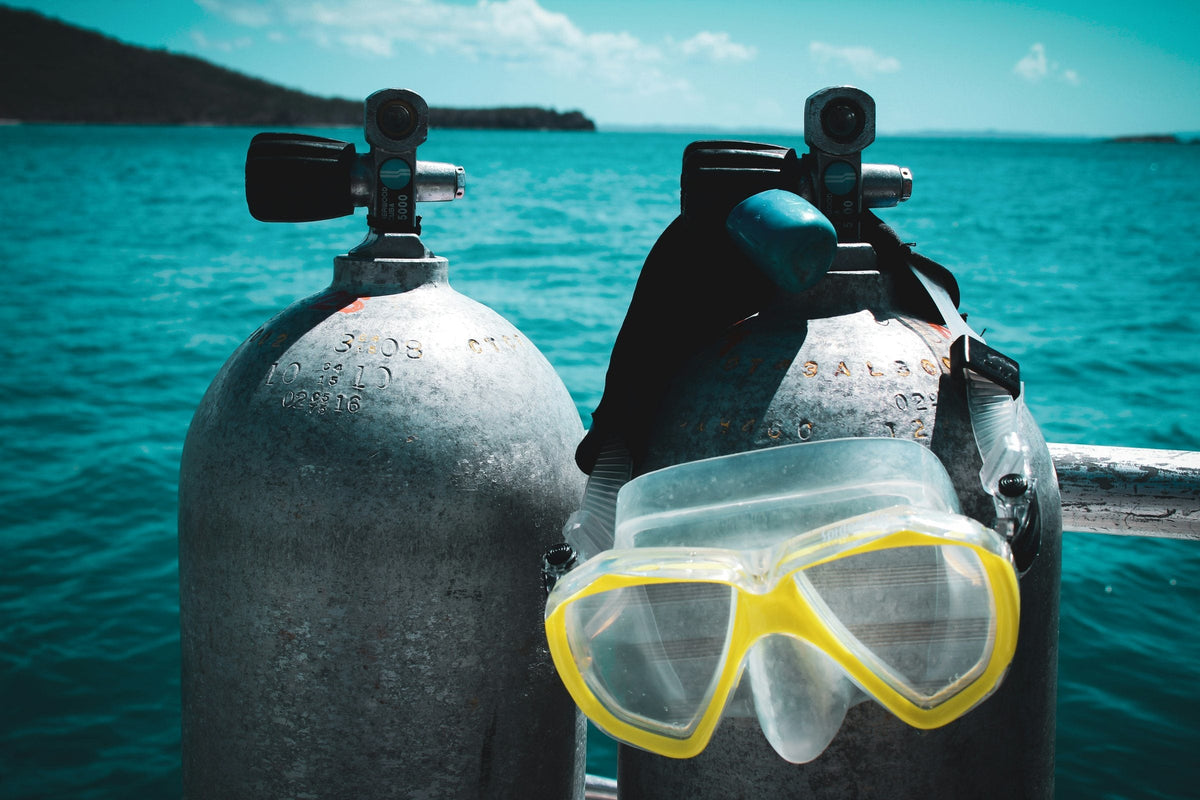
Fill a scuba cylinder with air to 207 bar and it carries 207 times as many oxygen molecules as the same space at the surface. It's still air, though: roughly 21% oxygen and 78% nitrogen, the mix you're breathing as you read this. Recreational divers breathe air or nitrox, not pure oxygen. The reason is pressure. Pure oxygen turns toxic as you descend, and PADI puts the accepted maximum depth for breathing it underwater at 6 metres.
So "oxygen tank" is the wrong name for the cylinder on a diver's back. At a dive centre the difference has consequences. A cylinder marked as oxygen there belongs to a blending panel, a decompression plan or a first-aid kit. Pure oxygen does have jobs in diving. Each of them keeps the pressure low or takes the diver out of the water.
What's in a scuba tank if it isn't pure oxygen?
A standard fill is compressed atmospheric air. NASA lists dry air as 78.08% nitrogen, 20.95% oxygen and 0.93% argon, with carbon dioxide and other trace gases making up the rest. Nitrox cylinders carry more oxygen, between 22% and 40% for recreational use according to PADI, and the balance is still nitrogen. Technical divers use a wider range of gases, pure oxygen included, but they carry it in a separate cylinder for one stage of the dive. Neither air nor nitrox is "oxygen" in the sense most people mean.
That misunderstanding has a practical edge. Picture the cylinder as oxygen and more oxygen sounds like an upgrade, which is the opposite of how pressure behaves. The depth that extra oxygen costs is set out in our guide to why nitrox doesn't let you dive deeper.
Why is pure oxygen dangerous underwater?
Toxicity depends on partial pressure, and partial pressure climbs with depth. The oxygen partial pressure, or PO2, equals the oxygen fraction multiplied by the absolute pressure. Pure oxygen at the surface sits at 1 bar. At 4 metres of sea water it reaches 1.4 bar, the planning limit for recreational nitrox. At about 6 metres, DAN puts it near 1.6 bar. For comparison, air doesn't reach 1.4 bar until almost 57 metres.
Your brain is the first organ at risk. A 2022 review in Frontiers in Physiology describes how high oxygen pressure drives up reactive oxygen and nitrogen species. The authors link that to overexcited nerve centres in the brain stem and, in the end, a seizure. Immersion makes it worse, because being in water shifts blood flow and raises the oxygen reaching the brain. The US Navy teaches early signs with the mnemonic VENTID: vision changes, ears ringing, nausea, twitching or tingling, irritability and dizziness. The review also notes that seizures sometimes arrive without any of them.
Lung damage builds more slowly. DAN compares pulmonary oxygen toxicity to a bad case of flu that rarely causes permanent damage. Its most common cause, according to DAN, is long recompression treatment. Recreational divers seldom get near it. The seizure risk is the one that kills underwater, since a convulsing diver can lose the regulator and drown.
What did the first oxygen divers learn?
Much of what divers know came from wartime work in chambers and open water. Kenneth Donald's trials, published in the British Medical Journal in 1947, exposed volunteers to pure oxygen at 90 feet, roughly 27 metres. Time to the first seizure was about 128 minutes in a dry chamber and only about 41 minutes in a wet one. Same gas, same pressure. Putting the diver in water cut the time to a convulsion by about two thirds.
Christian Lambertsen, whom the US Navy calls the father of its frogmen, built the American military's first closed-circuit oxygen rebreather. While training instructors with it, he drifted to about 30 metres on pure oxygen, a PO2 near 4 bar. His last act before the seizure was to inflate his breathing bags so he'd float. He came round with a buzzing head and a Navy chaplain looking down at him. His case shows how little a warning can offer. Modern limits build in enough margin to keep divers out of the range where symptoms appear at all.
When do divers breathe pure oxygen?
Pure oxygen has four accepted uses in diving, and each one keeps the pressure low or the diver still:
- Decompression stops. Technical divers commonly breathe 100% oxygen at 6 metres, about 1.6 bar. DAN says the seizure risk at rest there is low but not absent.
- Military oxygen rebreathers. They produce no bubbles, which suits covert work. The US Navy allows trained combat swimmers 1.7 bar for up to four hours at 7.6 metres. DAN warns that going 1.5 metres deeper puts a diver where convulsions have happened. At 15 metres the Navy limit drops to 10 minutes.
- First aid on the surface. DAN's primary first aid for decompression sickness is oxygen at the highest concentration practical. A study of 2,231 cases in DAN's injury database found a measurable benefit. After one chamber treatment, 67% of divers given first-aid oxygen had complete relief, against 58% without it.
- Recompression chambers. US Navy Treatment Table 6 puts the patient at 2.8 atmospheres, about 18 metres' equivalent. They breathe pure oxygen with scheduled air breaks for nearly five hours.
The deepest routine use of pure oxygen in diving happens in a dry chamber, at rest, with medical staff watching. No coincidence. Take away the water, the exercise and the unplanned depth changes, and the gas that caused convulsions in Donald's wet trials becomes a treatment.
Where does oxygen training fit for recreational divers?
For most divers, oxygen knowledge starts with nitrox. Scuba Evolution runs the PADI Enriched Air Diver course as the Nitrox Course. It covers planning within oxygen limits, analysing your own cylinder and setting a computer for the mix. Handling high-pressure oxygen is a separate skill again, with its own training and oxygen-clean equipment. DAN lists gas blending system fires among the rare but serious oxygen accidents. Its article on oxygen cleaning also notes that burn rates rise fast above 25% oxygen.
First-aid oxygen belongs to a different moment: a diver on the boat with symptoms after surfacing. The link between that oxygen and the nitrogen bubbles it treats is covered in our guide to how decompression sickness develops. In South Africa, DAN Southern Africa's emergency hotline, +27 82 810 6010, is staffed around the clock to help coordinate care and evacuation.
Sources
- PADI Blog: What Is in a Scuba Tank?
- NASA: Earth Fact Sheet
- DAN: Oxygen Toxicity
- Frontiers in Physiology: The O2-sensitive brain stem, hyperoxic hyperventilation, and CNS oxygen toxicity
- DAN: Treating Decompression Sickness
- Undersea & Hyperbaric Medicine (PubMed): First aid normobaric oxygen for the treatment of recreational diving injuries
- DAN Alert Diver: Oxygen Cleaning of Dive Gear
- DAN Southern Africa
Frequently Asked Questions
Is it safe to breathe pure oxygen after a dive?
On the surface, oxygen is the standard first aid for suspected decompression sickness, and DAN recommends the highest concentration practical. The seizure risk that limits divers comes from breathing oxygen under pressure. Lung irritation mostly follows long exposures, such as extended chamber treatments.
Why do technical divers switch to oxygen at 6 metres?
Breathing a gas with no nitrogen widens the pressure difference that draws nitrogen out of the tissues, so decompression runs faster. At 6 metres, pure oxygen sits near 1.6 bar, which DAN treats as acceptable only when the diver is at rest. Any deeper and the seizure risk climbs quickly.
Can you fill a scuba cylinder with pure oxygen?
Not for recreational diving. Oxygen at high pressure is a fire hazard. DAN cites the ASTM standard that high-pressure scuba gear used with 25% oxygen or more should be cleaned for oxygen service. Cylinders and valves for pure oxygen need that preparation and a gas plan that keeps the diver shallow.
Is nitrox the same as oxygen?
No. Recreational nitrox contains 22% to 40% oxygen, so most of each breath is still nitrogen. The extra oxygen gives every nitrox mix a maximum depth, which for EAN32 at 1.4 bar is about 34 metres.
What should you do if a buddy shows signs of oxygen toxicity?
For symptoms without a seizure, DAN advises alerting your buddy, making a controlled ascent and switching to a lower-oxygen gas. For a convulsing diver, DAN advises leaving the mouthpiece in place if it's still in, controlling the diver from behind and making a controlled ascent. Rescue skills like these are practised in training, not improvised on the day.
This is general information, not a substitute for a dive medical or advice from a doctor trained in dive medicine. In an emergency, contact DAN Southern Africa on +27 82 810 6010.
Reviewed September 2026. Devon Ford runs Scuba Evolution, a PADI 5 Star Dive Centre in Glenvista, Johannesburg.
Header photo: Manuel E Sankitts on Unsplash, used under the Unsplash License. View the original photo