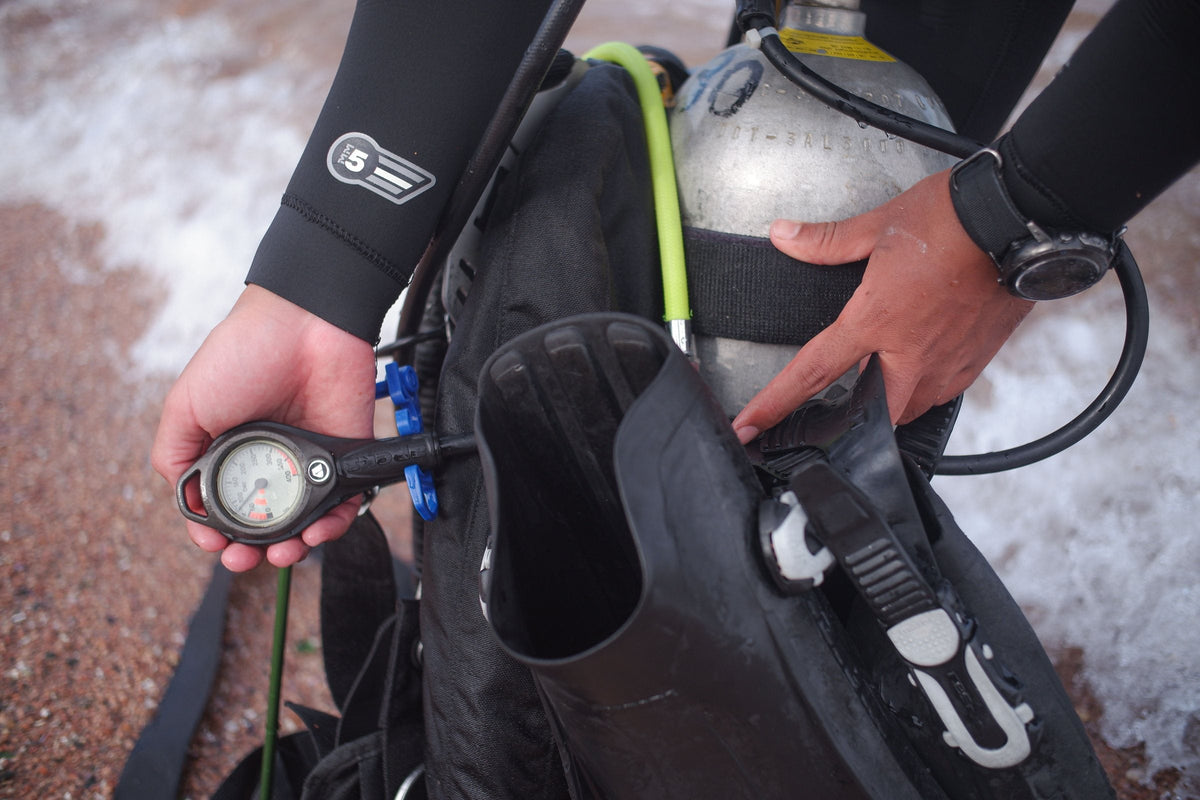
A 12 litre cylinder filled to 232 bar carries 2,784 litres of air at surface pressure. At 20 metres, a moderate breathing rate empties the usable part of that in a little over 40 minutes. Take the same cylinder to 30 metres and the same diver gets about 30. The honest answer to the question is a formula, not a number.
The sum runs to three lines and uses school multiplication. Cylinder volume times fill pressure gives the free air. Subtract the reserve you plan to surface with. Divide what remains by your breathing rate multiplied by the ambient pressure at depth. What follows works that sum on a 12 litre and a 15 litre. It then shows you how to measure your own breathing rate on a dive, so the answer is yours rather than an average.
How much air is in a 12 litre cylinder?
The 12 is the internal water capacity of the cylinder, not the air inside it. Fill it to 232 bar and you compress roughly 232 cylinders' worth of surface air into one. Multiply and you get the free air volume.
12 litres x 232 bar = 2,784 litres of air at surface pressure.
Two caveats before that figure goes into a plan. Air does not compress in perfect proportion at 232 bar, so the sum runs slightly optimistic. And you are not breathing the cylinder dry. Take a reserve off the top, commonly 50 bar.
50 bar x 12 litres = 600 litres of reserve, leaving 2,184 litres to use.
DAN sets out a stricter convention, the rule of thirds: one third of the gas outbound, one third for the return, one third untouched for a problem. Either works, as long as you pick one and stick to it. If you have landed here from an American page, those articles usually use an aluminium 80 cubic foot cylinder at 3,000 psi. That is about 11 litres at 207 bar. Every figure from here on stays in litres and bar.
Why does depth change how fast the air goes?
Your regulator delivers gas at the pressure of the water around you. At depth each breath fills your lungs with denser air, so a lungful at 20 metres contains three times the gas a lungful at the surface does. Your breathing rate has not changed. The gas your body draws from the cylinder has tripled.
NOAA puts the rate plainly: for every 33 feet, or 10.06 metres, pressure increases by one atmosphere. In round diving numbers that gives a workable formula.
Ambient pressure in bar = depth in metres / 10 + 1. So 10 metres is 2 bar, 20 metres is 3 bar, 30 metres is 4 bar, 40 metres is 5 bar.
Two footnotes for local divers. NOAA's figure is for seawater, and fresh water needs a fraction more depth per bar, which changes nothing in a gas plan. Altitude does. Surface pressure on the Highveld sits below one bar, which shifts the whole scale, and we have covered what altitude does to your tables separately. The worked examples here use a sea-level start.
How do you measure your own air consumption?
DAN splits this into two numbers, and the distinction is worth learning. SAC, surface air consumption, is expressed in bar per minute and belongs to one cylinder size. RMV, respiratory minute volume, is expressed in litres per minute and travels with you to any cylinder. Most divers say SAC rate when they mean RMV.
Measuring it takes ten minutes of one dive. Stay at a steady depth, swim at a comfortable pace, and note your pressure at the start and the end. Then work backwards.
A 12 litre cylinder at 10 metres for 10 minutes goes from 200 bar to 170 bar. That is 30 bar.
30 bar / 10 minutes = 3 bar per minute, measured at depth.
3 bar per minute / 2 bar ambient = 1.5 bar per minute. That is your SAC on a 12 litre.
1.5 bar per minute x 12 litres = 18 litres per minute. That is your RMV.
Write the RMV down. It works on any cylinder you pick up.
Run it on several dives before you trust it. A first measurement taken while you are still fighting your buoyancy reads high, and it falls as trim and weighting settle. DAN's own worked metric example lands at 22 litres per minute, so 18 is a reasonable working figure.
What does that give you at depth?
Take the 2,184 usable litres from the 12 litre cylinder and an RMV of 18 litres per minute. Multiply the RMV by the ambient pressure to get consumption at depth, then divide.
At 10 metres: 18 x 2 = 36 litres per minute. 2,184 / 36 = 60 minutes.
At 20 metres: 18 x 3 = 54 litres per minute. 2,184 / 54 = 40 minutes.
At 30 metres: 18 x 4 = 72 litres per minute. 2,184 / 72 = 30 minutes.
Moving from 10 metres to 30 metres halves the dive, because ambient pressure doubles. Now change the cylinder. A 15 litre at 232 bar carries 3,480 litres, with a 750 litre reserve at 50 bar, leaving 2,730 to use. At 20 metres that gives 2,730 / 54 = 50 minutes. Twenty-five percent more gas buys twenty-five percent more time, and costs you the extra weight and drag of a bigger cylinder.
Change the diver instead and the swing is larger. Run the same sum at 25 litres per minute and the 12 litre at 20 metres gives 2,184 / 75 = 29 minutes. Same cylinder, same depth, eleven minutes gone.
None of these numbers is a dive plan. They estimate when the gas runs low, and gas is one of two clocks. Your computer runs the other. Shallow dives usually end because the cylinder is empty. Deeper ones end because the no-stop time has gone, while the arithmetic above still says the gas is fine. Whichever clock is shorter governs the dive.
What changes your number?
The RMV you measure on a calm dive is a floor, not a ceiling. Plenty of things push it up on the day.
- Work rate. Finning into a current is the biggest single multiplier a recreational diver meets, and nothing else on this list moves the number as fast.
- Cold. Shivering burns oxygen, and an underdressed diver on a winter dive uses more gas than the same person in the same water in a thicker suit.
- Buoyancy and trim. Constant fin adjustments to stay level are work, and a head-up diver is pushing a larger frontal area through the water.
- Body size. A larger diver has larger lungs and a larger oxygen demand. This one is not a skill problem.
- Task loading. Camera work, navigation and anything that raises stress raises breathing rate with it.
- Kit drag. Dangling gauges, loose octopus hoses and a badly fitting suit all cost gas over a full dive.
Does a bigger cylinder or nitrox give you more time?
A bigger cylinder gives more time in direct proportion. The 15 litre example above is the whole story: more litres, more minutes, more kilograms on your back.
Nitrox does not. A nitrox fill puts the same number of litres into the same cylinder at the same pressure, so the gas lasts exactly as long as air would at that depth. What enriched air extends is no-stop time, which is a different limit entirely, and we have written up why nitrox does not buy you depth. On a deeper dive where the computer is the binding clock, nitrox helps. On a shallow dive where the cylinder is, it does nothing for duration.
Depth is the variable doing most of the work here. Gas planning and buoyancy sit on the Advanced Open Water course alongside the Deep Adventure Dive. Working out your own RMV on those dives is one of the more useful things you take away.
Sources
- DAN, Estimating Your Air Consumption The SAC and RMV distinction, the timed-swim method, the metric conversion and the rule of thirds.
- NOAA Ocean Service, Why does pressure increase with ocean depth? The one atmosphere per 33 feet, or 10.06 metres, used for the ambient-pressure multiplier.
- PADI, Advanced Open Water Diver Where deep diving and gas management sit in the training ladder.
- PADI, Enriched Air Diver What nitrox extends, and what it does not.
Frequently Asked Questions
How much air is in a 12 litre scuba cylinder?
At 232 bar, 12 x 232 gives 2,784 litres of air at surface pressure. Set aside a 50 bar reserve, which is 600 litres, and 2,184 litres remain for the dive.
How do you calculate a SAC rate in metric?
Divide the bar you used by the minutes you were down, then divide that by the ambient pressure in bar. Multiply the result by your cylinder size in litres for an RMV in litres per minute, which works on any cylinder.
What is a normal air consumption rate?
There is no published normal, and any figure quoted as one is a guess. DAN's worked metric example comes out at 22 litres per minute. Measure your own rather than borrowing a number.
Why does your buddy's air last longer than yours?
Lung volume, work rate, buoyancy control and cold all feed into it, and body size is a large part of it. Two divers on identical cylinders at identical depths routinely surface hundreds of litres apart.
Does depth change how fast you use air?
Yes, in direct proportion to ambient pressure. At 20 metres you draw three times the surface volume per breath, and at 30 metres four times, without breathing any faster.
Does nitrox make a cylinder last longer?
No. The same cylinder at the same pressure contains the same number of litres whatever the mix. Nitrox extends no-stop time at depth, not gas duration.
Reviewed September 2026. Devon Ford runs Scuba Evolution, a PADI 5 Star Dive Centre in Glenvista, Johannesburg.