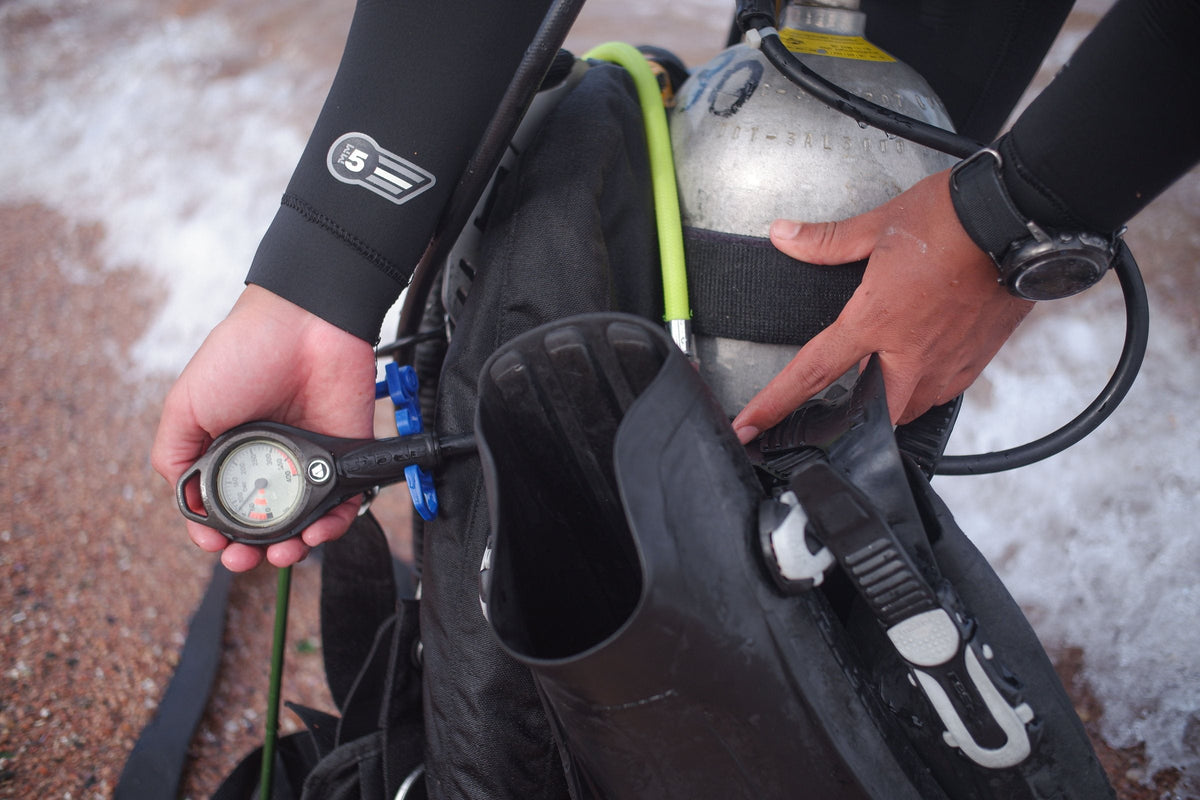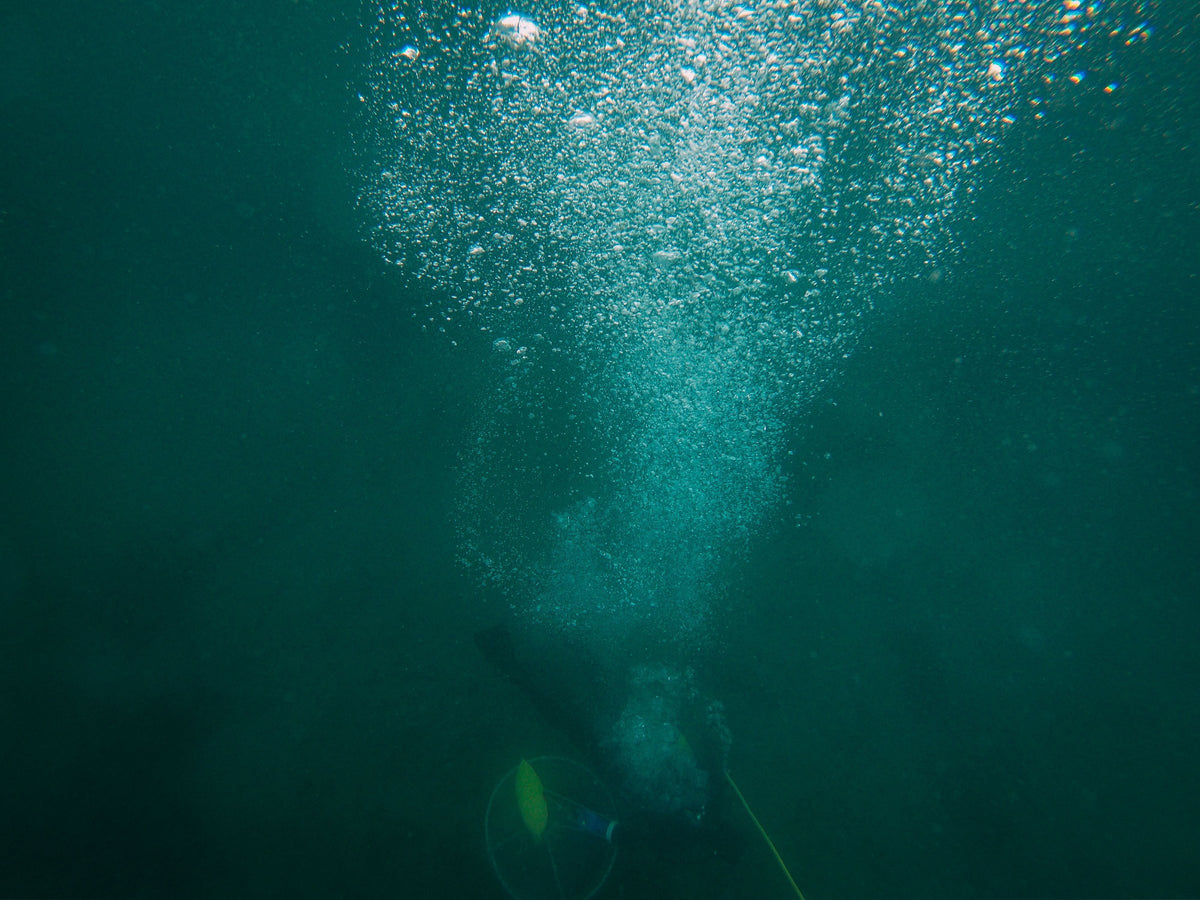
Twenty-five minutes in, you check your gauge and it reads 70 bar. Your buddy catches your eye and flashes ten fingers, then two. One hundred and twenty. You go back to looking at the reef and decide to say nothing until somebody asks.
The gap is rarely lung size on its own. Put two divers on identical 12 litre cylinders at 20 metres. One breathes 14 litres a minute, the other 22. After half an hour they are 60 bar apart. On a 12 litre that is 720 litres of air. Most of a gap that size goes on drag, cold water and a breathing pattern, and all three can be changed.
Why do you use air faster than your buddy?
Your regulator hands you gas at the pressure of the water around you. At 20 metres that is 3 bar, so a single breath pulls three times the surface volume out of the cylinder. Depth does that to both of you equally. What differs is the volume you move per minute at the surface, your respiratory minute volume, and the whole gap lives there.
Run it on a 12 litre cylinder filled to 232 bar. Diver A works at 14 litres a minute. Diver B works at 22, the figure DAN uses in its own metric worked example.
Diver A: 14 x 3 bar = 42 litres a minute at depth. Divided by 12 litres, that is 3.5 bar a minute off the gauge.
Diver B: 22 x 3 bar = 66 litres a minute at depth, or 5.5 bar a minute off the gauge.
Thirty minutes in, A has spent 105 bar and sits on 127. B has spent 165 and sits on 67. Same water, same kit. Sixty bar apart, which on a 12 litre cylinder is 720 litres of air that one diver breathed and the other did not.
What is a SAC rate, and is there a good number?
SAC is surface air consumption, given in bar a minute, and it belongs to one cylinder size. RMV is respiratory minute volume, given in litres a minute, and it travels with you to any cylinder you pick up. Most divers say SAC and mean RMV. Measuring either takes ten minutes of one dive at a steady depth, and the full sum is set out cylinder by cylinder in how long a tank lasts.
There is no published normal. DAN's metric worked example comes out at 22 litres a minute, which makes it a reference point and not a target. Anyone handing you a good SAC rate is handing you a number measured on somebody else. Take your own on three or four calm dives, write it down, then watch what moves it.
Do bigger divers use more air?
Partly, and that part will not train away. A taller, heavier person moves more air per breath and has more tissue asking for oxygen, so a larger diver tends to sit at a higher RMV on the same dive. Lung volume scales with frame. Physiology, not technique.
Size then gets blamed for more than it causes. A warm, well weighted, streamlined large diver can surface with more gas left than a cold, overweighted small one, because the fixable causes stack up faster than the fixed one does. Body size sets the floor. Everything below sets how far above that floor you land.
Does being cold or overweighted use more air?
Cold comes first because it is the one people ignore. Shivering is muscular work, and muscular work costs oxygen, so a diver losing heat tends to breathe harder to pay for it. Long before the shivering starts, the cold has taken a share of your attention and tightened your breathing. Water strips heat far faster than air at the same temperature, which is why a 24 degree dive feels nothing like a 24 degree day. Warmth is the cheapest gas you will buy.
Lead is the other one, and PADI lists weight management and trim alongside streamlining for exactly this reason. Carry four kilograms you do not need and you have to put gas in your BCD to cancel them. An inflated BCD is a larger object being dragged through the water, and a diver fighting one tends to drift head-up, so the fins start pushing upward instead of forward. The drag, the finning and the gas in the wing come out of the same cylinder. Running a proper weight check is a separate job and worth its own half hour.
Can breathing slowly make your air last longer?
Within limits, and the mechanism is worth getting right. PADI's instruction is a slow, rhythmic pattern, breathing fully while staying relaxed, and its own line is that a slow yet deep pattern results in lower air consumption. The reason sits in your airway. A fixed volume of each breath only refills your windpipe and bronchi, where no gas exchange happens. Short shallow breaths spend a large share of every lungful on that plumbing, so you take more of them.
Longer breaths out do the other half of the work, because they clear more carbon dioxide. Rising carbon dioxide is what makes you feel short of air in the first place. What does not work is skip breathing, the habit of pausing on a full chest to stretch the gas. PADI's rule is to keep breathing and at no point hold your breath, since a closed airway during an ascent of a metre or two is enough to injure a lung. Skip breathing also drives carbon dioxide up, so you pay it back later with harder breathing.
What should you change first?
Order these by payoff rather than by effort. The first three do most of the work, and none of them costs anything.
- Fix your weighting. The largest fixable cause, and half an hour in a pool settles it.
- Get warm. A suit matched to the water, plus a hood, ends the shivering tax for the whole dive rather than for the first twenty minutes.
- Flatten your trim. Horizontal presents the smallest area to the water. Head-up turns forward finning into a climb you are paying for in gas.
- Stop using your hands. Sculling burns gas and moves you almost nowhere. Hands do nothing useful under water except operate kit.
- Tidy your kit. DAN puts streamlining and leaks on the same list. A dangling console is drag on every metre you swim.
- Slow down and come up a little. PADI's advice is to pause, stop finning when finning is pointless, and stay shallow where the dive allows it, because a metre shallower is gas saved on every breath.
None of this is a personality change. It is buoyancy, and buoyancy is trainable. Peak Performance Buoyancy runs as an adventure dive inside the Advanced Open Water course. The weighting, the trim and the finning get fixed under supervision there, instead of guessed at over twenty dives. Measure your RMV before that course and again after, and compare the two numbers.
Sources
- DAN, Estimating Your Air Consumption The SAC and RMV method, the metric worked example of 2 bar a minute on an 11 litre cylinder giving 22 litres a minute, and streamlining and trim as ways to reduce consumption.
- PADI, Tips for Improving Air Consumption Weight management, trim, streamlining, pausing, slowing down and staying shallow.
- PADI, How Do You Breathe While Scuba Diving? The slow, deep, rhythmic pattern, its effect on consumption, and the instruction to keep breathing at all times.
- PADI, Peak Performance Buoyancy The buoyancy and weighting course, run here as an Advanced Open Water adventure dive.
Frequently Asked Questions
Does breathing slowly make your air last longer?
Slow and deep does, because a bigger share of each breath reaches the part of the lung that exchanges gas. Rapid shallow breaths spend more of each lungful refilling the airway, so you take more of them.
Does being overweighted make you use more air?
Yes. Lead you do not need has to be cancelled with gas in your BCD, and an inflated BCD is more drag. The head-up trim that comes with it turns finning into climbing, which costs more again.
Does cold water increase air consumption?
It tends to. Shivering is muscular work and muscular work needs oxygen, and cold tightens your breathing well before shivering starts. A suit matched to the water is the cheapest fix on the list.
Do bigger divers use more air?
Larger people move more air per breath and have more tissue to supply, so a larger diver tends to sit at a higher rate. It sets a floor rather than a ceiling, and weighting and trim move you further than body size does.
Is skip breathing a safe way to stretch a cylinder?
No. Pausing on a full chest is breath-holding, and PADI's instruction is to keep breathing throughout. It also raises carbon dioxide, so the saving comes back as harder breathing later in the dive.
How many dives before your air consumption settles?
Take the measurement on three or four calm dives before you trust it. Early figures read high while weighting and trim are still wrong, and they fall as those get sorted out.
This is general information, not a substitute for a dive medical or advice from a doctor trained in dive medicine. In an emergency, contact your local emergency services and DAN Southern Africa on +27 82 810 6010.
Reviewed September 2026. Devon Ford runs Scuba Evolution, a PADI 5 Star Dive Centre in Glenvista, Johannesburg.