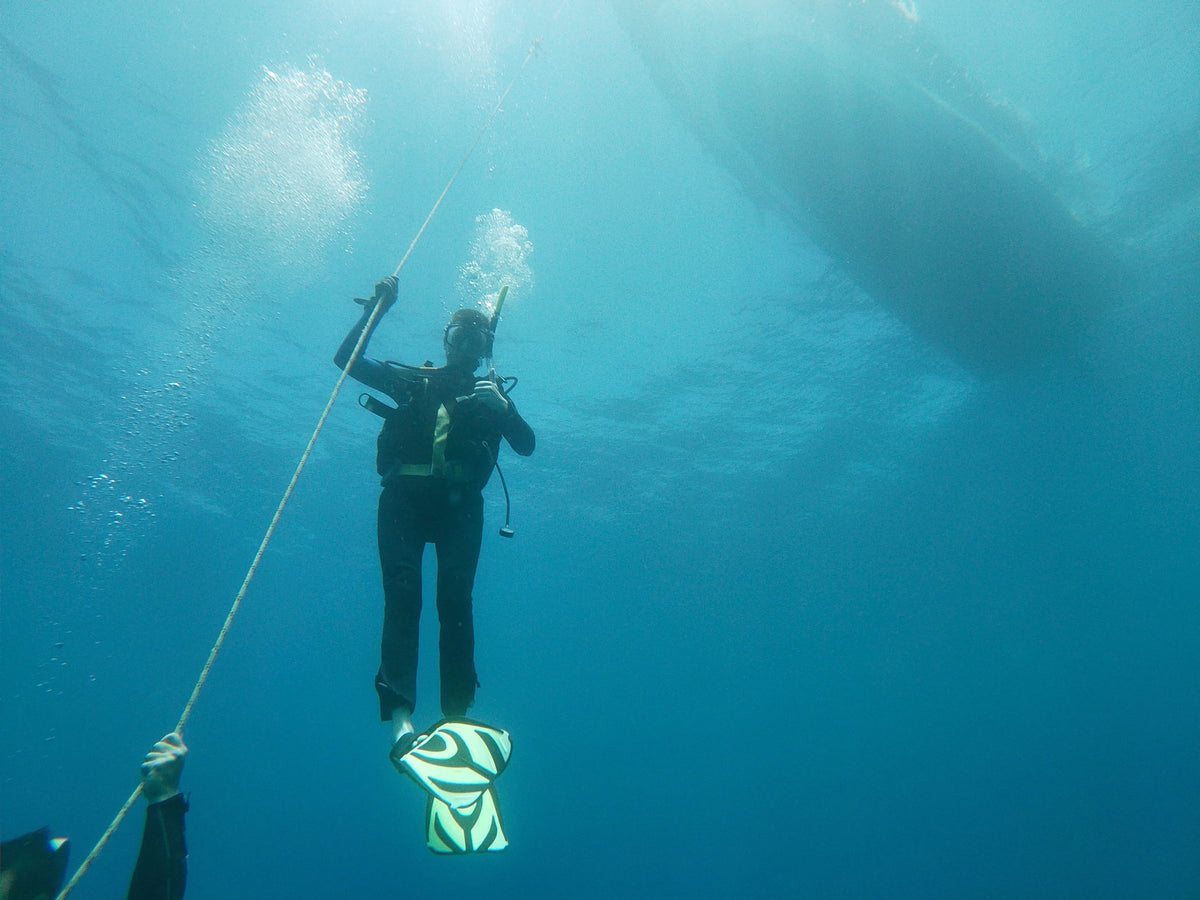
Five metres. Three minutes on the clock, and you are finning downward to stay at five metres while your buddy hangs on the line without moving a fin. Stop kicking for two seconds and you drift up half a metre. This is the easiest part of the dive and you are working harder than you did at 25.
Two opposite weighting errors produce that, and both start on the surface. A 12 litre cylinder filled to 232 bar and breathed down to 50 gives up 2,184 litres of air, and that air weighs roughly 2.6 kilograms. Set your lead on a full cylinder and you are about 2.6 kilograms light by the safety stop. Carry lead you do not need instead, and you have to put gas in your BCD to cancel it. That gas expands as you rise, and it lifts you off the stop from the other direction. A weight check tells you which one you have.
Why do you float up at the safety stop?
Gas expands as pressure drops, and the fastest expansion of any dive happens in the last ten metres. A bubble at 10 metres sits under 2 bar of absolute pressure. At the surface it sits under 1 bar, so it doubles. The same rise from 30 metres to 20 metres grows it by a third. Five metres is where a BCD becomes hardest to manage, which is exactly where the standard safety stop puts you.
An overweighted diver carries a large bubble in the wing all dive to cancel the extra lead. That bubble grows fastest in the shallows, so holding a stop turns into a running battle with the dump valve. The diver who is 2.6 kilograms light has the opposite problem. An empty BCD, nothing left to dump, and finning down as the only tool. Ascent control is where slow and steady does the most work, and it sits at the centre of how decompression sickness happens.
How do you do a proper weight check?
PADI states the target in one line. Properly weighted, you should float at eye level holding a normal lungful of air with an empty BCD. Then exhale fully. If you drop like a sack of bricks, take weight off. What you want is a slow sink that gives you time to equalise early on the way down.
Do it in full kit, with the suit, hood, gloves and boots you plan to dive in, and with the regulator in your mouth. Vertical, motionless, fins still. Any kicking at all makes the result a lie. A heated indoor training pool takes the cold and the chop out of the test. Ours is a better place to settle the number than a shore entry with a queue behind you.
Repeat it whenever the picture changes. A new suit, a different cylinder, a thicker hood or ten kilograms on or off your own frame all move the number. Log the result against the kit you used, because a number without its kit list is worth nothing next season.
Should you weight yourself with a full or an empty cylinder?
An empty one, or as near empty as you can get. The reason is the arithmetic in the second paragraph, worked properly.
12 litres x 232 bar = 2,784 litres of air in a full cylinder. Surface at 50 bar and you leave 600 litres behind, so 2,184 litres went into your lungs and out through the exhaust valve.
Air at sea level weighs about 1.2 grams a litre. 2,184 x 1.2 grams = roughly 2.6 kilograms of gas gone.
The cylinder takes up the same space empty as it did full, so it displaces the same water. Lose 2.6 kilograms of contents and the whole rig is 2.6 kilograms more buoyant than it was when you kitted up. A check done at 232 bar therefore sets you up to be neutral at the start and light at the end, which is the wrong way round. Do the check at about 50 bar and the number you get is the number you dive. Do it on a full cylinder and add roughly 2.5 kilograms before you trust it.
The arithmetic does not stop at 12 litres. A 15 litre cylinder breathed over the same range gives up about 3.3 kilograms of gas, so the correction grows with the cylinder. Steel and aluminium differ in how buoyant the empty cylinder itself sits, which changes your starting lead but not the size of this correction.
What else changes the number?
Your lead is the counterweight to everything buoyant you are wearing, so the list is short and each item is worth a kilogram or several.
- Suit thickness. Neoprene floats because it is full of gas bubbles, and a 7 mm suit carries far more of them than a 3 mm. Thicker suit, more lead.
- Suit age. Those bubbles crush a little more each dive and do not come all the way back. A five-year-old suit needs less lead than it did new, and divers who skip the recheck end up overweighted by habit.
- Hood, gloves and boots. They are neoprene too. A hood and 5 mm boots together can move the number by a kilogram.
- Salt water. Salt water is denser than fresh, so the same body and kit displace more upthrust in it and need more lead. Most Gauteng divers train inland in fresh water and then dive at the coast, which is the classic reason a first coastal dive goes badly.
- The BCD itself. Padding, backplates and integrated weight pockets all carry their own buoyancy, and swapping jacket for wing changes the answer.
There is a tempting shortcut here, a percentage of body mass. Avoid it. No agency publishes one as a standard. Two divers in identical suits routinely need different lead, and a formula cannot see your suit, your cylinder or the water you are standing in. The check takes ten minutes and answers for your kit rather than for an average person.
On the fresh-to-salt move, the honest instruction is the same one. Redo the check in the water you are about to dive, on the morning you dive it. The direction of the change is certain. Its size depends on the volume you and your kit displace, and a 7 mm suit displaces far more than a shorty. As a starting point for the first coastal dive we add two kilograms to what worked inland, then check it in the water rather than trusting it.
Our pool weight checks run on 10, 12 or 15 litre steel cylinders, which is what you will dive here. A steel cylinder is less buoyant than an aluminium one of the same size, so a check done on steel and a dive done on aluminium are two different sums.
What does carrying extra lead cost you?
Gas, first. Lead has to be cancelled with air in the BCD. An inflated BCD is a larger shape to drag through the water, and drag is paid for out of the cylinder. DAN puts buoyancy, trim and streamlining on its list of ways to cut consumption. The effect is large enough to check first when your air goes before everyone else's.
Trim goes next. A diver carrying too much lead on a belt tends to hang head-up with the legs low. Every fin stroke then pushes some of you toward the surface and wastes the rest. Photography from that position is hopeless, and the silt behind you tells the story. Warmth suffers too. A diver working that hard loses heat faster than one hanging still, and water takes it out of you quickly enough already.
The ascent is where it costs most. Weighting, trim and ascent control are what Peak Performance Buoyancy exists to fix, and it runs as an adventure dive inside the Advanced Open Water course. Two dives of attention to lead will do more for your diving than any piece of kit.
Sources
- PADI, Weight For It: Weighting and Descent Techniques The eye-level surface check with an empty BCD and a normal lungful, the full exhale, and the slow sink that should follow.
- PADI, Tips for Buoyancy Control The same surface check stated as a rule, and the observation that most beginners are overweighted.
- DAN, Estimating Your Air Consumption Buoyancy, trim and streamlining as levers on gas consumption, and the metric method behind the cylinder arithmetic.
- NASA Glenn, Earth Atmosphere Model The standard atmosphere equation from which sea-level air density of about 1.2 grams a litre is calculated, used for the weight of the gas you breathe.
- PADI, Peak Performance Buoyancy The weighting and buoyancy course, run here as an Advanced Open Water adventure dive.
Frequently Asked Questions
How do you do a weight check for scuba diving?
In full kit at the surface, with an empty BCD and a normal lungful of air, you should float at eye level. Exhale fully and you should sink slowly. Dropping fast means too much lead; staying up means too little.
Should a weight check be done with a full or an empty cylinder?
Near empty, at about 50 bar. A full cylinder makes you neutral at the start of the dive and buoyant at the end, which is the point at which you have a stop to hold.
How much extra lead does a full cylinder need?
About 2.5 kilograms for a 12 litre cylinder breathed from 232 bar to 50 bar, since that is roughly what the 2,184 litres of air weighed. A 15 litre over the same range works out nearer 3.3 kilograms.
Do you need more weight in salt water than fresh water?
Yes. Salt water is denser, so it pushes back harder on the volume you displace. How much more depends on your suit and your build, so redo the check in the water you are diving.
Does a thicker wetsuit need more lead?
Yes, because neoprene is buoyant in proportion to the gas trapped in it. A 7 mm suit with a hood and boots needs considerably more lead than a 3 mm, and an old suit needs less than it did new.
Does being overweighted use more air?
It tends to. The lead has to be offset with gas in the BCD, that gas makes a larger and draggier shape, and the head-up trim it causes turns finning into climbing.
Reviewed September 2026. Devon Ford runs Scuba Evolution, a PADI 5 Star Dive Centre in Glenvista, Johannesburg.