Of 1,881 Finnish divers who answered a survey published in 2021, 81% had suffered an ear squeeze while diving, and most felt it shallower than 10 metres. Equalising prevents it by letting air up the Eustachian tube into the middle ear before a pressure difference builds. In practice that means a gentle equalise on the surface, a feet-first descent, and another equalise every half metre or so through the first few metres. If an ear won't clear, stop, rise a little and try again gently. Pain that won't settle, vertigo or sudden hearing loss end the dive.
DAN calls middle-ear equalisation the most important skill a diver learns, and ear concerns make up at least 40% of the medical calls and emails it receives. In healthy ears the injury is preventable. The skill has less to do with one perfect technique than with timing.
Why do ears hurt most in shallow water?
The middle ear is a rigid air space with one flexible wall, the eardrum. Every metre of seawater adds roughly 0.1 bar of pressure, and the trapped air shrinks as it does. With no air added, the eardrum bows inward to make up the volume, then fluid and blood seep into the space. DAN's ear reference says a pressure difference of 0.35 bar can rupture the eardrum in some divers, and above 0.75 bar most eardrums tear. Descending from the surface with no equalising at all, that's roughly 3.5 and 7.5 metres.
The shallows cause the most trouble because the change is proportionally biggest there. The first 10 metres double the absolute pressure on the air in your middle ear. The next 10 raise it by only half. In the Finnish survey, 38% of affected divers had symptoms between the surface and 4 metres, and another 43% between 5 and 9 metres. Nearly 95% felt symptoms mainly on the way down. Waiting until the reef comes into view spends the margin before the dive has properly started.
Which equalising techniques work?
DAN lists seven methods, and plenty of divers only ever learn one. That's a weak spot, since a technique that works on a clear morning can fail with a slightly stuffy nose. In the Finnish data, divers who seldom managed a Valsalva had 11.6 times the odds of recurring ear squeeze, compared with divers who succeeded every time. A second technique is cheap insurance.
- Valsalva. Pinch the nose and blow gently against it. Gentle is the whole instruction, because a hard blow raises pressure inside the head.
- Frenzel. Pinch the nose, close the back of the throat and lift the tongue up and back, as if saying "k". The tongue works as a piston, so the chest stays out of it.
- Toynbee. Pinch the nose and swallow. DAN rates it as useful on ascent.
- Lowry. Blow gently against a pinched nose while swallowing.
- Edmonds. Push the jaw forward, then add a Valsalva or Frenzel.
- Voluntary tubal opening. Open the tubes with throat and jaw muscles alone, like the start of a yawn. DAN says up to 30% of divers can master it.
DAN also recommends a gentle equalise on the surface before diving, to check the tubes are working. Two methods that both produce a pop on dry land give a real backup at 3 metres.
How often should you equalise on the way down?
Earlier than feels necessary. DAN's routine starts on the surface, with a gentle equalise before the descent, which puts a little extra air in the middle ear. DAN Southern Africa suggests equalising every 0.3 to 0.5 metres at the start of a dive. PADI's Open Water Diver course teaches the same idea as "equalise early and often". The point is to add air before the pressure difference grows, rather than to chase it once it hurts.
Body position changes the effort. DAN advises descending feet first, so air travels upward into the Eustachian tube, with a descent line to keep the speed down. A 1987 study of Japanese fishermen divers found the tube opens less readily head-down, which the authors put down to hydrostatic venous pressure. Tilting a stubborn ear towards the surface can help as well.
Pain means the routine has fallen behind. DAN's advice is to stop, rise a metre or so until the pain eases, and try again gently, without bouncing up and down. If the ear still won't clear, the dive ends there. Descending on a blocked ear risks an injury that can cost the rest of the trip.
What happens if you force an ear that won't clear?
Forcing it can move the damage further in. A hard Valsalva raises pressure in the fluids of the head, and that pressure can push the inner ear's round window outward while the middle ear is still unequalised. If the membrane tears, inner-ear fluid leaks into the middle ear, an injury called a perilymph fistula. DAN lists severe vertigo, nausea, ringing and hearing loss among the signs. The hearing loss usually hits the higher frequencies and may not be noticed for a few hours.
Inner-ear barotrauma also resembles inner-ear decompression sickness, and the difference changes the treatment. Decompression sickness is treated with recompression in a chamber. DAN warns that recompression, or any pressure change, is contraindicated when inner-ear barotrauma is likely. Timing offers a clue: barotrauma tends to follow a failed equalise early in a dive, while DCS follows the ascent. Telling them apart is a job for a doctor, and an urgent one.
Which symptoms mean the dive is over?
DAN's rule is short. Pain, vertigo or sudden hearing loss at any point ends the dive. A sharp pain on descent that suddenly stops often means the eardrum has torn, and vertigo can follow. Vertigo underwater is dangerous in its own right, because a diver who can't tell up from down may panic or vomit. DAN's advice is to abort and get help reaching the surface safely.
The ascent has its own version. If a tube stays blocked on the way up, expanding air presses outward on the eardrum, a reverse squeeze. DAN cites estimates that up to 25% of divers experience alternobaric vertigo at some point, when one ear vents and the other doesn't. It usually settles with a little more ascent, or within minutes of surfacing. Fluid or blood from the ear canal, or pain and fullness lasting more than a few hours, needs a doctor.
What's the next step when equalising is a struggle?
Congestion comes first. DAN's advice is not to dive with a cold or a blocked nose, because swollen tissue narrows the tube before the descent begins. Decongestants can help, but only with a doctor's agreement, and not for the first time on a dive day. DAN notes that decongestants taken one to two hours before a dive last eight to 12 hours, and that repeated use of over-the-counter sprays can cause rebound congestion. A decongestant that wears off at depth can trap expanding air on the ascent.
Repeated trouble on healthy days belongs in the debrief, because it points to technique or anatomy. An ENT doctor with diving experience can assess Eustachian tube function. After an inner-ear injury, DAN's list of things to avoid includes altitude. For a Johannesburg diver, that covers the drive back up to the highveld as well as flying after diving. Shallow water and a slow, feet-first descent are the best place to find which technique suits your ears. The Open Water Diver course builds that routine from the first descents.
Sources
- DAN: The Ears and Diving (Health and Diving Reference Series)
- DAN: Middle-Ear Equalization
- DAN Southern Africa: Release the Pressure
- DAN Southern Africa: Middle-Ear Equalisation
- Diving and Hyperbaric Medicine: Middle ear barotrauma in diving (Lindfors et al., 2021)
- Sangyo Igaku: A study of Eustachian tube function in fishermen divers (Shibayama et al., 1987)
- PADI: Ear Equalization and Ear Care for Scuba Divers
Frequently Asked Questions
Can you wear earplugs when scuba diving?
DAN advises against them. A solid earplug traps an air space against the eardrum that can't be equalised, and water pressure can wedge the plug deeper into the canal. Vented dive plugs exist, but DAN says their claims haven't been independently tested.
How long before diving again after a perforated eardrum?
DAN says most perforated eardrums heal on their own within a few weeks. A return to diving within several months is possible once a doctor confirms solid healing and normal Eustachian tube function. A perforation that won't heal rules diving out.
Does equalising get easier with experience?
For some divers. In the Finnish survey, 38% said they suffered ear squeeze less often than earlier in their diving, 56% reported no change and 6% said it had become more frequent. The share reporting more trouble was highest among divers who struggled with the Valsalva.
Why do ears still feel blocked after a dive?
Fluid in the middle ear after a squeeze is a common reason. DAN's first-aid guidance is to stop diving, and a nasal decongestant spray may help the tube drain, but nothing should go into the ear canal. Discharge from the ear, or fullness that doesn't clear within hours, needs a doctor.
Can earwax affect equalising?
A tight wax plug can trap air against the eardrum, and DAN warns it can cause an unusual outward tear. It can also stop cold water reaching one ear, which causes caloric vertigo. DAN's medics like to say nothing smaller than an elbow belongs in an ear, so cotton buds are out.
This is general information, not a substitute for a dive medical or advice from a doctor trained in dive medicine. For persistent ear pain, hearing changes or vertigo after diving, see a doctor. In an emergency, contact DAN Southern Africa on its 24-hour hotline, +27 82 810 6010.
Reviewed September 2026. Devon Ford runs Scuba Evolution, a PADI 5 Star Dive Centre in Glenvista, Johannesburg.
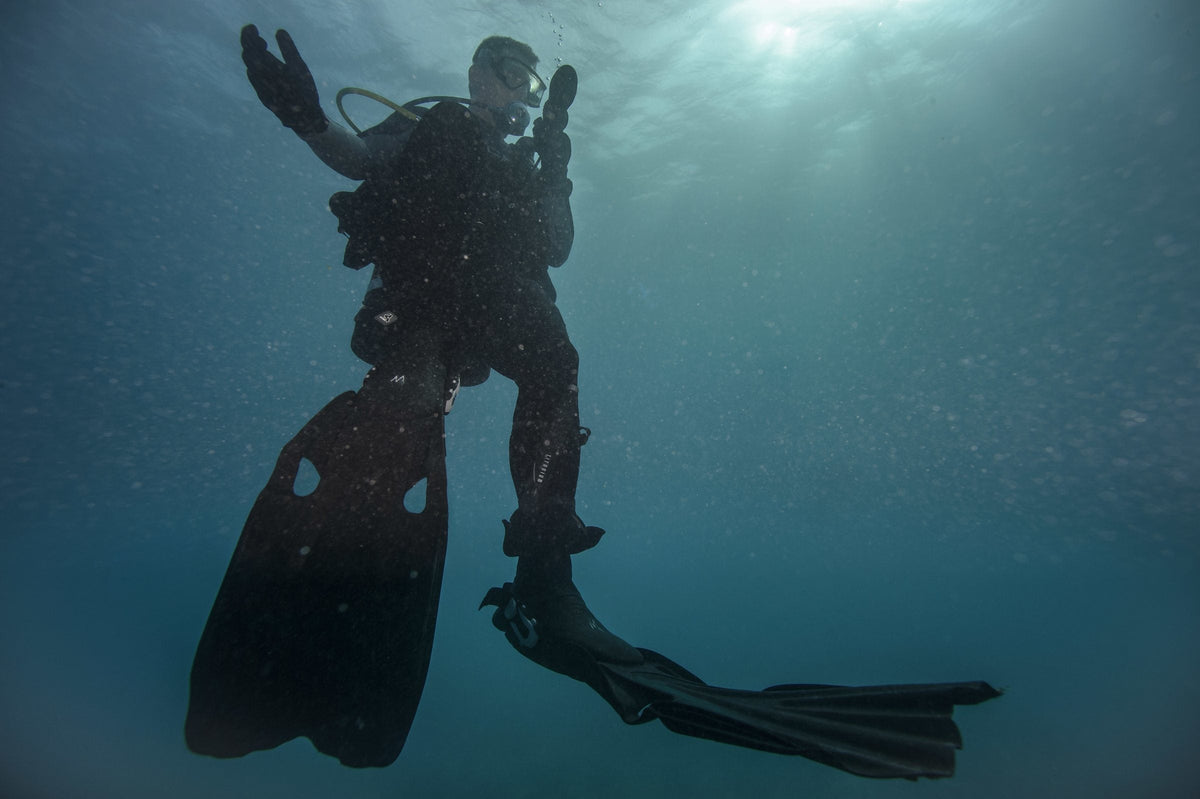
Header photo: U.S. Navy, via Wikimedia Commons. Public domain. View the original photo