
A rescue diver unclipping a dive flag in 3.4 metres of water bumped the bottom and drifted up a little. That night his chest hurt. Hospital X-rays showed air leaking from an overinflated lung into the middle of his chest, and he spent the night on oxygen. He had most likely held his breath for part of that short rise. His case, published by DAN, is the answer in miniature. Air held in the lungs expands as you rise, and with full lungs about a metre of ascent can be enough to tear tissue. Breathing normally, ascending slowly and exhaling steadily on any emergency ascent prevents it.
PADI puts "never hold your breath" first on its list of golden rules for scuba divers. DAN's fatality data explains why it earns the top spot. The injury doesn't need depth, a long dive or any nitrogen at all. It needs a closed airway and a short trip upward.
What happens to the air in your lungs as you ascend?
It expands, in line with Boyle's law. Every 10 metres of seawater adds about one atmosphere of pressure. Gas breathed at depth is compressed, and it grows again as the pressure falls. A diver breathing normally vents that extra volume with each exhale. A diver holding a breath keeps it inside, and lungs that are already full have almost no room to stretch.
| Breath taken at | Pressure there | 1 litre of that air at the surface |
|---|---|---|
| 1.5 metres | 1.15 atmospheres | 1.15 litres |
| 3.4 metres | 1.33 atmospheres | 1.33 litres |
| 10 metres | 2 atmospheres | 2 litres |
| 18 metres | 2.8 atmospheres | 2.8 litres |
| 30 metres | 4 atmospheres | 4 litres |
The table shows why shallow water is the trap. A DAN physician notes that the biggest pressure change relative to the surface happens in the first 3 to 4.5 metres. A breath held at the 3.4-metre flag anchor grows by a third on the way up. The same one-third expansion takes a 10-metre rise from 30 metres, where most divers are already watching their ascent.
How little depth change can injure your lungs?
Less than most divers assume. Animal experiments cited in the British Thoracic Society's diving guideline found air escaping into lung tissue and the bloodstream once pressure inside the airway passed 80 mmHg. That's roughly the pressure of one metre of water. A held lungful a metre down carries enough stored pressure to do the damage on the way up.
DAN Southern Africa's account of the flag case goes further, warning that a breath-hold ascent of about 1.5 metres could be enough to cause an arterial gas embolism. The medical literature backs it up: a 1993 case report described air embolism with both lungs collapsed after a five-metre dive. A swimming pool offers no protection. The deep end is plenty.
What does a lung overexpansion injury do to the body?
Torn lung tissue lets air escape in several directions. DAN lists mediastinal emphysema, where air collects between the lungs, and subcutaneous emphysema, where it tracks under the skin. A pneumothorax collapses a lung. In the flag case, chest pain several hours later was the first sign, and a phone call to DAN sent the diver to an emergency room.
The worst outcome is arterial gas embolism, when air enters the pulmonary veins and travels through the heart to the brain. DAN describes it as a stroke-like event that usually strikes within minutes of surfacing, and about half of divers with a cerebral gas embolism lose consciousness suddenly. Some revive within minutes and seem normal. DAN's advice is that every one of them still needs urgent hospital evaluation, because symptoms can return after an apparent full recovery.
How often does breath-holding on ascent kill divers?
Often enough to top the list of emergency ascent deaths. A DAN study of 947 recreational scuba deaths from 1992 to 2003 found arterial gas embolism was the disabling injury in 29% of cases. Among those embolism cases, 96% involved an emergency ascent and 63% involved running low on or out of gas. In a separate DAN analysis of 964 deaths, embolism caused 54% of deaths in fatal emergency ascents.
Few of those divers set out to break the rule. In a crisis, divers forget their training, and an out-of-air diver may be afraid to exhale in case there's nothing left to breathe. DAN points out that, from recreational depths, the expanding air in the lungs is usually more than enough to reach the surface. A full breath also adds buoyancy, which can start the uncontrolled ascent that turns a held breath into an injury.
Why can freedivers hold their breath but scuba divers can't?
A freediver's lungs can't end the dive holding more air than they started with. The breath is taken at the surface, squeezed on the way down and restored to its original volume on the way up. Marine mammals avoid the problem the same way, as covered in how whales hold their breath for over an hour. A scuba diver's breath is taken at depth, so the surface is where it would be at its largest.
The protection disappears the moment a breath-hold diver breathes compressed gas below the surface. In 2019, doctors in Perth reported an experienced 26-year-old freediver who took breaths from a scuba set at about 10 metres and ascended. He suffered massive lung barotrauma and a fatal cerebral gas embolism.
How do divers prevent lung overexpansion injuries?
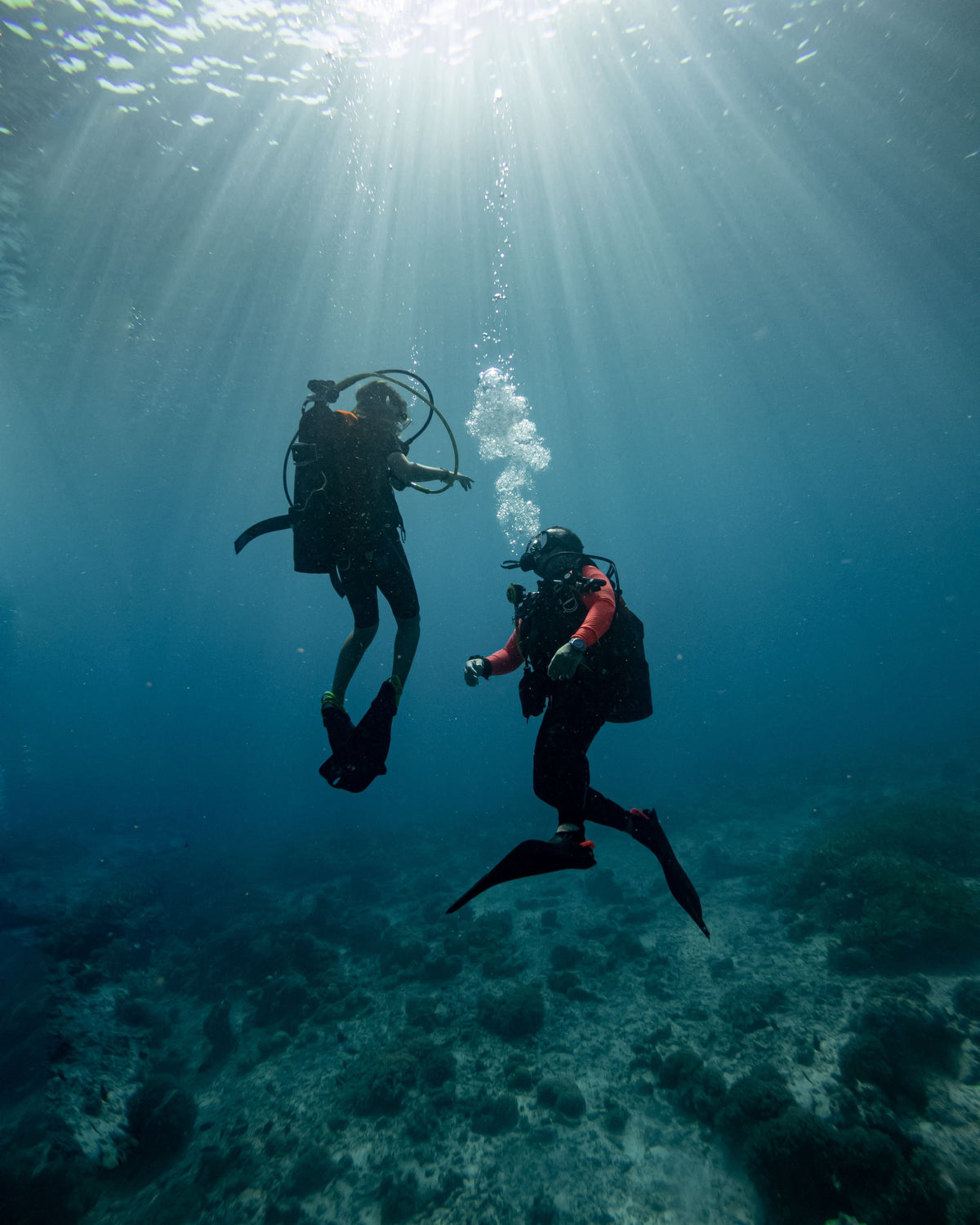
By breathing normally through the whole dive, and by treating the ascent as the most exposed part of it. PADI's standard is no faster than 18 metres a minute, followed by a three-minute safety stop at 5 metres. Buoyancy control does most of the work, since a diver who vents air from the BCD on the way up doesn't get dragged into a fast ascent.
Out-of-air training covers the rest. PADI's instructor blog calls the Controlled Emergency Swimming Ascent one of the most complex skills in the Open Water Diver course. It rehearses exhaling slowly and continuously all the way to the surface. DAN adds one detail worth keeping: leave the regulator in your mouth, because expanding cylinder air can give one more breath. A sound gas plan keeps that skill in the logbook as a training entry rather than a real one. Lung conditions that trap air, including poorly controlled asthma, can cause the same injury with no breath-hold at all. That's why diving with asthma starts with a medical.
Sources
- DAN Southern Africa: Shallow-Water Arterial Gas Embolisms
- DAN Alert Diver: Back to Basics (arterial gas embolism)
- DAN Alert Diver: Emergency Ascents, Managing the Risks
- Undersea and Hyperbaric Medicine: Common causes of open-circuit recreational diving fatalities (Denoble et al., 2008)
- British Thoracic Society: Guidelines on respiratory aspects of fitness for diving (Thorax, 2003)
- Diving and Hyperbaric Medicine: Fatal air embolism in a breath-hold diver (Banham and Lippmann, 2019)
- PADI: The Golden Rules of Scuba Diving
- PADI Pros: Conducting CESA
Frequently Asked Questions
Is pulmonary barotrauma the same as the bends?
No. DAN groups both under decompression illness, but decompression sickness comes from dissolved nitrogen forming bubbles, while an embolism comes from air forced out of a torn lung. A lung injury can follow a short, shallow dive with almost no nitrogen loading. An embolism is treated like DCS, with oxygen first and then a chamber, though DAN notes recompression isn't indicated when air has only leaked into the chest.
Does holding your breath save air on a dive?
PADI's guidance is the opposite: breathing normally keeps you calmer and uses less gas than holding your breath. Skipping breaths also changes your buoyancy, since full lungs lift you. A slow, relaxed breathing rhythm is the efficient option.
Can you get lung barotrauma in a swimming pool?
Yes. A pool's deep end gives enough pressure change for a held breath to overexpand the lungs on the way up. The British Thoracic Society guideline cites two cases of cerebral air embolism in trainees with asthma during scuba training in a pool.
What should you do if a diver has chest pain or confusion after surfacing?
Treat it as a diving emergency, even if the symptoms fade. DAN notes that breathing 100% oxygen before chamber treatment can reduce symptom severity. Call emergency medical services and the DAN Southern Africa hotline, and get the diver to hospital.
Can you dive again after a lung overexpansion injury?
That decision belongs to a doctor trained in dive medicine, after a full assessment. The diver in the flag case made a full recovery, but the injury kept him out of the water until he had healed.
This is general information, not a substitute for a dive medical or advice from a doctor trained in dive medicine. In an emergency, contact DAN Southern Africa on its 24-hour hotline, +27 82 810 6010.
Reviewed September 2026. Devon Ford runs Scuba Evolution, a PADI 5 Star Dive Centre in Glenvista, Johannesburg.
Header photo: Joseph Northcutt on Unsplash, used under the Unsplash License. View the original photo