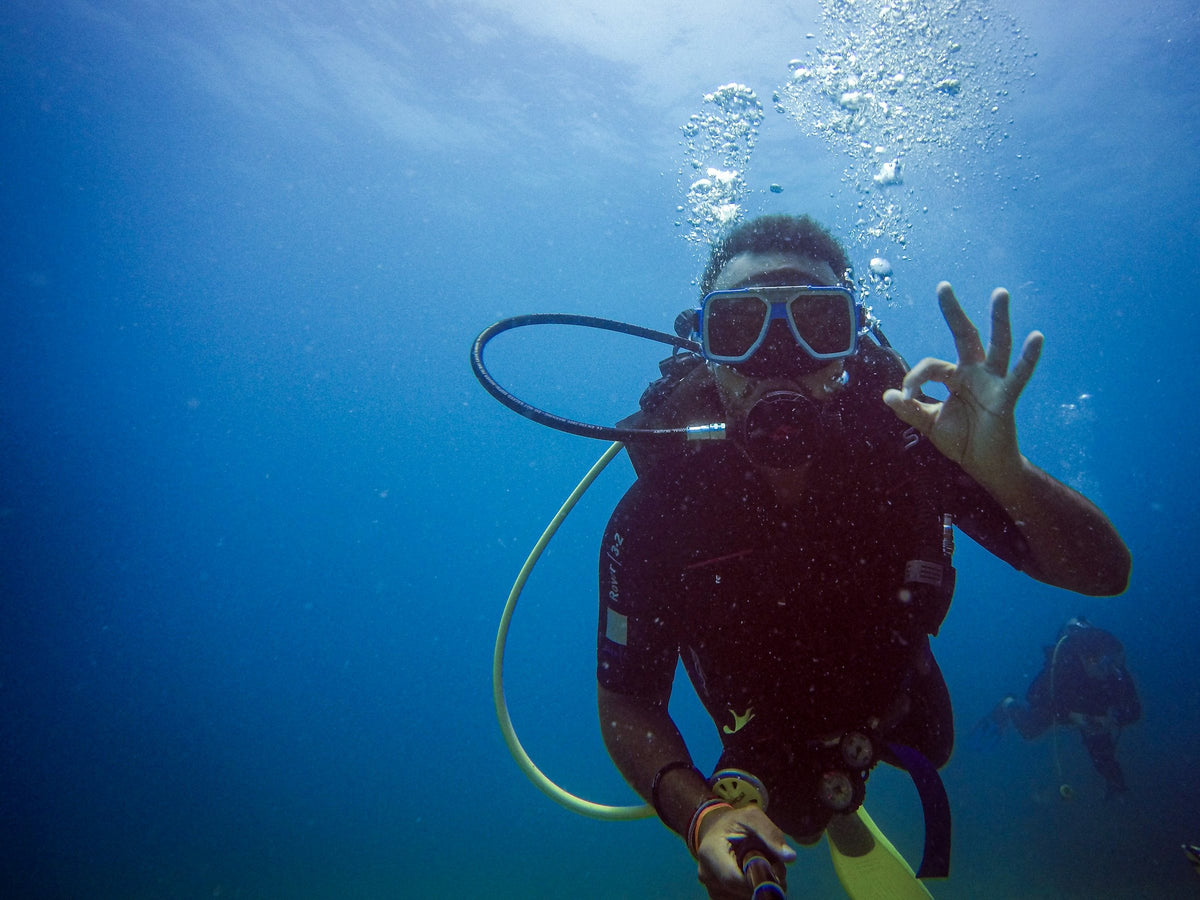


A diver hanging at 5 metres on a safety stop hears an outboard engine and can't point to it. The sound seems loud and oddly all around. Both cues your brain uses to place a sound shrink or disappear underwater. Sound travels about four and a half times faster in seawater than in air, so it reaches your two ears with a far smaller time gap. Your head also stops casting the acoustic shadow that tells the brain which side a sound is on.
The effect is well documented. DAN's Alert Diver magazine notes that a diver can usually hear a boat from underwater but may find it hard to tell which direction the sound is coming from. A 2022 study of blindfolded subjects in the water rated human directional hearing there as extremely poor. Your ears still deliver a decent briefing: something's out there, and it may be getting louder. They leave out the part that says where.
How much faster does sound travel in water than in air?
Roughly four to four and a half times, depending on temperature and salt. The neuroscience textbook edited by Dale Purves works with about 340 metres per second for air. Georgia State University's HyperPhysics pages give 1,482 metres per second for fresh water at 20°C and 1,522 for seawater at the same temperature. Cold water is slower: fresh water at 0°C carries sound at 1,402 metres per second.
The usual explanation, that water's molecules sit closer together, misses the main point. Sound speed depends on two properties of a medium: its stiffness, meaning how hard it resists being compressed, and its density. Water is far denser than air, which on its own would slow sound down. It's also vastly harder to squeeze, and that stiffness wins by a wide margin. It's the rare case where more speed buys a diver less information.
Fresh or salt makes little difference to the problem. On those HyperPhysics figures, a highveld dam and the sea off Sodwana Bay carry sound within about 3% of each other at the same temperature. Either way, your ears are working with less than a quarter of the timing gap they get on land.
How does your brain work out where a sound comes from?
On land it uses two cues, and both rely on a head surrounded by air. The first is timing. The Purves textbook puts the longest interaural time difference, for a sound directly beside one ear, at about 700 microseconds. That figure is the width of the head divided by the speed of sound in air. People can detect differences as small as 10 microseconds, which translates into localisation accuracy of about 1 degree.
The second cue is loudness. Timing does most of the work below about 3 kHz, where the ear's nerve signals can follow the sound wave. Above roughly 2 kHz, the head starts blocking the shorter wavelengths and leaves an acoustic shadow at the far ear. The brain compares the two levels and reads the quieter ear as the one facing away. Both systems are tuned by a lifetime of hearing through air, and a dive takes that calibration away.
Why can't you tell where sound is coming from underwater?
Because the timing cue shrinks and the loudness cue almost vanishes. Apply Purves's maths with water's speed of sound and the 700-microsecond maximum drops to roughly 160 microseconds. That's still far above the 10-microsecond detection limit. The old explanation, that the gap becomes too small to notice, doesn't survive the arithmetic. The trouble is interpretation: a sound directly beside you now produces the gap your brain links to a sound about 13 degrees off-centre in air.
The shadow goes too. A 2005 study from the Israel Naval Medical Institute explains that the skull's acoustic impedance is close to that of the surrounding water. Sound passes through the head instead of being blocked by it, so the far ear gets nearly the same level as the near one. In the 2022 University of Southern Denmark study, blindfolded subjects judged the direction of a 700 Hz tone underwater extremely poorly. The authors concluded that humans have no special adaptations for processing directional sound cues underwater.
Do divers hear through their skull underwater?
Partly, and the science isn't settled. The 2005 Israeli study tested ten scuba divers at 3 metres in the open sea, with and without a mask that kept air around the ears. Air around the ears didn't improve hearing or sound localisation, and the authors read that as support for bone conduction as the main route. Later work complicates the picture. The Danish researchers found underwater thresholds below 1 kHz too low to fit published bone-conduction figures. They suggested that resonance of the air in the middle ear explains the good low-frequency result, and that underwater hearing isn't purely a bone-conduction process, as had been thought.
Two findings are practical either way. The Israeli divers' pure-tone hearing thresholds underwater were significantly worse than on land across 250 to 6,000 Hz. In a 2011 University of Rostock study, sounds were louder without a 5 mm neoprene hood than with one. They were also louder with a hole over the ear than with the hood intact. A hooded diver hears less, and still can't place what they hear.
Can you judge distance by sound underwater?
Better than direction, within limits. In experiments published in 1986, Harry Hollien and colleagues found divers could tell apart sound sources at different distances at levels well above chance. Their divers also navigated by acoustic signals alone, within certain limits. On an ordinary dive, loudness is the usable cue. An engine note that keeps rising usually means a boat is getting closer.
It can also mean the same boat has opened the throttle. A rising engine note on a safety stop is a reason to stay at the stop, look up and turn slowly, not to guess a bearing and swim for it. The safety stop earns its place as margin here too. Three minutes of looking is cheaper than sharing the surface with a propeller.
What should you do when you hear a boat on the ascent?
Treat the sound as a warning without a bearing. DAN's Alert Diver cites US Coast Guard figures of 636 injuries and 38 deaths from propeller strikes among people in water activities between 2005 and 2013. DAN's guidance is to use the safety stop to scan for boat traffic, to deploy a surface marker buoy and to fly a dive flag. It also warns that boat operators may not see divers because of glare, waves and weather. Look up before the final ascent and keep turning as you rise.
Finding your way back to the boat or the exit without surfacing to check depends on your eyes and a compass, not your ears. The PADI Underwater Navigator course covers compass and natural navigation over three open water dives, including estimating distance from kick cycles and timing. Your other senses shift underwater too. Light loses its red within metres, as why colours disappear underwater explains, and your mask makes objects look closer than they are.
Sources
- HyperPhysics, Georgia State University: Speed of Sound in Liquids
- NCBI Bookshelf: Integrating Information from the Two Ears, in Neuroscience (Purves et al.)
- PubMed: Underwater hearing and sound localization with and without an air interface, Shupak et al., 2005
- PubMed: Is human underwater hearing mediated by bone conduction? Sørensen et al., 2022
- PubMed: Experiments on the mechanism of underwater hearing, Pau et al., 2011
- PubMed: An acoustic approach to diver navigation, Hollien et al., 1986
- DAN Alert Diver: Boat Collision and Propeller Safety
- PubMed Central: Hybrid Metasurfaces for Perfect Transmission and Customized Manipulation of Sound Across Water to Air Interface, Advanced Science, 2023
Frequently Asked Questions
Does sound travel faster in warm or cold water?
Warm water. HyperPhysics lists fresh water at 1,402 metres per second at 0°C and 1,482 at 20°C, about 4 metres per second faster for each degree. Salt adds speed too, so warm seawater is the fastest of the common cases.
Why does sound carry so far underwater?
Water is a good carrier for low-frequency sound. HyperPhysics notes that low-frequency pulses can cross thousands of kilometres of ocean and still be detected, which scientists use to track ocean temperature. A boat engine a long way off can still sound close.
Why use a tank banger if divers can't locate sound?
A banger is an alert, not a beacon. The sharp metallic note tells your buddy to stop and look around. Whatever you need to say next has to be visual, with a hand signal or a torch.
Can divers talk to each other underwater?
Not usefully with a regulator in your mouth. Speech into a mouthpiece comes out as muffled noise, and your buddy can't tell where it came from. Divers who need voice contact use full-face masks with through-water communication units, and everyone else relies on hand signals.
Why can't you hear someone shouting from the boat?
Almost all of the sound bounces off the surface. A 2023 paper in Advanced Science puts the acoustic impedance mismatch between water and air at about 3,600 times, which lets only around 0.1% of the sound energy cross. A shout from the deck loses nearly everything at the waterline.
Reviewed September 2026. Devon Ford runs Scuba Evolution, a PADI 5 Star Dive Centre in Glenvista, Johannesburg.
Header photo: Talia Cohen on Unsplash, used under the Unsplash License. View the original photo