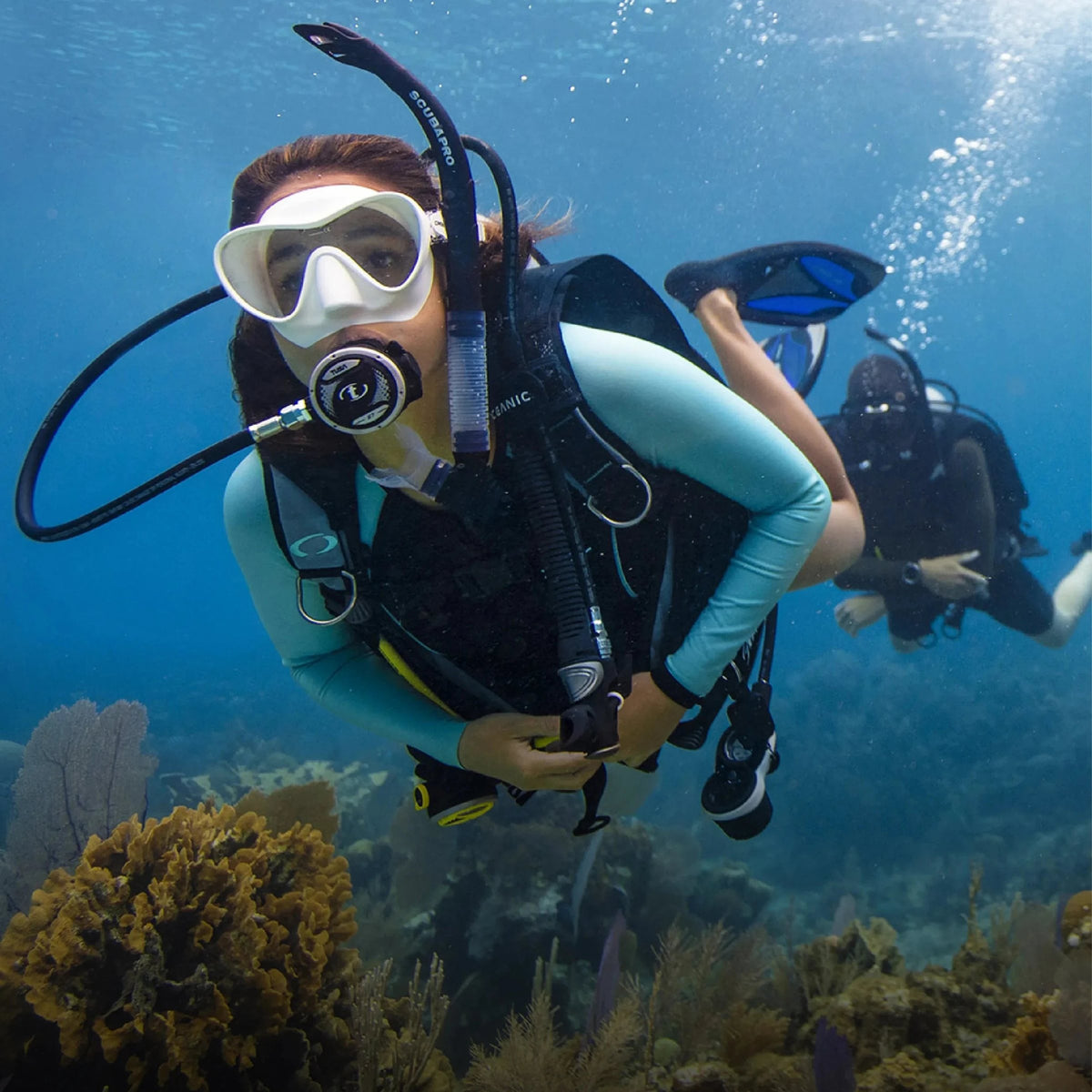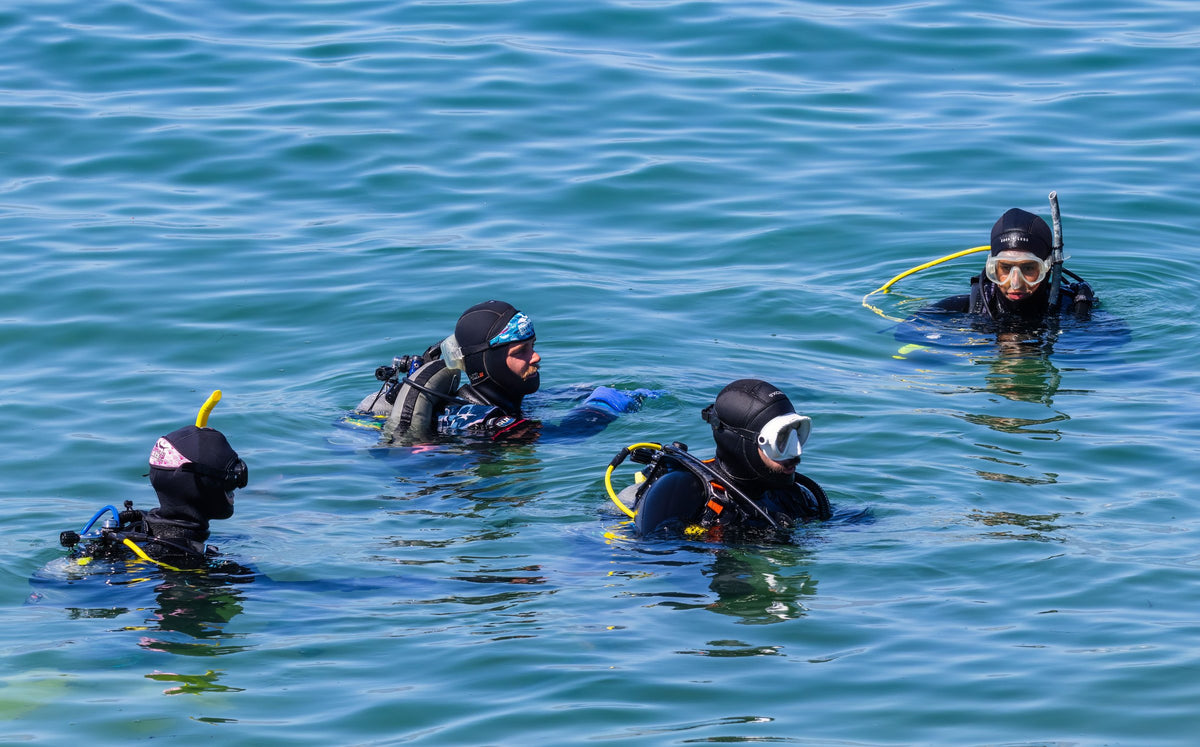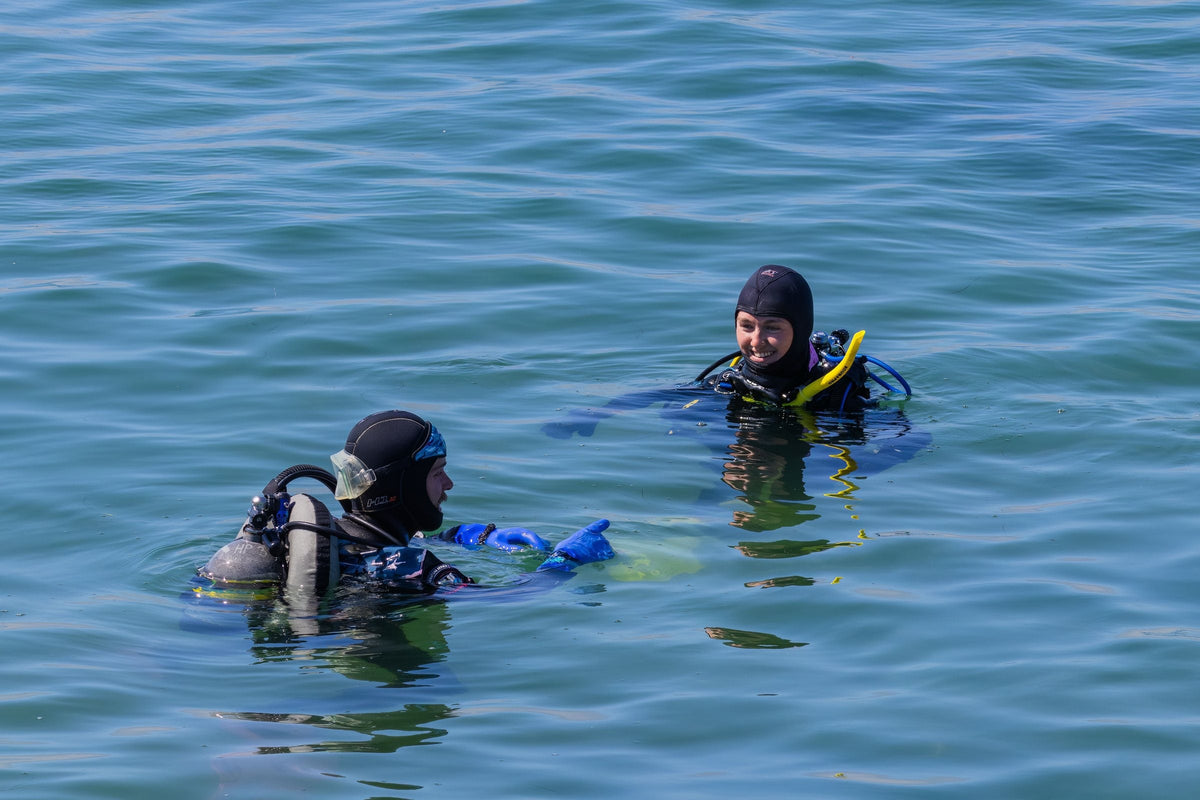
Twelve metres, with a PADI Instructor within arm's reach, and no certification card at the end. That is the full extent of what an uncertified person does inside PADI's system, and the programme has a name: Discover Scuba Diving. The pool portion goes no deeper than 6 metres. An optional open water dive extends the limit to 12 metres, and the experience ends there.
Past that point the answer gets short. Without a certification you do not get a cylinder filled, you do not buy scuba equipment, and you do not plan or lead your own dive. Scuba Evolution asks for a current certification before an air fill and before a scuba equipment sale. A card is not a formality. It is the record that an agency's standards were taught, demonstrated and witnessed by somebody qualified to sign for them.
What is Discover Scuba Diving, and does it certify you?
It is a supervised first experience, not a course and not a certification. A PADI Instructor fits your kit, teaches a short set of skills, and stays with you in the water. PADI's own restrictions page puts it bluntly: a participant is not qualified to go scuba diving afterwards. The minimum age is 10.
Two things follow from that. The instructor carries the responsibility that a certified diver would carry alone, which is why the ratios and the depth are tight. And the experience expires the moment it ends, so a try dive three years ago buys you nothing today. Discover Scuba Diving answers the question of whether you like it. Certification answers the question of whether you can dive.
Does a try dive count towards the Open Water course?
It can, and this is the part most people miss. Arranged in advance, the confined water portion of a Discover Scuba Diving experience credits as the first confined water dive of the PADI Open Water Diver course. The optional open water dive can credit as the first open water dive. The credit depends on the standards for those dives being met, not on time spent in the water.
PADI sets a window on it: the Open Water Diver course has to start within 12 months of the experience. Say so on the day you book. An instructor running the session as a taster teaches a different set of skills from one running it as Confined Water Dive One, and the paperwork differs too.
How deep can you go, and who is responsible?
Six metres in the pool, 12 metres on the optional open water dive, and only with a PADI professional supervising you directly. PADI publishes those limits against the programme itself, so they apply wherever the experience runs. A certified PADI Scuba Diver sits at the same 12 metre limit, also under direct professional supervision. An Open Water Diver plans dives with a buddy to 18 metres.
Depth is the visible limit. The one underneath it is what happens when something goes wrong: a free-flowing regulator, a mask knocked off, an inflator stuck open. An uncertified participant has practised none of those responses, which is the reason the instructor stays inside reaching distance for the whole dive.
Can you teach yourself to scuba dive?
No, and the reason is specific rather than commercial. Two failure modes account for the bulk of serious recreational incidents, and both are invisible from a video.
- Lung overexpansion on ascent. Gas in your lungs expands as pressure falls, and a closed airway on the way up can rupture lung tissue in water shallow enough to stand in. Continuous breathing on ascent is the first rule taught in every entry-level course for that reason.
- Pressure in the ears and sinuses. The technique is simple and the failure is common. Equalising early and often, and stopping when it does not work, is a habit built under supervision.
- Gas planning and buoyancy. Nobody reads their way to a reliable ascent rate or a sensible turn pressure. Those come from repetition with somebody watching your depth for you.
- The rescue half. Self-taught divers tend to practise descending and swimming. They rarely practise sharing gas with a stranger at 15 metres.
The medical questionnaire is the other half of the gate. A course screens for conditions that change how you dive before you get in the water. That is a conversation with your instructor and, where the form directs you, with a doctor.
Is it illegal to dive without a certification?
South Africa does not issue a recreational diving licence in the way it issues a driving licence, and this article makes no legal ruling. What governs an uncertified diver in practice is simpler. The people with the compressor, the boat and the site access decide who dives, and they decide on the card.
That is why the question of legality tends to be academic. A diver with no certification and no professional supervision has no route to compressed air, no insurance position worth having, and no buddy who will accept the risk. The gate is operational, not statutory, and it is closed either way.
What does certification add?
The PADI Open Water Diver course runs five confined water sessions and four open water dives alongside the knowledge development, and it typically takes four to seven days. The output is an 18 metre certification that lets you plan and run dives with a certified buddy, without a professional in the water.
There is also a middle rung. PADI Scuba Diver covers three confined water sessions and two open water dives. It certifies you to 12 metres under direct supervision, and it upgrades to Open Water Diver later by completing the remainder. For somebody short on time, or unsure about the 200 metre swim assessment, that route keeps the training rather than abandoning it.
Training at Scuba Evolution splits the same way. Confined water skills run in the heated indoor pool in Fourways, and the open water dives are done at Bass Lake or Miracle Waters. The course fee covers eLearning, instruction and all equipment. Site entry and air are charged separately.
Sources
- PADI, Discover Scuba Diving. The programme as a supervised first experience conducted by a PADI professional, rather than a certification course.
- PADI, Discover Scuba Diving FAQs. The 6 metre pool limit and 12 metre open water limit, the minimum age of 10, the water-comfort wording, and the credit towards the Open Water Diver course including the 12 month window.
- PADI, PADI Diving Restrictions. The statement that a Discover Scuba Diving participant is not qualified to dive afterwards, the 12 metre limits, and the 18 metre Open Water Diver limit.
- PADI, What's the Difference Between Scuba Diver and Open Water Diver?. Course structure for both certifications, the direct supervision requirement for Scuba Diver, and the swim assessment that applies only to Open Water Diver.
- PADI, Become a Certified Scuba Diver FAQs. What an entry-level certification covers, the minimum age, and the water-skills assessment.
Frequently Asked Questions
Can you scuba dive without being certified?
Only on a supervised introductory programme such as PADI Discover Scuba Diving. That is limited to 6 metres in a pool, or 12 metres on an optional open water dive with a PADI professional present. It does not certify you to dive afterwards.
Do you need a licence to scuba dive?
There is no state-issued recreational diving licence in South Africa. What you need in practice is a certification card from a recognised training agency, because fill stations, dive operators and equipment retailers ask for one.
Does a try dive count towards the Open Water Diver course?
Yes, if it is arranged in advance and run to the relevant standards. The confined water portion can credit as the first confined water dive, and PADI requires the Open Water Diver course to start within 12 months.
How deep can an uncertified person dive?
Twelve metres, and only on the optional open water dive of a Discover Scuba Diving experience under direct professional supervision. The pool portion is limited to 6 metres.
Can you teach yourself to scuba dive from videos?
No. The two skills that prevent the most serious injuries, continuous breathing on ascent and controlled buoyancy, are trained by repetition under supervision. Self-taught divers also skip the gas-sharing and rescue skills entirely.
Will a dive shop fill a cylinder for someone without a card?
Scuba Evolution asks for a current certification before an air fill or a scuba equipment sale, and reputable operators apply the same rule. A PADI Scuba Diver card satisfies it at the 12 metre supervised level.
Reviewed September 2026. Devon Ford runs Scuba Evolution, a PADI 5 Star Dive Centre in Glenvista, Johannesburg.