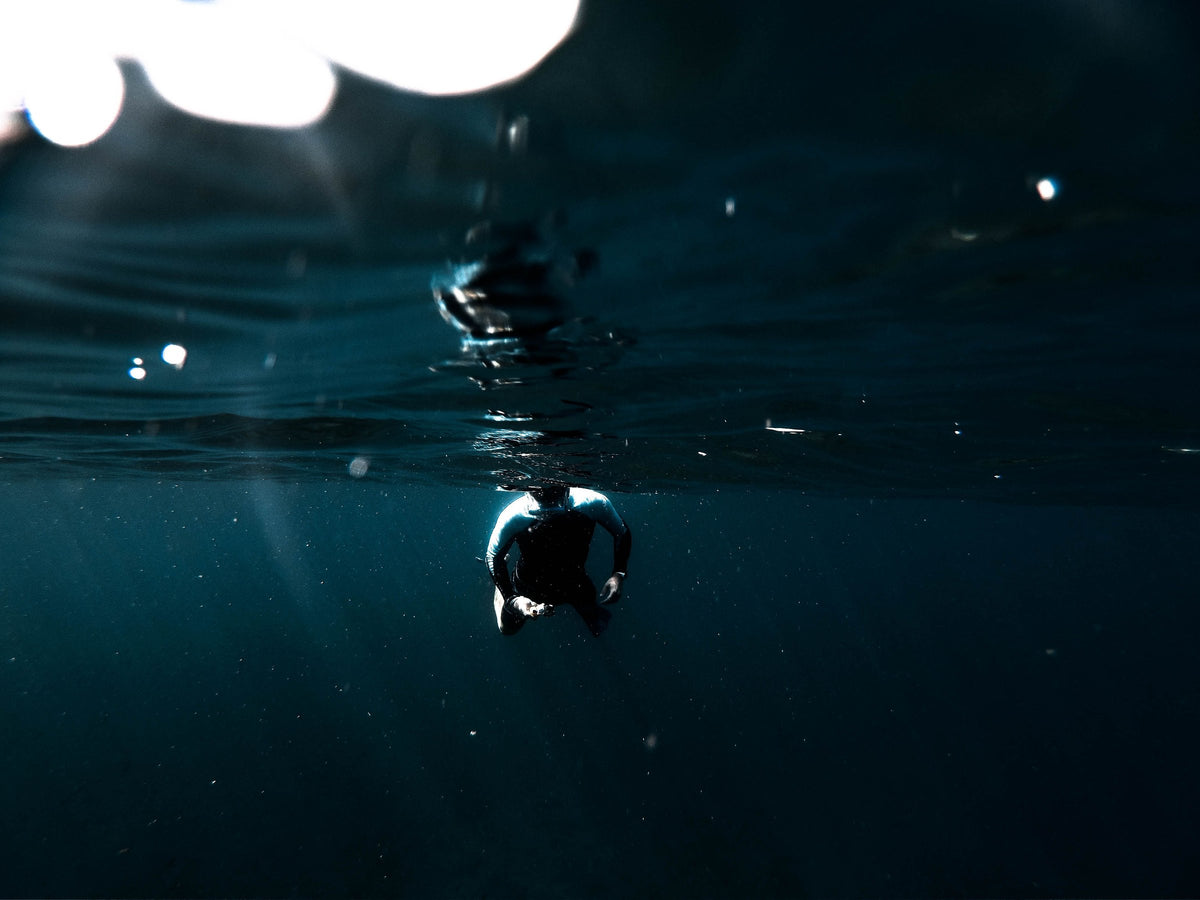
You are six metres down, holding the line, and everything is fine. Then your chest tightens. Your breathing turns fast and shallow. The regulator feels like it is giving you less than you asked for. The only thing you want in the world is the surface.
That experience is common enough to be ordinary. DAN cites a national survey in which more than half of divers reported at least one panic or near-panic episode. Panic is not a character fault or a sign that you are unsuited to the sport. It is an adrenaline response with a known physiology, a predictable set of triggers, and a sequence that training is built to interrupt.
Why do divers panic underwater?
Panic is an involuntary reaction to a flood of adrenaline. Alert Diver Europe sets out what follows. Heart rate climbs, breathing turns rapid and shallow, and perception narrows until the problem in front of you is the only thing in view. Working through options gets harder at the moment you most need options.
The trigger is usually smaller than people expect. Colvard's survey of more than 12,000 divers who had panicked offered 43 possible causes in three categories. In each one, the box ticked most often was "Other". A flooded mask, a slipped fin strap, a buddy who is suddenly not where you left them. Routine problems, at a moment when routine ran out.
One detail from that work is worth keeping. The divers studied had begun to hyperventilate before the panic started, not after. Breathing changes first, which makes breathing the place to intervene. That is the reason instructors go on about it in the pool.
What happens if you panic while scuba diving?
The danger is not the fear. It is what the fear makes a body do. DAN's description is blunt: a panicked diver can ascend fast enough to cause an often-fatal arterial gas embolism. The ascent is the injury.
Gas in the lungs expands on the way up. If the airway is shut or the exhale is incomplete, that expanding gas can tear lung tissue and force bubbles into the arterial circulation. The mechanism runs on Boyle's law, so it works from shallow water as readily as from depth. The guide to breath-holding on scuba sets out how little depth change it takes.
Morgan's 1995 review in Sports Medicine put the numbers in context. It estimated 3 to 9 deaths per 100,000 divers a year in the United States. It also reported broad agreement in the field that panic causes many of the sport's injuries and fatalities.
Is it normal to be scared on a first dive?
Yes, and instructors plan for it. A first descent removes most of the reflexes a person relies on. You cannot take a breath of fresh air at will, you cannot speak, your face is covered, and your field of view is cropped to a rectangle. A body reads that as a problem whatever the briefing said.
Nerves before a dive and panic during one are different states. Nerves are anticipatory and tend to settle once a task starts. Panic arrives mid-task and takes away the ability to work the problem. Telling a nervous student to relax is close to useless. Giving that student one specific thing to do tends to work, because a task competes with the adrenaline for attention.
How do you stop yourself panicking underwater?
By rehearsing one response until it runs without a decision. Panic closes down choice, so the answer has to be a sequence you do not have to choose. Confined-water skills sessions exist to build that sequence, under a small and controlled version of the same stress.
- Stop moving. Grip something solid, or settle neutral and still. Movement burns gas and feeds the loop.
- Breathe out long, then in. A slow, complete exhale is the lever. Rapid shallow breathing leaves carbon dioxide behind, and rising carbon dioxide is itself an air-hunger signal. Each breath then feels more urgent than the last.
- Find the problem. Mask, gas, buddy, buoyancy. Most triggers sit on that short list.
- Fix it, or signal it. Your buddy and your instructor are the second half of the plan, and using them is a skill rather than a failure.
- Then move. An ascent made after those steps is a controlled ascent, which is a different event from a bolt for the surface.
Divers know that sequence as "stop, breathe, think, act". The pool is where it becomes dull, and dull is the target. The pool in Fourways is heated and indoors, the water is shallow, and an instructor is an arm's length away. Pool time is not charged separately, so repeating a skill until it stops feeling like an event costs nothing extra. A mask clear performed forty times in warm water is a different memory from a mask clear performed once, cold, in front of an audience.
Two habits do more than any single drill. Buoyancy control comes first, because a diver who can stop and hover has taken away the physical urge to go up. Gas awareness comes second, because watching a pressure gauge fall is among the commonest triggers there is.
Can you scuba dive with anxiety, panic attacks or claustrophobia?
That is a medical question, and the form asks it. Question 7 of the Diver Medical Participant Questionnaire covers treatment within the last five years for psychological problems, personality disorder, panic attacks or addiction. A yes sends you to box E, which names major depression, suicidal ideation, panic attacks and uncontrolled bipolar disorder, and from there to a doctor for an evaluation.
DAN's stated position is that each case is assessed on its own merits. A diagnosis is not an automatic refusal. What a doctor weighs is control, triggers and medication, since some psychoactive drugs carry sedation or interaction risks at depth. Anyone taking one should raise it at the appointment rather than on a forum.
Claustrophobia splits into two separate things. One is the confined feeling a mask and a regulator produce, which tends to fade with exposure and often settles inside a single pool session. The other is a diagnosed phobia. DAN notes that true claustrophobia can prevent immersion altogether, or entry into a recompression chamber, which is the reason the form asks about it at all.
Morgan's review also looked at the interventions people reach for, among them hypnosis, imagery, meditation and relaxation training. The findings were inconsistent, and the paper called for systematic research into which of them work. Treat any page promising a technique that stops panic with suspicion. The evidence is thinner than the confidence.
Does panic get better with more dives?
The evidence points that way without promising it. Experience reduces the number of situations that count as novel, and novelty is what most triggers are made of. A diver who has cleared a flooded mask two hundred times does not read a flooded mask as an emergency.
Frequency does more than the lifetime total. Skills decay, and a diver returning after three years away carries a beginner's triggers with none of the recent practice behind them. Currency is the thing to protect. Comfort in the water is the same problem in another form. The guide to learning to dive if you cannot swim spends most of its length on the pool for that reason.
For a reader who would rather find this out privately, a Discover Scuba Diving session is a supervised pool experience with a PADI Professional beside you and no certification attached. If it goes well, the Open Water Diver course begins in the same water with the same instructor. If it does not, the afternoon was spent in a heated indoor pool rather than at a dive site, which is the better place to find out.
Sources
- DAN: Psychiatric Conditions and Diving, for the national survey figure, the arterial gas embolism mechanism, the case-by-case assessment position and the note on true claustrophobia.
- DAN Europe, Alert Diver: "No Panic, we're Divers!", for the physiology of the adrenaline response, Colvard's 12,000-diver survey and the hyperventilation finding.
- Morgan WP, "Anxiety and panic in recreational scuba divers", Sports Medicine 1995;20(6):398-421, for the fatality estimate, the trait-anxiety association and the inconsistent intervention findings.
- Diver Medical Participant Questionnaire (form 10346), for the wording of question 7 and box E.
- PADI: Discover Scuba Diving, for what a supervised first experience involves.
Frequently Asked Questions
How common is panic underwater?
DAN cites a national survey in which more than half of divers reported at least one panic or near-panic episode. A separate survey of over 12,000 divers who had panicked found the triggers were mostly routine rather than dangerous.
What is the fear of scuba diving called?
There is no single clinical term. Aquaphobia covers fear of water, thalassophobia covers deep or open water, and the confined feeling from a mask sits closer to claustrophobia. The diving literature treats underwater panic as a situational response.
What should you do if you feel panic starting on a dive?
Stop moving, grip something solid or go neutral, and make one long exhale before the next breath. Then find the problem, signal your buddy, and ascend under control if the dive is over. The order is what stops the bolt for the surface.
Should you tell your instructor you are nervous?
Yes, before the session rather than during it. It changes where the instructor stands and how many repetitions you get. A nervous student who says nothing gets the standard pace.
Can you dive while taking medication for anxiety?
Question 10 of the Diver Medical form covers prescription medication and a yes goes to a doctor. Some psychoactive drugs carry sedation or interaction risks at depth, so the decision belongs to a physician trained in dive medicine.
Does a Discover Scuba Diving session need the medical form?
Yes. The questionnaire is a prerequisite to recreational scuba diving activity, not to certification courses alone. One supervised pool session is screened the same way a full course is.
This is general information, not a substitute for a dive medical or advice from a doctor trained in dive medicine. In an emergency, contact your local emergency services and DAN Southern Africa on +27 82 810 6010.
Reviewed September 2026. Devon Ford runs Scuba Evolution, a PADI 5 Star Dive Centre in Glenvista, Johannesburg.