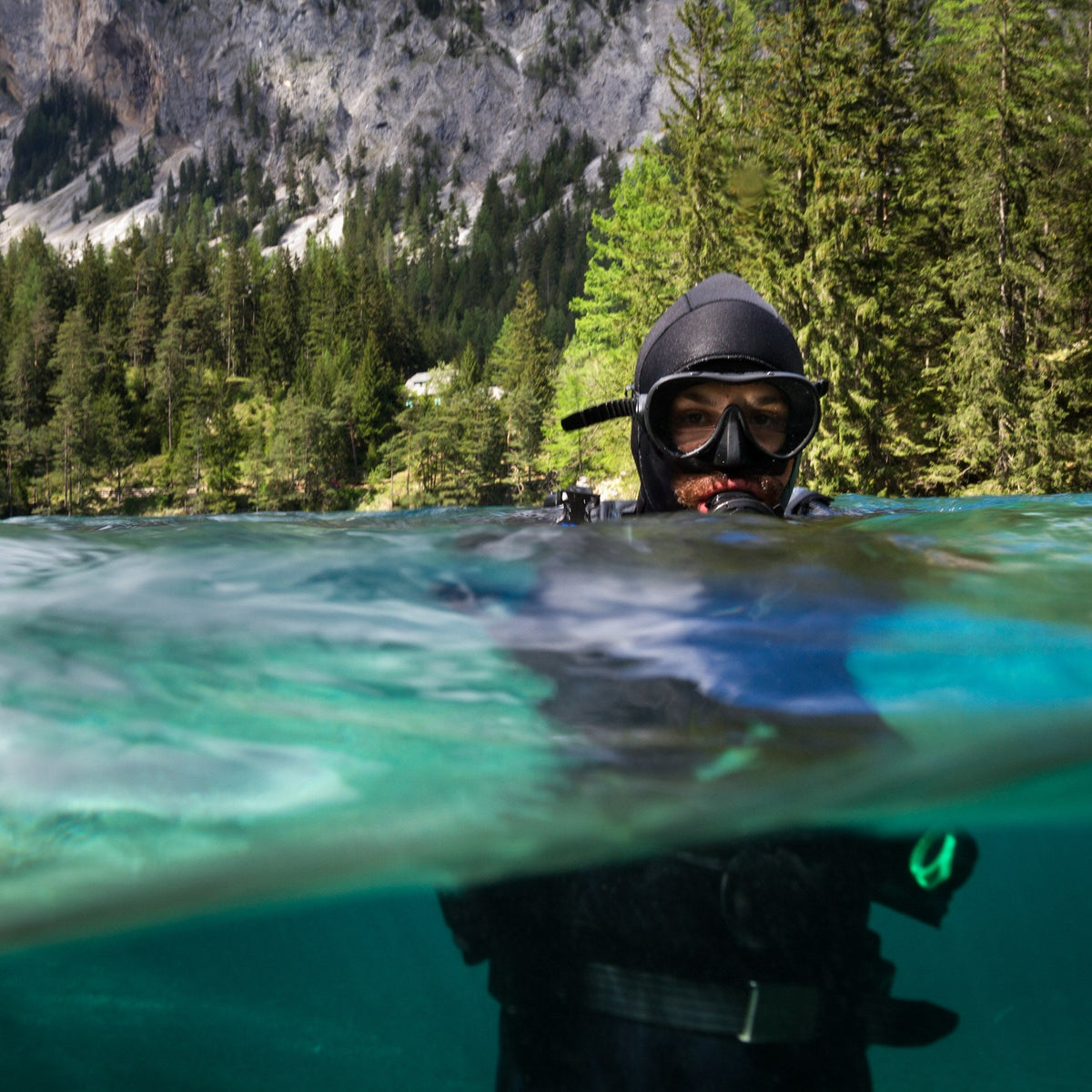
Most new students ask the same thing before they've finished the eLearning. Johannesburg is about seven hours from the sea by road, so where do the open water dives happen? Closer than they expect. Bass Lake, near Henley on Klip, is 35 kilometres from our shop in Glenvista, about 40 minutes on an empty road.
You can scuba dive within about 40 minutes of Johannesburg. Bass Lake near Henley on Klip and Miracle Waters near Brits are spring-fed training sites, 23 and 33 metres deep. Komati Springs, a flooded mining hole about four hours east, is where technical divers train. All of them sit above 900 metres, so every dive there is an altitude dive.
Where can you scuba dive near Johannesburg?
Two established open water sites sit within an hour and a half of the city. About four hours out are two deeper sites for experienced divers, and a shallow spring. Komati Springs and Wondergat both publish depths well past the 40-metre recreational limit.
| Site | Where | Drive from Glenvista | Published depth | Altitude | Mainly used for |
|---|---|---|---|---|---|
| Bass Lake | Henley on Klip, Midvaal, Gauteng | 35 km, about 40 minutes | 23 m | About 1,450 m | Training and recreational dives |
| Miracle Waters | Beside the N4 near Brits, North West | 95 km, about 1.5 hours | 33 m | About 1,100 m | Training and recreational dives |
| Komati Springs | Off the R38 near Badplaas, Mpumalanga | About 320 km, about 4 hours | 55 m open water, caves dived to 186 m | 915 m (site's figure) | Technical and cave diving |
| Wondergat | 30 km from Mahikeng, North West | 320 km, about 4 hours 20 minutes | About 58 m | About 1,440 m | Advanced and technical divers |
| Marico Oog | Near Lichtenburg, North West | About 270 km, about 4 hours | 14 m deepest pool (2012 magazine figure) | About 1,480 m | Recreational dives in a shallow spring |
Drive times are free-flow estimates from OSRM, a routing service built on OpenStreetMap, so weekend traffic adds to them. Depths are each site's own figures, except Marico Oog's, which come from a 2012 DO IT NOW magazine feature. Komati Springs and Wondergat publish their altitudes, and the other three come from NASA's SRTM elevation data.
How deep is Bass Lake?
Bass Lake's deepest point is 23 metres, reached from a walk-in slope, according to the venue. It's a 10-hectare spring-fed lake on a 75-hectare estate that Bass Lake Adventures runs as an adventure resort. The venue lists training grids at several depths for skills practice, and a number of wrecks for more experienced divers.
A fill station sits on site, and no private compressors may be run there. For kit hire, Bass Lake asks for a dive card with a photo, or a printed certificate plus ID, and won't accept a certificate shown on a phone. It keeps the card for the length of the hire. The venue opens Wednesday to Sunday and shuts its gates at 6pm.
How deep is Miracle Waters?
Miracle Waters is 33 metres deep, by the venue's own figure. It was an open-cast chrome pit, now fed by an underground spring. South African Tourism places it beside the N4 near Brits, reached up the R511 through Fourways to Hartbeespoort and then the R514. From Glenvista, allow about an hour and a half.
Entry is down paved paths, and the site lists several training platforms at different depths, with training from Open Water to instructor level. A compressor room handles fills and cylinder hire. Objects placed in the lake include two buses, the newer one at 30 metres, a Cessna, a Falcon 10 jet and a Puma helicopter. The venue says the buses and aeroplanes can be entered by divers trained to do it, which is a different skill from swimming past them. The gate opens Friday to Sunday only, and night dives run on Saturday evenings, booked at the office with a night dive form.
How deep is Komati Springs?
Komati Springs reaches 55 metres in open water, and divers have followed its caves to 186 metres, according to the site. Mining stopped there in 1972, and groundwater filled the hole. It sits off the R38 near Badplaas in Mpumalanga, about four hours from Glenvista. The last 8.4 kilometres are a dirt road through three gates, partly across a game reserve.
It's a technical site first, and our tec training runs there. The dive centre on site supplies air, nitrox, helium and argon. The open basin is about 110 metres by 50, with training grids at 5, 9 and 30 metres. Its caves run over eight interconnecting levels.
The rules are stricter than at the training lakes. Booking is essential, because the guards at Gate 2 work from a list of names. Divers must have their qualification and logbook available, sometimes before arrival, and the site's rule is not to dive anywhere you aren't qualified for. The card gets you through the gate. The logbook is what you may be asked to show. The site keeps oxygen and first aid on hand, and names Johannesburg or Pretoria for the nearest chambers, with DAN coordinating.
Wondergat, a dolomite sinkhole near Mahikeng, is the other deep inland site within a long drive. Its owners give a maximum depth of about 58 metres and say it isn't for beginners or lone divers. It's for groups of advanced divers, and a training site for instructors and technical divers.
Marico Oog, near Lichtenburg, is a natural spring on farmland, made up of interlinking pools. A 2012 DO IT NOW magazine feature put the largest pool at 14 metres and the rest at 3 to 4 metres on average, so most of it is shallow. It has no website, only a Facebook page. There's no air fill on site, so bring filled cylinders, and phone the owners before you go to check access and fees.
Is diving near Johannesburg altitude diving?
Yes. PADI defines altitude diving as diving more than 300 metres above sea level, and the lowest site here, Komati Springs, gives its own altitude as 915 metres. Bass Lake sits at about 1,450 metres, Miracle Waters at about 1,100, Wondergat at about 1,440 and Marico Oog at about 1,480. Komati Springs asks divers to adjust their dive planning for it.
Lower surface pressure makes the same depth count for more, so no-decompression limits shorten. A computer or table set for sea level will under-read the nitrogen you carry out of the water. The guide to why Joburg changes your dive limits works through the numbers and the computer settings.
The drive home belongs in the same plan. Glenvista sits at about 1,650 metres, higher than all five sites, so the road home climbs. From Bass Lake that's about 200 metres, and from Miracle Waters over 500. From Komati Springs the N4 crosses 1,900 metres near eMakhazeni, roughly 1,000 metres above the water. Unlike flying, the drive is a gradual climb over several hours. There are no established, evidence-based waiting periods for driving inland, and in DAN Southern Africa's clinical experience, decompression sickness caused simply by the drive home hasn't emerged as a recognised concern after ordinary recreational diving within no-decompression limits. DAN's 12 hour and 18 hour figures were developed for flying, and the guide to flying after diving sets out DAN's flying figures. A conservative last dive, good hydration and shared driving are sensible, and decompression dives and air dives deeper than 40 metres call for more caution. If symptoms appear on the way home, stop travelling, avoid going higher and call the DAN emergency line on +27 82 810 6010. Put the drive in the briefing, not the debrief.
What do you need to dive at an inland site?
A certification card, a booking where the site asks for one, and money for entry and air.
- Your card, on paper or plastic. Bass Lake asks for a photo card before it hires out kit. Komati Springs asks for your qualification and logbook.
- A booking. Komati Springs won't let you through the gate without one, and Miracle Waters books night dives at its office.
- Entry fees. Day entry for an adult diver ran from about R100 to R200 at the four sites that publish rates, in October 2026. Rates change, so check before you go.
- Air. Bass Lake, Miracle Waters, Komati Springs and Wondergat fill cylinders on site, at roughly R100 to R130 a fill. Bass Lake and Komati Springs don't allow private compressors. Marico Oog has no fill station, so divers bring filled cylinders.
- The right day. Bass Lake is shut on Mondays and Tuesdays, and Miracle Waters from Monday to Thursday.
Certified divers who haven't dived inland before can book Discover Local Diving, R650. It's a site briefing and a guided dive with a PADI Divemaster or higher, usually at Bass Lake or Miracle Waters, for PADI Scuba Divers and above from age 10. The briefing covers the layout, depths, entry and exit points and altitude.
Where else can you dive in South Africa?
At the coast, a long drive in either direction. Sodwana Bay in northern KwaZulu-Natal and Aliwal Shoal off Umkomaas, south of Durban, are two of the coastal destinations Johannesburg divers travel to. OSRM puts Sodwana 563 km from Glenvista, nearly eight hours, and Umkomaas 591 km, about seven. Scuba Evolution arranges trips to both by enquiry. Open Water qualification dives can also be done in the sea on request.
Where does learning to dive near Johannesburg start?
In a pool, then a lake. The PADI Open Water Diver course is R5,650. It runs five pool sessions in a heated indoor pool in Fourways, at four students per instructor, then four open water dives at Bass Lake or Miracle Waters. Air fills are included; site entry is paid separately, as the guide to what learning to dive in Joburg costs sets out. Open Water divers can add Altitude Diver, R3,500: two dives at an altitude site, with the computer settings and planning that go with them.
Sources
- Bass Lake: Scuba, Fill Station and Kit Hire
- Miracle Waters: About
- South African Tourism: Miracle Waters in the North West
- Komati Springs: Diving
- Wondergat: About this Dive Site
- PADI: Altitude Diver
- DAN Southern Africa: Flying After Diving
- OSRM: Open Source Routing Machine (OpenStreetMap) and Open Topo Data: NASA SRTM elevation
Frequently Asked Questions
Is there scuba diving in Johannesburg?
Not in open water inside the city. Pool training runs in the city, including in a heated indoor pool in Fourways. The nearest open water site is Bass Lake, about 35 km south of Glenvista, and Miracle Waters near Brits is about 95 km away.
What is the closest place to scuba dive near Johannesburg?
Bass Lake near Henley on Klip, about 40 minutes from Glenvista on an empty road. It's a spring-fed lake with a published depth of 23 metres, training grids and a fill station.
Where do you do your open water dives in Johannesburg?
Our Open Water students do their four qualifying dives at Bass Lake or Miracle Waters, after five pool sessions in a heated indoor pool in Fourways. The open water dives can be done in the sea on request instead.
Do you need to be certified to dive at Bass Lake or Miracle Waters?
To dive on your own, yes. Bass Lake asks for a dive card with a photo, or a printed certificate plus ID, before it hires out kit. If you aren't certified yet, you dive these sites with an instructor as part of a course such as Open Water.
How far is Sodwana Bay from Johannesburg?
About 560 km by road. OSRM routing from Glenvista puts it at nearly eight hours without traffic. Plan for a full day each way, and for the climb back to Johannesburg's altitude after diving.
Is Bass Lake an altitude dive?
Yes. It sits at about 1,450 metres, well above the 300 metres where PADI counts a dive as an altitude dive. A dive computer needs the right altitude setting there, or an automatic one. The Altitude Diver course covers the settings and the planning.
Reviewed October 2026. Devon Ford runs Scuba Evolution, a PADI 5 Star Dive Centre in Glenvista, Johannesburg.