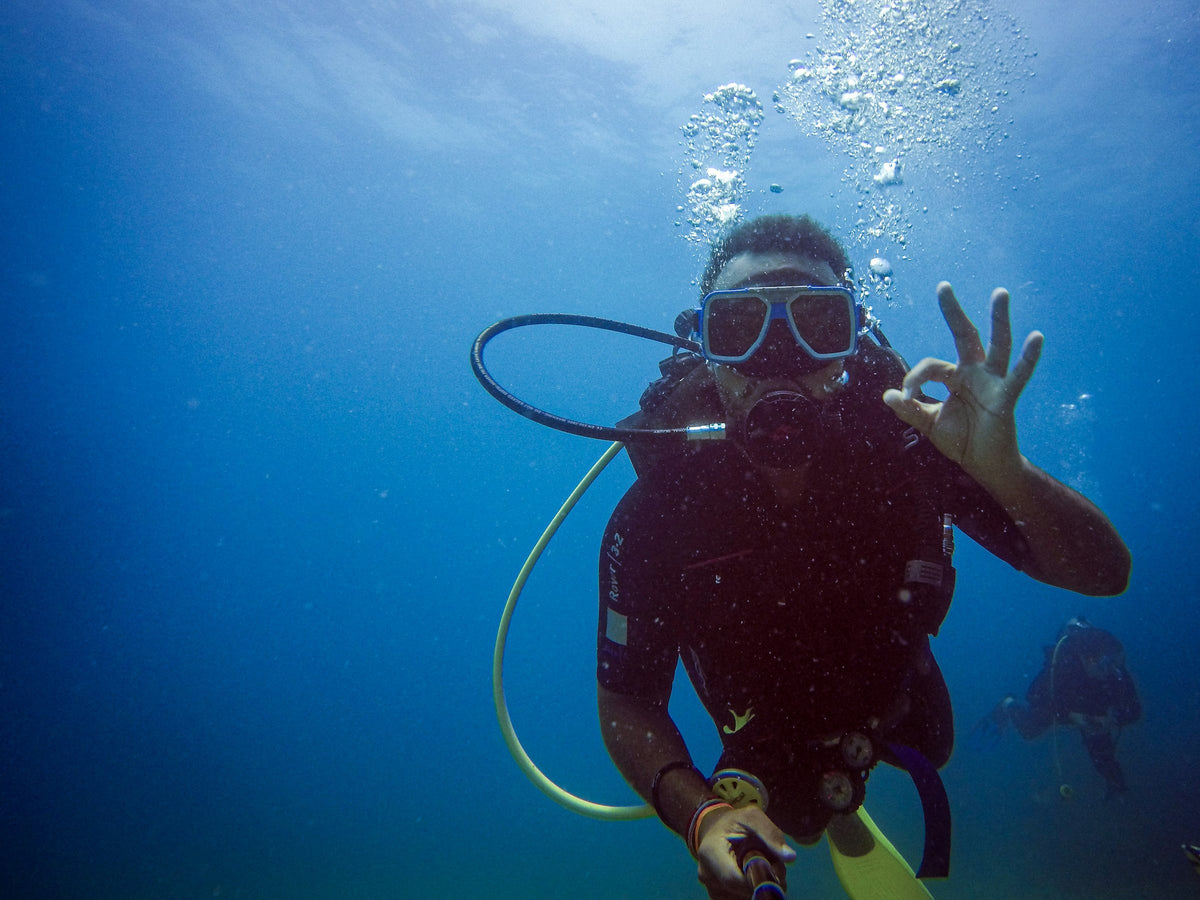
Fifteen minutes into your first dive after the course, the pattern sets in. A press on the inflator, a slow rise, a pull on the dump, a slow sink, another press. Your buddy floats a metre above the sand without moving a fin. You've touched the inflator more often than you've looked around.
To improve your buoyancy, fix it in order. Carry only the lead you need and place it so you lie flat. Then steer with your lungs, and treat the BCD as a coarse control you touch in small puffs and wait on. Most yo-yo dives come from too much lead and too many inflator presses, and both respond to practice.
Why do you keep floating up or sinking when you dive?
Usually because the BCD is doing a job your lead created. PADI's buoyancy tips say many divers, beginners especially, dive overweighted. Extra lead has to be cancelled with gas in the BCD, and that gas changes volume with every metre you rise or sink. A big bubble magnifies each small depth change, so you correct, overshoot and correct again.
Momentum adds to it. A puff of air doesn't stop a sinking diver at once, and a second press before the first has worked turns the descent into a rise. DAN Europe makes the point beginners rarely hear: lead carried as insurance against shooting to the surface can need more gas than you can vent in time.
So weighting comes first. PADI's surface check: in full kit, with an empty BCD and a normal breath, you should float at eye level, then sink slowly as you breathe out. Our guide to how much weight you need covers the cylinder sums and the move from fresh water inland to salt at the coast.
What is good trim, and where should the weight sit?
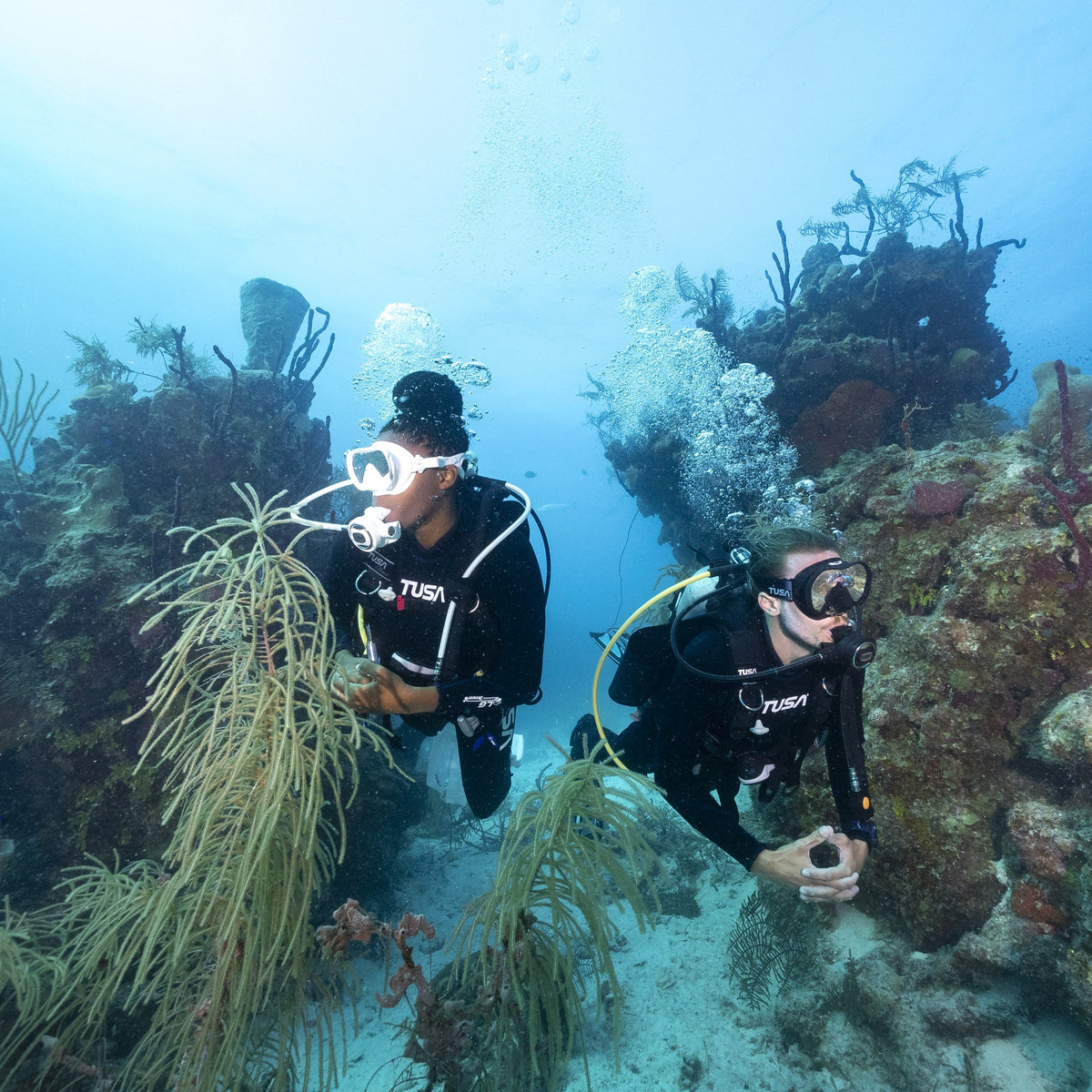
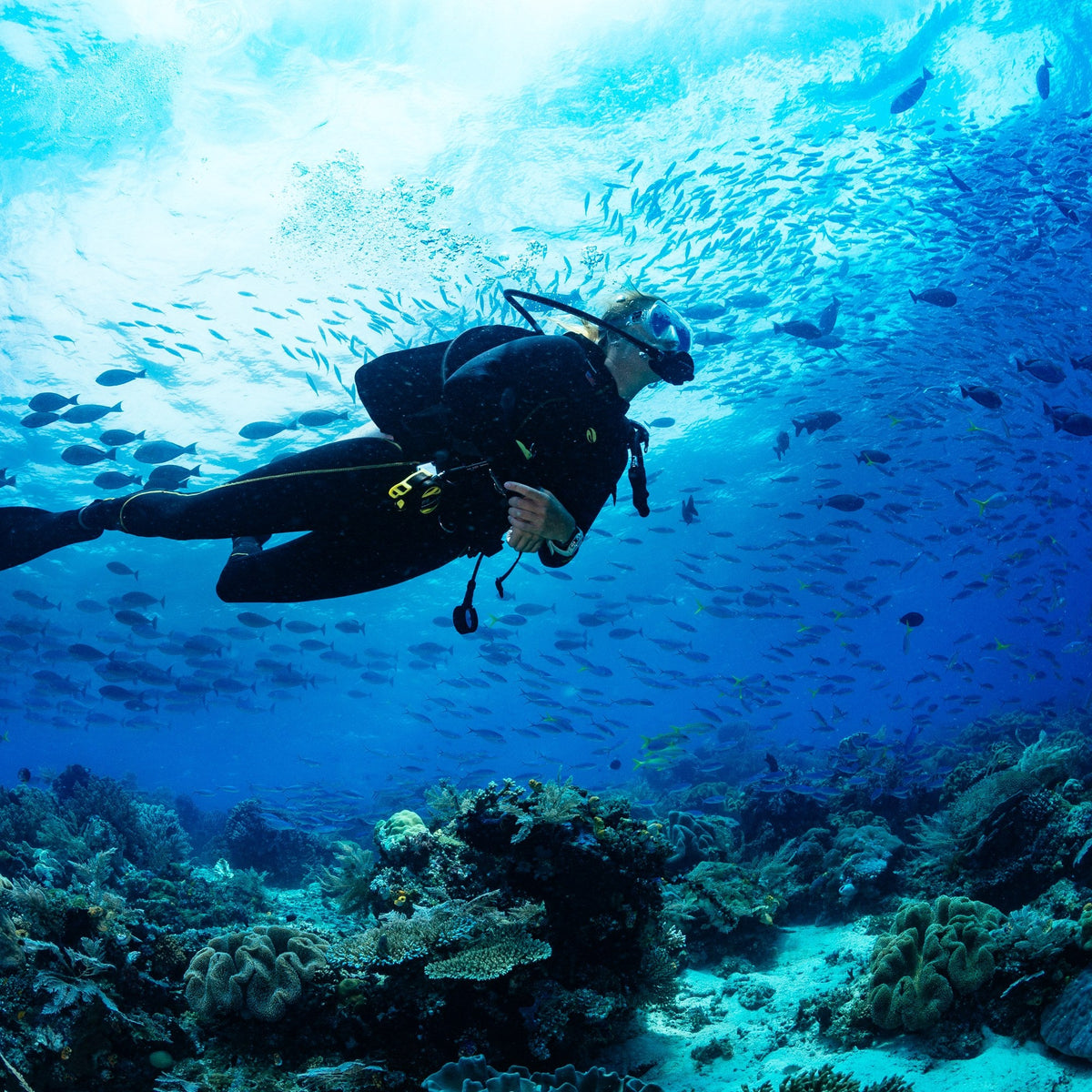
Trim is the angle your body settles at when you're neutral and still, and the target is flat. DAN describes it as horizontal, head forward, knees bent and feet raised. That shape presents the smallest area to the water, which cuts effort and gas use, and a flat diver meets more resistance moving up or down, so drifts less.
Where the lead sits decides most of it. With every kilogram on a belt at the hips, a diver tends to hang head-up, the "seahorse" position DAN describes. DAN Europe compares a heavy belt to an unbalanced seesaw. The fixes:
- Spread the lead. DAN advises distributing weight around the torso rather than relying on a belt alone, using a steel cylinder, a backplate or small trim weights.
- The cylinder. Sliding it up or down in its band shifts your balance point, within limits. You still need to reach the valve.
- Fins. DAN Europe notes that fin weight in water varies widely between models and sizes. Heavy ones drag the legs down.
- Anything dangling. Clip the alternate air source and gauge close. DAN Europe's standard is that nothing hangs below the line of your body.
To test it, DAN Europe suggests a trim check in shallow water. Get neutral, lie still, look forward, breathe normally and watch whether you tip forward, back or sideways. Good trim also saves energy, and effort is one reason two easy dives can leave you wrecked.
How do you control buoyancy with your breathing?
Your lungs are the fine control, and the BCD is the coarse one. Each litre of air in your chest displaces about a kilogram of water. The American Lung Association puts the air a healthy adult can move between a full breath and a full exhale at about 4.8 litres. End to end, that's close to 5 kilograms of buoyancy. DAN Europe's weight check uses the range: at 50% lung volume you should float at the surface, and at 20% you should start to sink.
On a dive you use a slice of it. Breathe in a little deeper and you start to rise; breathe out a little longer and you settle. DAN Europe's view is that small ascents and descents can start with the lungs alone, not another trip to the inflator. Two habits work against it. Big, gulping breaths swing you up and down, and DAN Europe notes they leave less reserve for fine adjustment. Breath-holding is dangerous on an ascent and, PADI notes, throws your buoyancy off too. The same slow pattern stretches your gas, as our guide on why your air goes first explains.
How do you use your BCD to get neutral?
In small puffs, one change at a time, with a pause after each. PADI's tips say exactly this: adjust in small increments and give each one time to take effect before the next. Impatience is what turns one correction into five.
On the way down, add a short puff each time the descent speeds up, then wait and watch your gauge. Once you can stop where you choose, leave the inflator alone and steer with your lungs. On the way up it reverses. The gas expands as you rise, so vent a little, early. Gas collects at the highest point of the bladder, so use whichever dump is uppermost: the shoulder dump or inflator hose when upright, the rear dump when flat.
Do you lose buoyancy as you go deeper?
Yes, from two sources, and both reverse on the way up. Gas in the BCD compresses with depth. So does the gas sealed in your wetsuit's neoprene, which is what makes a suit float. PADI's tips list both, plus a third change: the cylinder gets lighter as you breathe it down.
The suit is the one divers forget. In a 2025 study of 33 commercial neoprene sheets, a load equal to about 5 metres of seawater squeezed them by a third of their thickness on average. A load equal to 20 metres took off 64.3%. The sheets were pressed in a machine rather than by water from every side, so treat the figures as a rough size. The shape is the useful part. More than half the squeeze measured at 20 metres had happened by 5.
So a diver neutral at 5 metres feels heavy at 18 and needs a small puff, then turns light again as the suit re-expands on the way up. A 7 mm suit swings further than a 3 mm one because it carries more gas.
How do you stay neutral on the ascent and safety stop?
By venting before you need to and rising slowly enough to keep up. DAN's Alert Diver describes the trap: air in the BCD expands as you ascend, so you rise faster unless you vent it. The US Navy and NOAA use about 9 metres a minute, and training agencies recommend 9 to 18. DAN cites a 2009 study of 47 divers in which the faster rate produced higher bubble grades.
The safety stop is the hardest test. PADI's standard stop is three minutes at 5 metres, in the shallows where DAN notes the largest pressure changes happen. Gas in the BCD and suit expands fastest there, and the cylinder is at its lightest. Vent small amounts from the bottom up, so little gas is left to expand by 5 metres, then settle with your lungs. DAN's weighting test is staying at 3 metres with a nearly empty cylinder. Fail that with an empty BCD and the lead is short, not your technique.
How do you practise hovering?
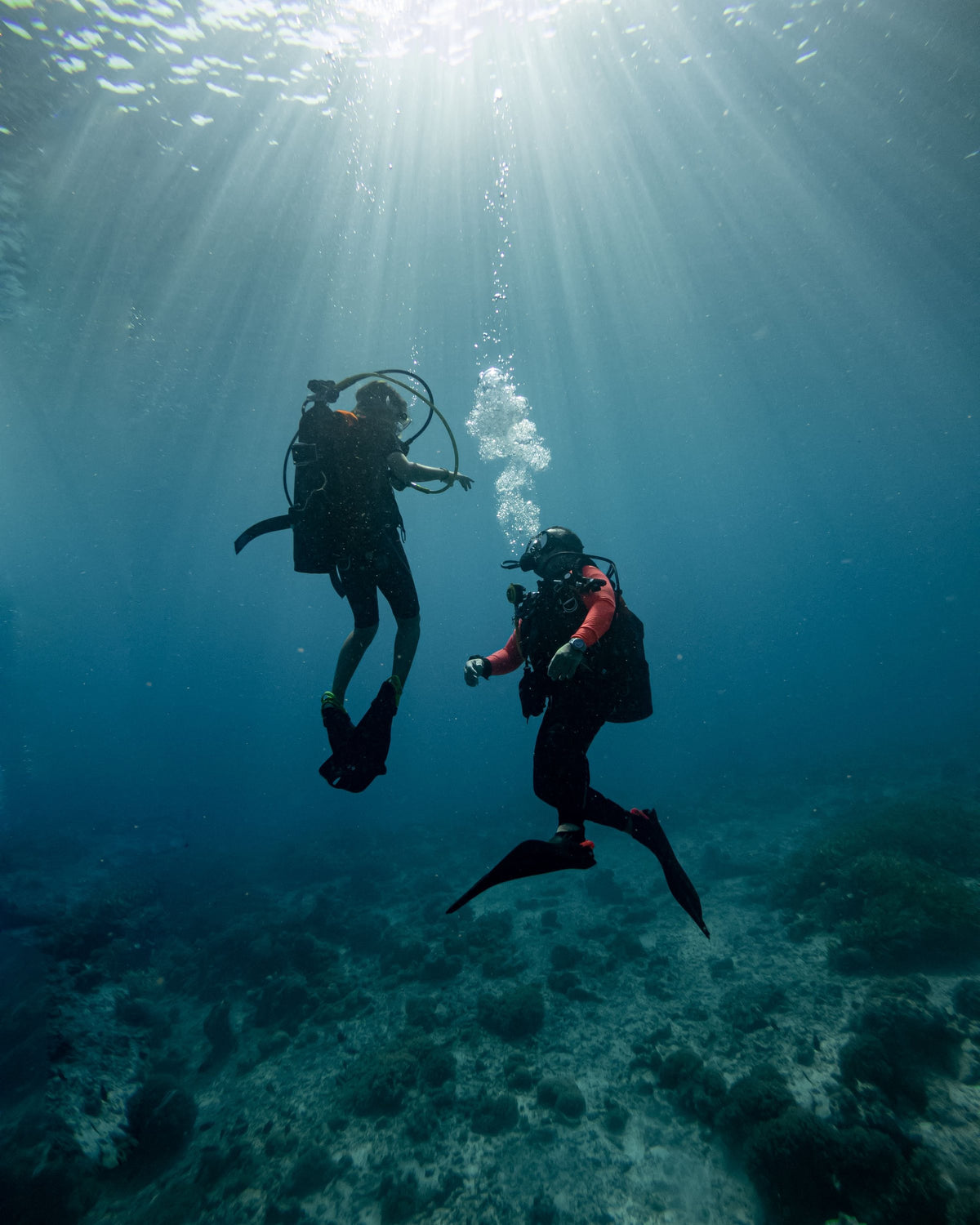
Little and often, in shallow water, starting on the bottom and finishing off it. DAN's Alert Diver is blunt: without practice, most divers struggle to stay neutral for more than a few moments while holding still. The muscle memory may take dozens of hours. Buoyancy is the most misunderstood skill in recreational diving. The card is where it starts, and the logbook is where it improves.
| Drill | How to run it | What it trains |
|---|---|---|
| Fin pivot | Lie face down on sand or a pool floor. Add small puffs until a slow breath in lifts your chest and a breath out lowers it, pivoting on your fin tips. | Finding neutral |
| Hover | From the fin pivot, rise half a metre and stay still for 30 seconds, no hands, no kicks. | Steering with the lungs |
| Fixed reference | Face a ladder step or a line marker and keep it at eye level, within a metre up or down. | Seeing drift you can't feel |
| Stepped stops | Stop for three minutes every 3 metres, going down and coming up. | Adjusting as gas changes volume |
| Task hover | Clear your mask or swap to your alternate air source without changing depth. | Staying neutral while busy |
The drills draw on PADI's instructor blog, PADI's write-up of its buoyancy course and DAN. DAN also suggests measuring: set a depth tolerance, stay within 20 to 30 degrees of horizontal, and film the drill. Video makes an honest debrief.
Good buoyancy is also the first thing PADI AWARE asks of a diver who wants to protect a reef: a fin that stays off the bottom does no damage. See how divers protect South Africa's reefs.
What does the Peak Performance Buoyancy course add?
Supervised practice, with someone watching who can see what you can't. Our Peak Performance Buoyancy course is R3,800. PADI eLearning on weighting, trim and streamlining comes first. Then two open water dives with an instructor set your exact weighting, trim your kit and practise hovering in different positions. All scuba equipment is included; air fills and dive site entry are paid separately. You need Open Water Diver certification or equivalent, and a minimum age of 10.
The first dive can be credited as an Adventure Dive towards Advanced Open Water, and the course counts towards PADI Master Scuba Diver. There's no exam. The writer of PADI's own post on the course found they'd been holding their breath slightly, and once relaxed, cut their lead by 20%.
Sources
- PADI: 11 Top Tips for Buoyancy Control, for overweighting, the surface weight check, small BCD increments, breathing and the buoyancy changes with depth.
- PADI: Why Peak Performance Buoyancy Should Be Your Next Specialty, for the fixed-reference hover within a metre, the 20% weight reduction and the course having no exam.
- PADI: The History of the Safety Stop, for the three-minute stop at 5 metres.
- DAN Alert Diver: Mastering Neutral Buoyancy and Trim (2013), for the trim position, weight distribution, the 3 metre weighting test, metrics and video, and the practice drills.
- DAN Alert Diver: Ascent Rates, for expanding BCD gas on ascent, the 9 to 18 metre range, the 47-diver study and safety stops in the shallows.
- DAN Europe Alert Diver: Breathing and Buoyancy Control, for the lungs as the fine control, the lung volume weight check and the overweighting trap.
- DAN Europe Alert Diver: Mastering Proper Trim, for the weight belt seesaw, fin weight and the trim check.
- Potočić Matković VM, Salopek Čubrić I, Pavko Čuden A, "Dependence of Thermal Comfort of Diving Suit on Neoprene Properties and Diving Depth", Polymers 2025;17(21):2820, for the neoprene compression figures.
Frequently Asked Questions
How do you improve buoyancy when scuba diving?
Check your weighting at the surface first. Then move the lead so you lie flat, use your breathing for small depth changes, and touch the BCD only in small puffs you wait on. Practise hovering in shallow water.
Why do you keep floating up when diving?
Gas in your BCD and wetsuit expands as you rise, so a small rise speeds itself up unless you vent early. Deep breaths add lift too. Floating up at the safety stop with an empty BCD usually means too little lead.
How do you hover when scuba diving?
Get neutral with small BCD puffs, then keep still and steer with your lungs: breathe out as you start to rise, in as you start to sink. Practise for 30 seconds at a time facing a fixed reference.
What is a fin pivot in scuba diving?
A training drill. Lying face down on the bottom, you add small amounts of air until a slow breath in lifts your chest and a breath out lowers it. It teaches what neutral feels like.
At what depth do you lose buoyancy?
From the first metre. Gas in a BCD halves in volume by 10 metres. In a 2025 lab test, neoprene lost about a third of its thickness under a load equal to 5 metres of seawater.
What do you learn on the Peak Performance Buoyancy course?
Exact weighting, trimming your kit, streamlining and hovering in different positions, over eLearning and two open water dives. Ours is R3,800 with all scuba equipment included, and it needs Open Water certification.
This is general information, not a substitute for an in-water skills check or an instructor's judgement on the day. In a diving emergency, contact your local emergency services and DAN Southern Africa on +27 82 810 6010.
Reviewed October 2026. Devon Ford runs Scuba Evolution, a PADI 5 Star Dive Centre in Glenvista, Johannesburg.