Your nine-year-old has watched you kit up for every dive trip and has started asking when it's their turn. Under PADI's rules, it's sooner than most parents expect. From age 8, children can breathe from a scuba regulator in a pool on a PADI Bubblemaker or Seal Team session. From age 10 they can earn a real certification, the Junior Open Water Diver card, and at 15 that card becomes a full Open Water Diver certification.
The limits are what change with each birthday. Under 10, children stay in the pool, no deeper than 2 metres on Bubblemaker. Junior Open Water Divers aged 10 or 11 can dive to 12 metres with a PADI Professional or a certified parent or guardian. From 12 to 14, the limit is 18 metres with a certified adult. Every PADI course for a child under 18 needs a parent's approval.
What age can kids start scuba diving?
Eight, in a pool. PADI's Bubblemaker programme is open to children aged 8 and up who are comfortable in the water, and it's capped at 2 metres. Seal Team is also for children of 8 and up, built as a series of pool "AquaMissions" that teach real skills inside a game. In our Seal Team sessions, the first AquaMission stays within 2 metres and the rest go no deeper than 4 metres.
Ten is the next step. From 10, a child can do a Discover Scuba Diving session or start the Open Water course, which certifies them as a Junior Open Water Diver. It's the same course adults take, with the same eLearning, pool skills and open water dives. The difference is the depth limit and the rules on who they dive with afterwards.
| Age | Programme | Where and how deep | Our price |
|---|---|---|---|
| 8 and up | PADI Bubblemaker | One pool session, 2 metres maximum | R850 |
| 8 and up | PADI Seal Team | Pool AquaMissions, 2 metres, then up to 4 metres | R3,000 |
| 10 and up | Discover Scuba Diving | One pool session, not a certification | R1,000 |
| 10 to 14 | Junior Open Water Diver | The Open Water course; 12 metres at 10 or 11, 18 metres at 12 to 14 | R5,650 |
| 15 and up | Open Water Diver | 18 metres with a buddy | R5,650 |
Prices are in rand, VAT included, and current as of October 2026. The Open Water course covers PADI eLearning, instruction, equipment and pool air; open water air fills and dive site entry are paid separately.
What can a 10 or 11 year old do once certified?
Dive to 12 metres, with a PADI Professional or a certified parent or guardian on every dive. That pairing rule is the bigger restriction of the two. A 10 year old can't buddy up with a friend from the course or another child. The adult in the water has to be a professional, or their own certified parent or guardian.
Twelve metres is a real dive, not a pool session in disguise. A young diver who certifies at 10 dives in open water alongside their parents, inside a shallower limit, and the limit rises as they grow.
What changes at 12, and again at 15?
At 12, the limit moves to 18 metres, the same as an adult Open Water Diver, and the buddy can be any certified adult rather than a parent or professional. Between 12 and 14, a Junior Advanced Open Water Diver can go to 21 metres. At 15, a Junior Open Water Diver can upgrade to a full Open Water Diver certification and drop the junior restrictions.
Nothing is retaken at 15. The skills were learned to the full standard on the original course, which is why the card simply upgrades. The real question is whether those skills have been used since. A 15 year old who certified at 10 and hasn't dived for three years would benefit from a refresher before a sea trip, exactly as an adult would.
How do you know your child is ready to dive?
Age is a stand-in. DAN Southern Africa makes the point that the age limits are a proxy for physical strength and for emotional and intellectual maturity. Some 10 year olds have both. Some 13 year olds aren't there yet. Look for a child who can follow a sequence of instructions and say clearly when something feels wrong. If they stay calm when water gets into a mask, they're closer to ready than one who simply meets the birthday.
The body plays a part too. DAN Southern Africa draws on the diving medicine textbook by Carl Edmonds here. Children's Eustachian tubes are narrower, so ear problems are more likely. And a child's larger skin area relative to body mass means they lose heat faster than adults. A properly fitted wetsuit and a warm pool aren't comfort extras for a child. They're part of keeping the session safe and enjoyable. Every child also completes the same PADI medical questionnaire as an adult, and what a yes on the dive medical form means explains what happens if a question is ticked.
The clearest sign of all is who's asking. A child who wants to dive learns quickly and remembers what they learned. A child taken along because a parent wants a dive buddy tends to struggle with the skills that keep them safe. If you aren't sure which one you have, a single pool session usually answers it.
What does a first session look like for a child?
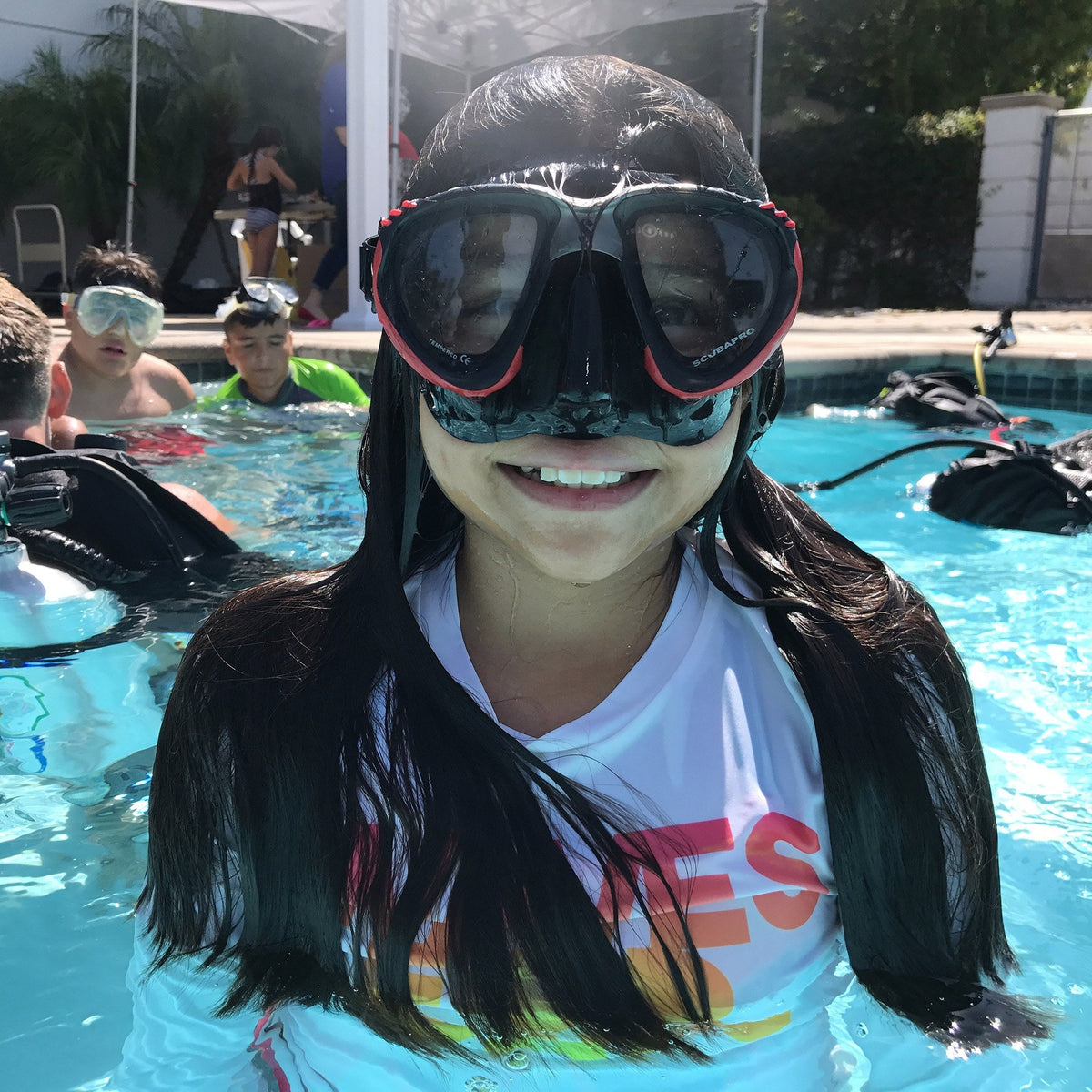
Short, shallow and supervised. Our children's sessions run in a heated indoor pool in Fourways, with an instructor in the water the whole time and equipment sized for the child. On Bubblemaker there's no theory and no test. The child gets used to breathing from the regulator and moving around near the bottom of the pool. At 2 metres they can stand up in seconds if anything feels strange, and that reassurance is often what lets a nervous child relax.
Most children come up talking. Bubblemaker ends with a certificate, a logbook entry and an emblem, which at eight is the whole point. If they take to it, Seal Team builds real skills over several sessions. If they're already 10, a Discover Scuba Diving session does the same job for an older child.
Which course should a child start with?
It depends on the age and how keen they are. Between 8 and 9, Bubblemaker at R850 is the simplest first try, and Seal Team at R3,000 is the longer programme for a child who's hooked. From 10, Discover Scuba Diving at R1,000 is a single pool session, and it can count towards Open Water if the course starts within PADI's 12-month window. The Open Water Diver course at R5,650 is the full certification, and children aged 10 to 14 finish it as Junior Open Water Divers. All four are bookable online, and the December school holidays are a good time to start.
Sources
- PADI Blog, PADI diving restrictions, for the minimum ages and depth limits of Bubblemaker, Discover Scuba Diving, Junior Open Water Diver and Junior Advanced Open Water Diver.
- PADI Blog, Scuba diving lessons for kids, for Bubblemaker and Seal Team from age 8, the Junior Open Water limits, the upgrade at 15, and parental approval for every course under 18.
- PADI Blog, PADI certification rules, for the Junior Open Water depth limits by age.
- DAN Southern Africa, Is your child ready to dive?, for age as a proxy for maturity, and for children's ears and heat loss.
Frequently Asked Questions
What age can a child start scuba diving?
Under PADI's rules, children can try scuba in a pool from age 8 on a Bubblemaker or Seal Team session, with a 2 metre limit on Bubblemaker. From age 10 they can do Discover Scuba Diving or the Open Water course, which certifies them as Junior Open Water Divers.
Can a 7 year old scuba dive?
Not on a PADI scuba programme. Bubblemaker and Seal Team, the youngest PADI scuba experiences, start at age 8. A younger child who loves the water can build confidence swimming and snorkelling until then.
How deep can a Junior Open Water Diver go?
Divers aged 10 or 11 can go to 12 metres and must dive with a PADI Professional or a certified parent or guardian. Divers aged 12 to 14 can go to 18 metres with a certified adult. Junior Advanced Open Water Divers aged 12 to 14 can go to 21 metres.
What happens to a Junior Open Water card at 15?
At 15, a Junior Open Water Diver can upgrade to a full Open Water Diver certification without retaking the course, because the skills were learned to the full standard. If they haven't dived for a while, a refresher before a sea trip is still a good idea.
Does a child need to be able to swim to learn to dive?
For Bubblemaker and Seal Team, PADI asks that children are comfortable in the water. The Junior Open Water course has the same water skills requirement as the adult course, including a swim and a float without aids.
Do children need a medical to scuba dive?
Children complete the same PADI medical questionnaire as adults. If any answer is yes, a doctor needs to sign them off before they get in the water. A parent or guardian also has to approve any PADI course for a child under 18.
Reviewed October 2026. Devon Ford runs Scuba Evolution, a PADI 5 Star Dive Centre in Glenvista, Johannesburg.