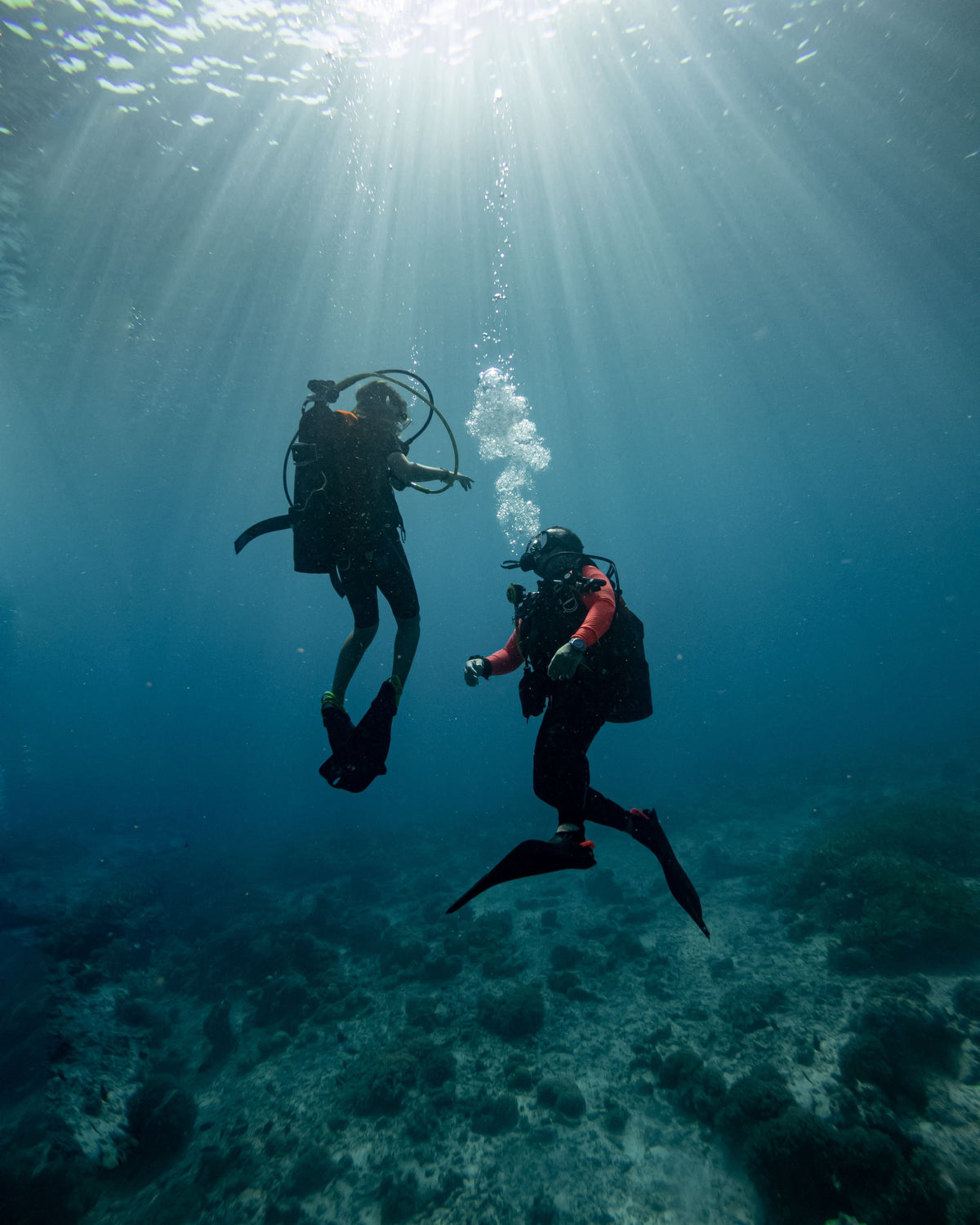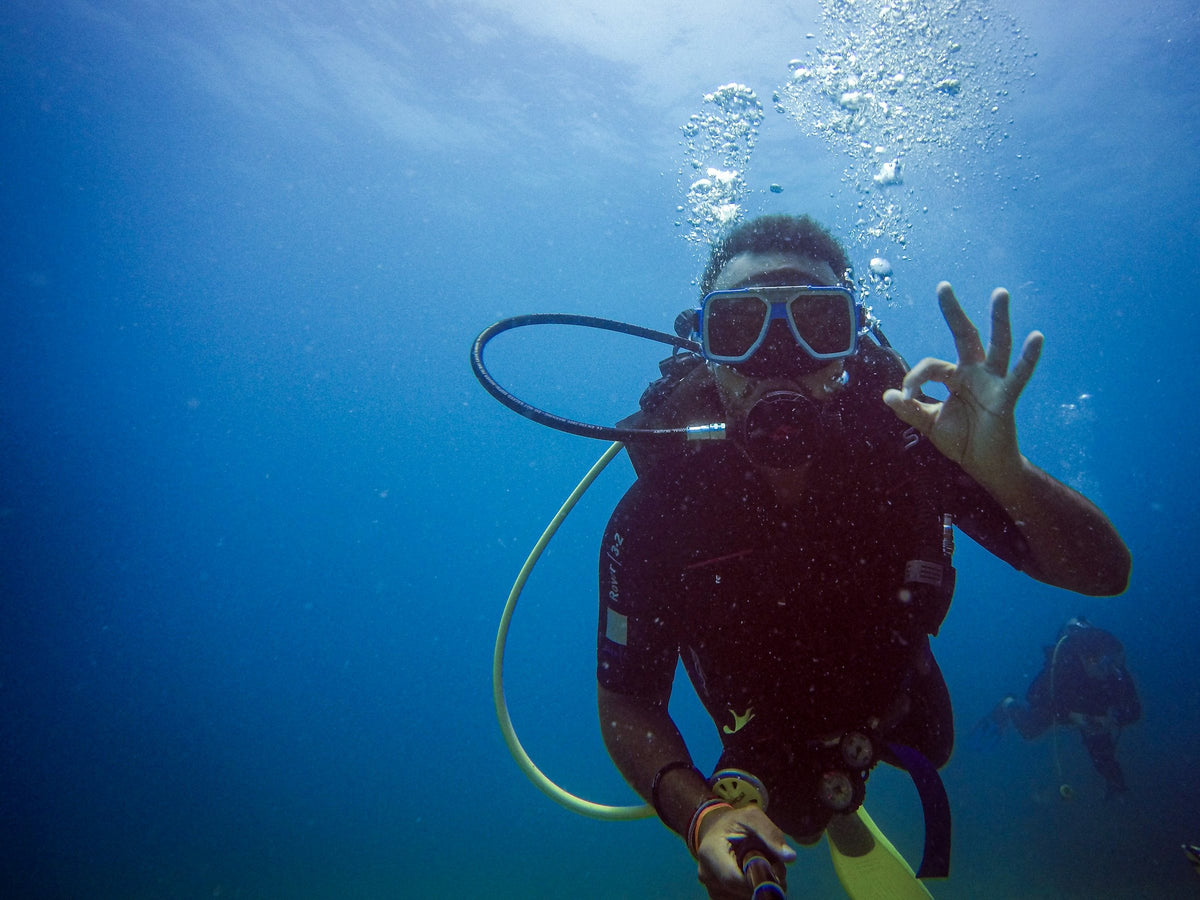

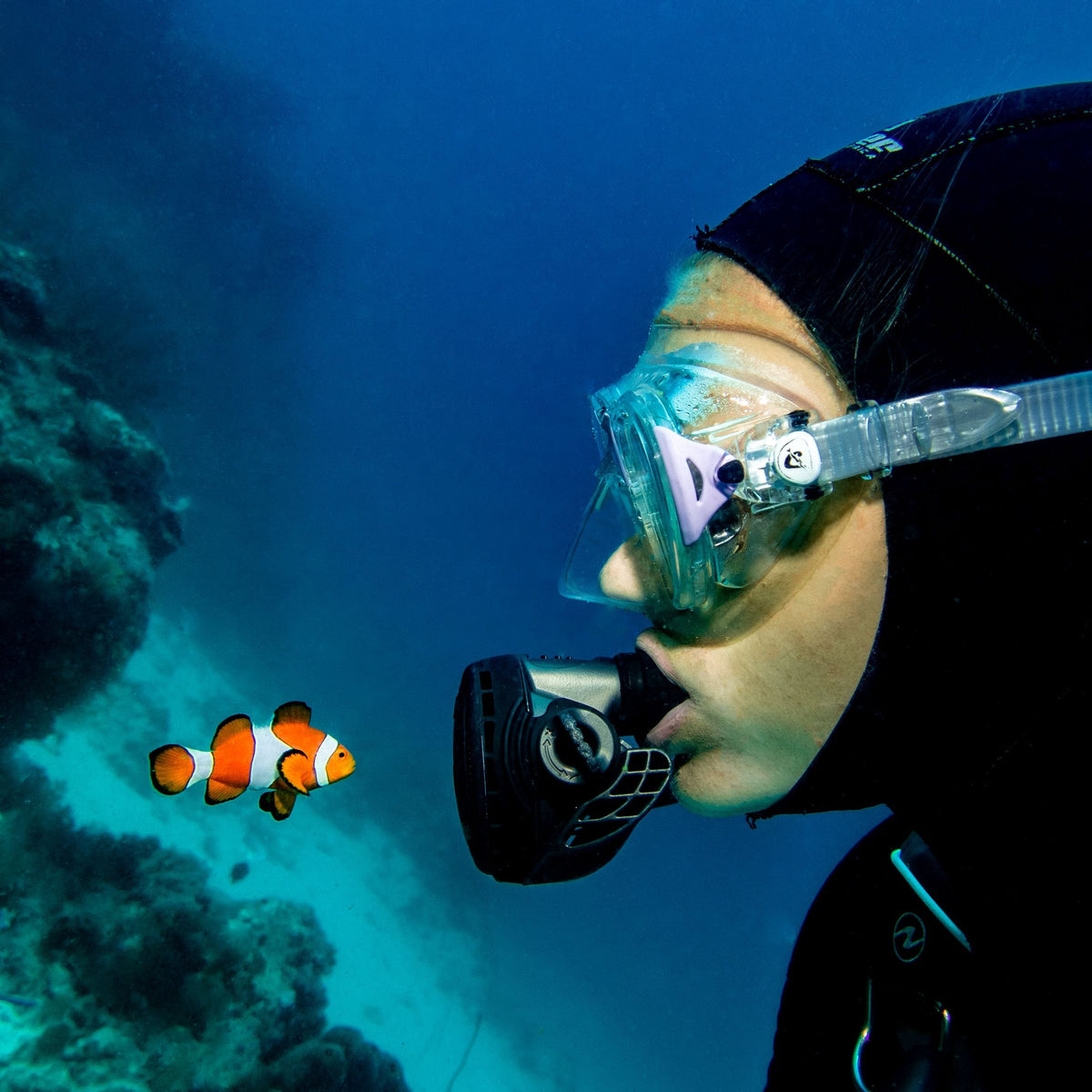
A diver reaches for a mooring line that looks half a metre away and closes a hand on open water. Through a flat mask, light from the line bends as it passes from the water into the air pocket in front of the eye. The line's image sits at about three-quarters of its real distance and fills an angle about a third larger. That's the source of the rule most divers learn in training: objects look 33% bigger and 25% closer. At close range the rule works. Further out, and sooner in murky water, the error flips and objects start to look farther away than they are.
The brain adds its own twist. Studies going back to the 1960s show divers see objects as enlarged, but by less than the optics predict. They also misjudge distance in ways that depend on how murky the water is. The same illusion turns up in fog on land.
Why do things look bigger and closer underwater?
Light travels more slowly in water than in air, and it bends when it crosses from one to the other. HyperPhysics at Georgia State University lists the refractive index of water at 1.33 and air at 1.0003. Light leaving the water for the air inside your mask bends away from the perpendicular. Your eye traces those rays back in straight lines and places the object nearer than it is.
The glass faceplate itself barely changes the result. A flat pane with parallel faces bends light on the way in and straightens it by the same amount on the way out. The net effect is the jump from water to air. Helen Ross and Shazia Nawaz spell out the result in a 2003 paper from the University of Stirling. With the eye at the water surface, the image sits at three-quarters of the true distance and subtends an angle four-thirds larger. Through a mask, the air gap in front of the eye makes the effect slightly smaller for close objects.
Do objects look exactly 33% bigger and 25% closer?
Optically, that's the figure. Both numbers describe one ratio. Four-thirds is 1.33, the angular magnification, and three-quarters is the apparent distance. Perception is a different story. In the same paper, Ross and Nawaz summarise earlier underwater experiments that found perceived size increases between none and 25%, well short of the full 33%.
Their own study had twenty observers look into tanks of air and water at targets 15 to 25 centimetres inside. Distances set by hidden reaching matched the physical distance in air and the optical distance in water. Size matches, though, were only about 5% larger in water than in air. The authors put the gap down to incomplete adaptation to the distortion and to the brain's use of other size cues. The textbook third is the most the optics can deliver, and the brain rarely delivers all of it.
Why do distant objects look farther away underwater?
Contrast, mostly. In a 1969 study, Kinney, Luria and Weitzman found observers underestimated the distance of a close target, then overestimated it as the target moved further away. Estimates were greater in turbid water than in clear water in every case.
Helen Ross had already found the same pattern in 1967 with sixteen divers judging white discs. Size judgements were larger underwater, and they tracked an overestimation of distance. She found the same overestimation in fog on land. Her explanation was the exaggerated loss of brightness contrast with distance, the cue the brain reads as far away. Water strips out light and colour quickly, as why colours disappear underwater explains, so a faded outline gets read as a distant one. The murkier the water, the closer the point where "looks closer" turns into "looks farther".
Do divers get used to the distortion?
Partly, and only for the water they've practised in. Ross and Nawaz cite eye-hand experiments by Ross and Lennie that found around 14% angular adaptation. That's real but incomplete. In 1973, Steven Ferris trained 24 subjects in clear and turbid water. Training in one body of water initially made them less accurate in the other, but training in both improved accuracy in both.
That finding is close to home for highveld divers. Someone who learns to judge distance in an inland dam, then dives at Sodwana Bay or the Aliwal Shoal, may be switching between waters with markedly different turbidity. The calibration from one doesn't carry over automatically. The judgement lives in the logbook, not on the card, and it takes dives in varied water to build.
Why can't you see clearly underwater without a mask?
Because your cornea stops working as a lens. A 2003 Lund University study in Current Biology notes that the curved cornea provides two-thirds of the eye's focusing power in air, and that power is lost in water. The mask's air pocket gives it back, and the magnification is the price. The same study found something remarkable. Moken children, from a sea-nomad community in Southeast Asia, saw more than twice as well underwater as European children.
They did it by constricting their pupils to 1.96 millimetres, against 2.50 in the European group, and by focusing at the limit of human performance. A 2006 follow-up by the same group trained European children for a month, eleven sessions in all. Tested months later in an outdoor pool in bright sun, they matched the Moken children's underwater acuity. Underwater focus, it turns out, is partly a trained skill.
How do divers judge size and distance more reliably?
By checking the eyes against something else. Near a reef or a wreck, move slowly and let your fins and hands find the gap, rather than lunging at a distance that looks right. Leave a margin on any gap to the reef, the way you'd leave one on a gas plan. Estimate an animal's size against a known reference, such as a buddy, and treat a first impression as generous. Every fish story gets a head start from the optics before the diver says a word. For distance over any real range, divers count kick cycles and time their swims.
The PADI Advanced Open Water Diver course includes a required Underwater Navigation adventure dive that practises kick cycles, natural landmarks and timed swims. Those measures don't depend on what the water does to the view. Your ears get fooled underwater too, as why you can't tell where sound is coming from underwater covers.
Sources
- SciELO, Arquivos Brasileiros de Oftalmologia: Why do objects appear enlarged under water? Ross and Nawaz, 2003
- HyperPhysics, Georgia State University: Index of Refraction
- PubMed: Water, fog and the size-distance invariance hypothesis, Ross, 1967
- PubMed: Effect of turbidity on judgments of distance underwater, Kinney, Luria and Weitzman, 1969
- PubMed: Improving absolute distance estimation in clear and in turbid water, Ferris, 1973
- PubMed: Superior underwater vision in a human population of sea gypsies, Gislén et al., 2003
- PubMed: Visual training improves underwater vision in children, Gislén et al., 2006
- PADI: Advanced Open Water Diver, Everything You Need to Know
Frequently Asked Questions
Do things look bigger underwater without a mask?
No, because there's no flat boundary between water and air in front of the eye to create the magnification. The trade-off is focus. With water against the cornea, most people see a heavy blur, so the lack of magnification is little help.
Why does a swimming pool look shallower than it is?
It's the same refraction seen from the other side. Looking down from above, light from the pool floor bends as it leaves the water, so the floor appears at roughly three-quarters of its true depth. A pool that looks chest-deep can be over your head.
Does a mask narrow your field of view underwater?
Yes. Refraction squeezes the view: a ray reaching your eye 45 degrees off-centre inside the mask left the water at about 32 degrees, on the water's refractive index of 1.33. The same mask frame covers a smaller slice of the water than it would of a room, so turning your head does more of the work.
Does the magnification affect underwater cameras?
A flat port in front of a camera lens refracts light the same way a mask does. The lens sees a narrower, magnified view compared with the same lens in air. That's why a lens chosen for its wide view on land tends to frame tighter behind a flat port.
Does a prescription mask change the magnification?
No. Corrective lenses fix focus for people who need them, but the bend happens where water meets the air inside the mask. A diver with a prescription mask sees the same enlargement as anyone else, only sharper.
Reviewed September 2026. Devon Ford runs Scuba Evolution, a PADI 5 Star Dive Centre in Glenvista, Johannesburg.
Header photo: Matt Botha on Pexels, used under the Pexels License. View the original photo