A steel 12 litre stands in the corner of a garage with 2019 stamped on its shoulder. No fill station will touch it. SANS 10019 is the South African standard for transportable gas cylinders. It sets a visual inspection every 24 months and a hydrostatic test every four years. A cylinder outside either date is refused rather than filled.
We book both tests through the shop and send cylinders out to an accredited test station. The two tests answer different questions. A visual inspection asks what two years of diving did to the inside of the cylinder. A hydrostatic test asks whether the metal still behaves like new metal under pressure. Plenty of cylinders pass one and fail the other.
What does a visual inspection look for?
The valve comes off first, with the cylinder emptied. That is the whole point of the exercise. Everything worth seeing sits behind the valve, and no external check reaches it. The inspector lights the interior and works down the wall. Corrosion shows up in three recognised forms: general corrosion spread across a surface, line corrosion running in a band, and pit corrosion eating into one spot.
Pitting is what condemns cylinders. General surface rust in a steel cylinder can often be cleaned out, and the cylinder goes back into service. A pit concentrates that same loss of metal into a small area. The remaining wall thickness under it becomes the question. Where the inspector cannot judge a pit by eye, the station measures its depth ultrasonically, or weighs the cylinder against its stamped tare mass.
Water inside leaves a signature. A flooded valve, a wet fill or a cylinder stored on its side puts free water at the lowest point. Rust then forms a hard line where air met water. That tidemark tells an inspector how the cylinder was stored, and roughly for how long. In steel it develops into line corrosion along the bottom of the barrel, which is a rejection criterion in its own right.
The outside gets its own pass: dents, gouges, bulges, arc burns, heat damage, and stamp markings someone has ground away. A detachable boot comes off so the base can be seen, because a boot traps salt water against the metal it protects. With the valve out, the inspector checks the neck threads for type, full form, burrs and cracks. Older aluminium alloys also get an eddy current test of the neck for sustained-load cracking. The valve comes apart for cleaning, with o-rings, seat and burst disc renewed as needed.
What does a hydrostatic test measure?
The station fills the cylinder with water, seals it, and lowers it into a closed jacket of water. Pressure goes in until the cylinder reaches the test pressure stamped on its shoulder. That figure sits at roughly one and a half times working pressure, so a 232 bar cylinder goes to 348 bar. As the cylinder swells, it pushes water out of the jacket into a calibrated tube. The volume displaced gives its total expansion.
The station then releases the pressure and reads the tube again. Most of the expansion comes back, because steel and aluminium are elastic within their working range. Whatever stays behind is the permanent expansion, also called permanent set. Pass or fail turns on the relationship between those two figures, not on either one alone.
The reasoning behind it is metallurgical. A cylinder that gives back the whole of its stretch is working inside its elastic limit. That is where a pressure vessel is designed to live. A cylinder that keeps part of the stretch has been pushed past that limit somewhere in its wall. The deformation is permanent, it repeats on every fill, and it points to metal that has begun to fatigue. Permanent expansion above the allowed proportion of total expansion fails the cylinder outright, and a correctly run pressure test is final.
What do the stamps on the shoulder mean?
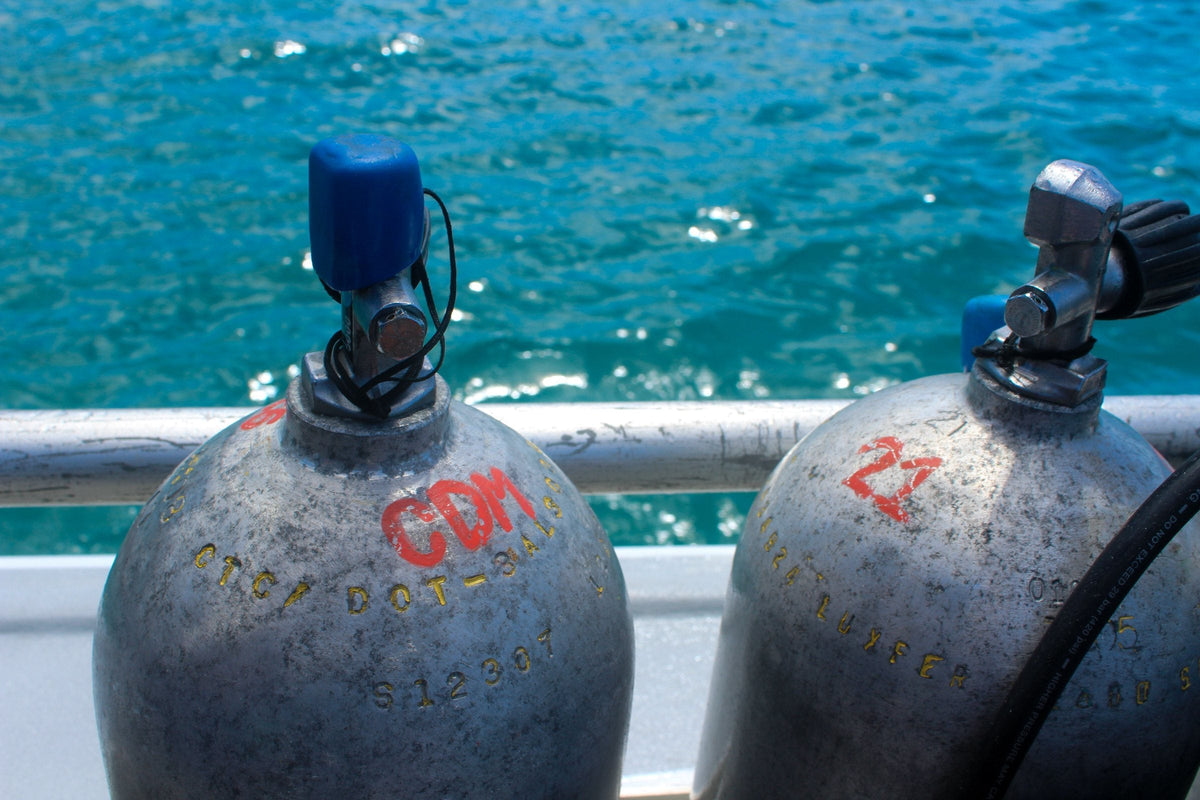
Every cylinder carries its birth certificate in steel. The manufacturer's mark, serial number, design standard, water capacity, tare mass and pressures go into the shoulder at manufacture. ISO 13769 sets that stamp format internationally. Below the original data sits a growing column of test dates, each beside the registered mark of the station that did the work.
That column is what the person behind the fill panel reads. Month, year, most recent entry, against today's date. Test stations keep their own records of serial number, mass, test pressure, result and tester, so a lost certificate is recoverable. An illegible stamp is the harder problem. Without the design standard and pressures struck into the metal, a station has no specification to test the cylinder against.
Will a fill station fill an out-of-test cylinder?
No, and the reason sits in the regulations rather than in shop policy. DAN Southern Africa's guidance puts the onus on the filling station rather than on the private owner. A competent filler has to be satisfied of three things before any gas goes in. The cylinder is not due for periodic inspection or testing. The valve and safety devices are serviceable. The cylinder shows no significant defects. The filler then logs the fill against the owner and the cylinder.
Stations are entitled to be stricter than the standard, and many are. A valve thread the operator distrusts can end in a polite refusal. So can a foot ring, or a boot that will not come off for the base check. What a station cannot do is keep your property. DAN Southern Africa is clear that a cylinder can be refused, not seized. A test station that fails one has to render it unserviceable, but the standard allows for a second opinion. The cylinder then comes back unstamped and without its valve, alongside a certificate stating why it failed.
What makes a cylinder fail?
Failures cluster. Most of what ends a cylinder's working life arrived through the valve as water, or through the fill panel as heat and pressure cycling.
- Pit corrosion that has taken the wall below its minimum thickness at any single point.
- Line corrosion along the bottom of the barrel, the classic signature of water left standing inside between dives.
- Neck thread damage: cracks, burrs, a thread that gauges outside its limits, or sustained-load cracking found by eddy current testing in older aluminium alloys.
- Permanent expansion above the allowed share of total expansion at test pressure.
- Bulges, gouges and arc burns. A bulge says the cylinder has already been overpressurised or heated somewhere in its past. An arc strike from a welder working nearby changes the metal at that spot.
- Illegible markings, which leave a test station with nothing to work to.
Who is allowed to test cylinders in South Africa?
Gas test stations here are accredited by the South African National Accreditation System, under the approval of the Department of Employment and Labour. SANAS is the national accreditation body, set up under the Accreditation for Conformity Assessment Act of 2006. DAN Southern Africa publishes a listing of accredited inspection bodies alongside the SANAS register. That accreditation is what gives a test stamp meaning at a fill panel anywhere in the country.
Bring the cylinder to the shop and we book it out to an accredited station. It comes back stamped, certificated and with the valve serviced. Cylinders used for enriched air need one more step. DAN notes that a cylinder carrying a breathing gas above 23.5 percent oxygen has to be oxygen-cleaned, and cleaned again if oil or hydrocarbon contamination is suspected. Our FAQ page carries the short version of the intervals, and the article on what is in a scuba cylinder covers the gas that goes into it.
Sources
- DAN Southern Africa: Inspecting and Testing Scuba Cylinders supports the scope of visual inspection and hydrostatic testing, oxygen cleaning above 23.5 percent oxygen, and the marking of condemned cylinders.
- DAN Alert Diver: Inspecting and Testing Scuba Cylinders supports eddy current testing of older aluminium alloys, test record keeping, and a fill station's right to reject a cylinder.
- DAN Southern Africa: Filling and Test Station Resources supports SANAS accreditation of gas test stations, the duties of a competent filler, the boot removal check, and the refusal and second opinion rules.
- SABS Store is where SANS 10019 is published and purchased; the standard is cited here by number and paraphrased, not reproduced.
- Testing and inspection of diving cylinders supports the South African test intervals, the rejection criteria, the water jacket method and the ISO 13769 stamp format.
Frequently Asked Questions
How often does a scuba cylinder need testing in South Africa?
Visual inspection every 24 months and hydrostatic test every four years, under SANS 10019. A cylinder whose service history or external condition gives cause for concern can be called in sooner.
Can a cylinder pass the hydrostatic test and still fail the visual?
Yes, and that combination is common. The pressure test measures how the metal behaves as a whole. The visual inspection finds local damage, such as a single deep pit or a cracked neck thread. Either one on its own condemns the cylinder.
What happens if water gets inside a cylinder?
The inspection shows a rust tidemark at the old waterline, and the cylinder goes for internal cleaning before it can pass. Caught early, it costs a clean. Left for a year or two, it becomes line corrosion, which is a rejection criterion.
Can a test station keep or destroy a cylinder that fails?
No. A failed cylinder has to be rendered unserviceable, but the standard provides for a second opinion. It can be returned to you unstamped and without its valve, with a certificate giving the reason for failure. Nobody is entitled to withhold it.
Do nitrox cylinders need anything extra?
Yes. DAN's guidance is that a cylinder carrying a breathing gas above 23.5 percent oxygen has to be oxygen-cleaned. It is cleaned again if oil or hydrocarbon contamination is suspected. That step is booked with the test and inspection rather than after it.
How are the dates on the shoulder read?
Look for the column of month and year pairs, each next to a test station's registered mark. The most recent pair is the one a filler checks. The figures above them are the cylinder's original manufacturing data.
Reviewed September 2026. Devon Ford runs Scuba Evolution, a PADI 5 Star Dive Centre in Glenvista, Johannesburg.