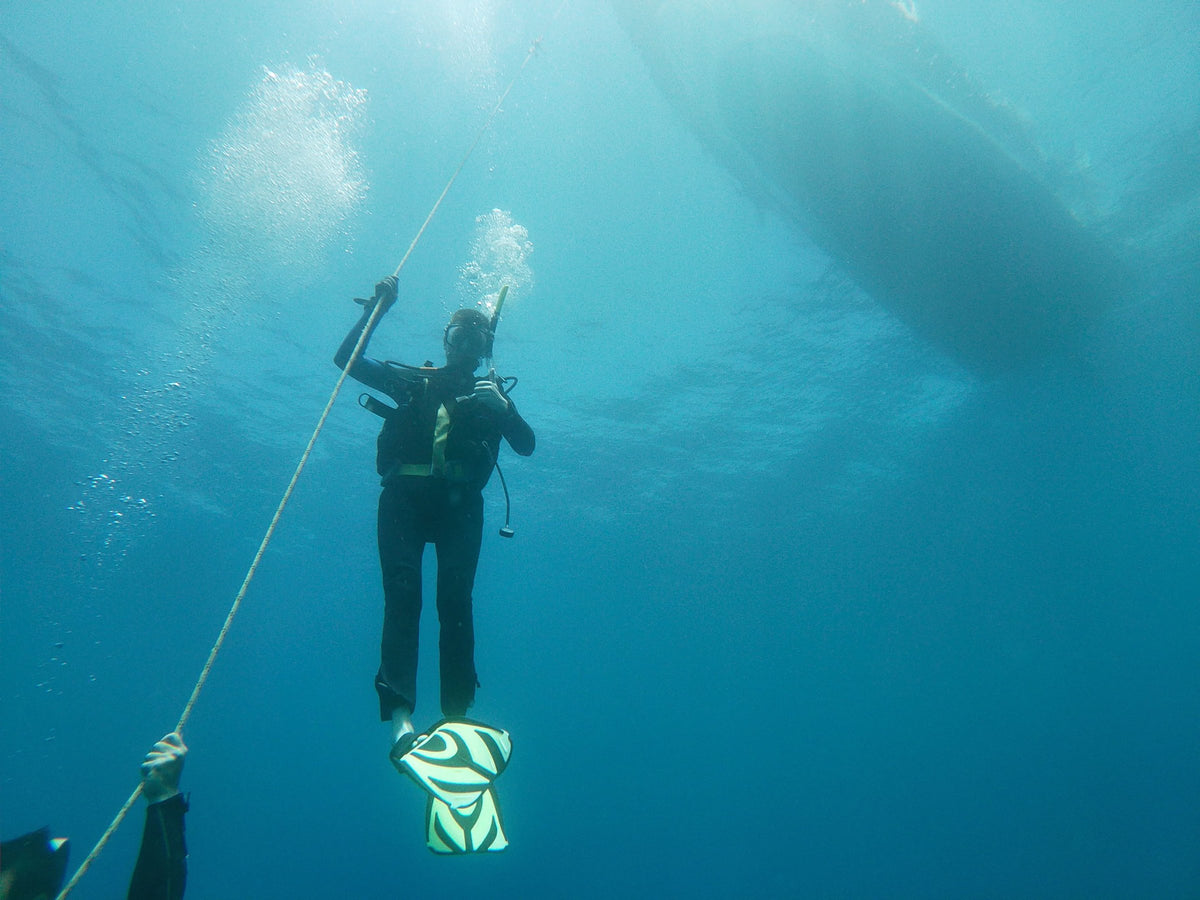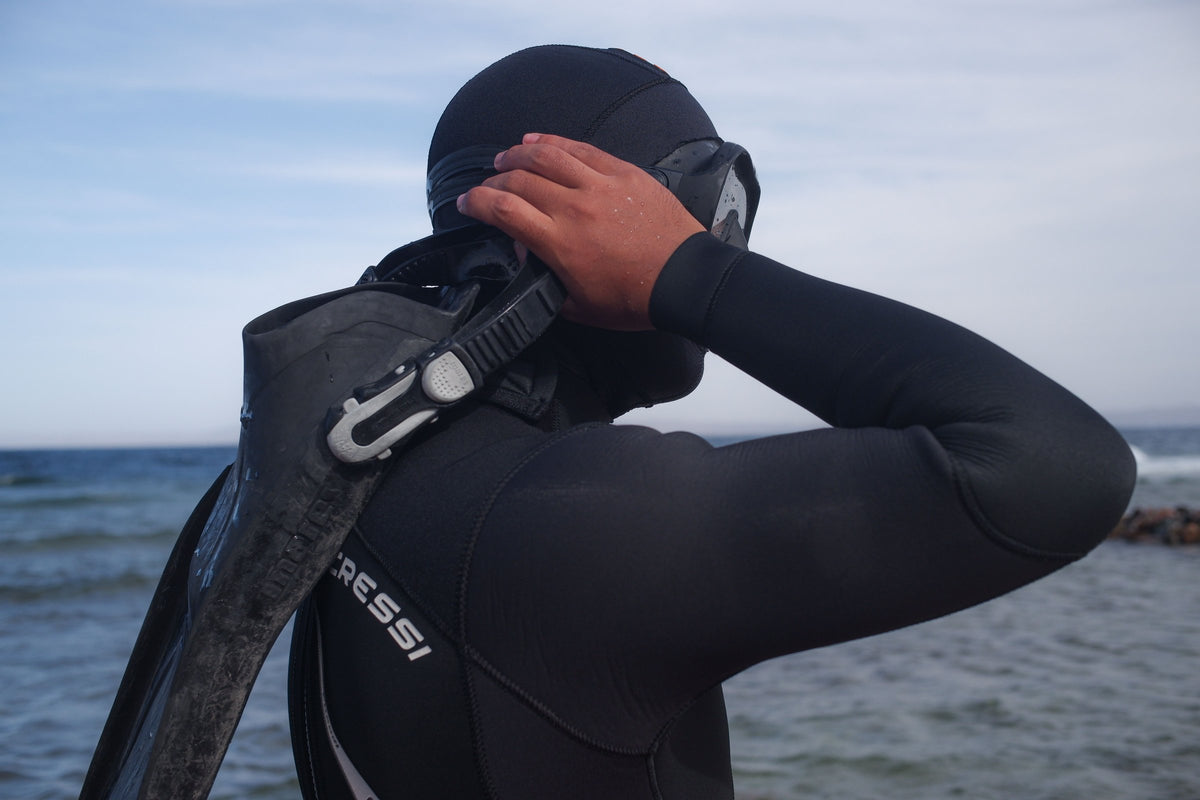
Three minutes in, you are tilting your head to find the one corner of the lens you can still see out of. You crack the skirt, flood it, blow it clear, and buy yourself ninety seconds. Then it goes again. Somewhere off to your left, your buddy has found a fish.
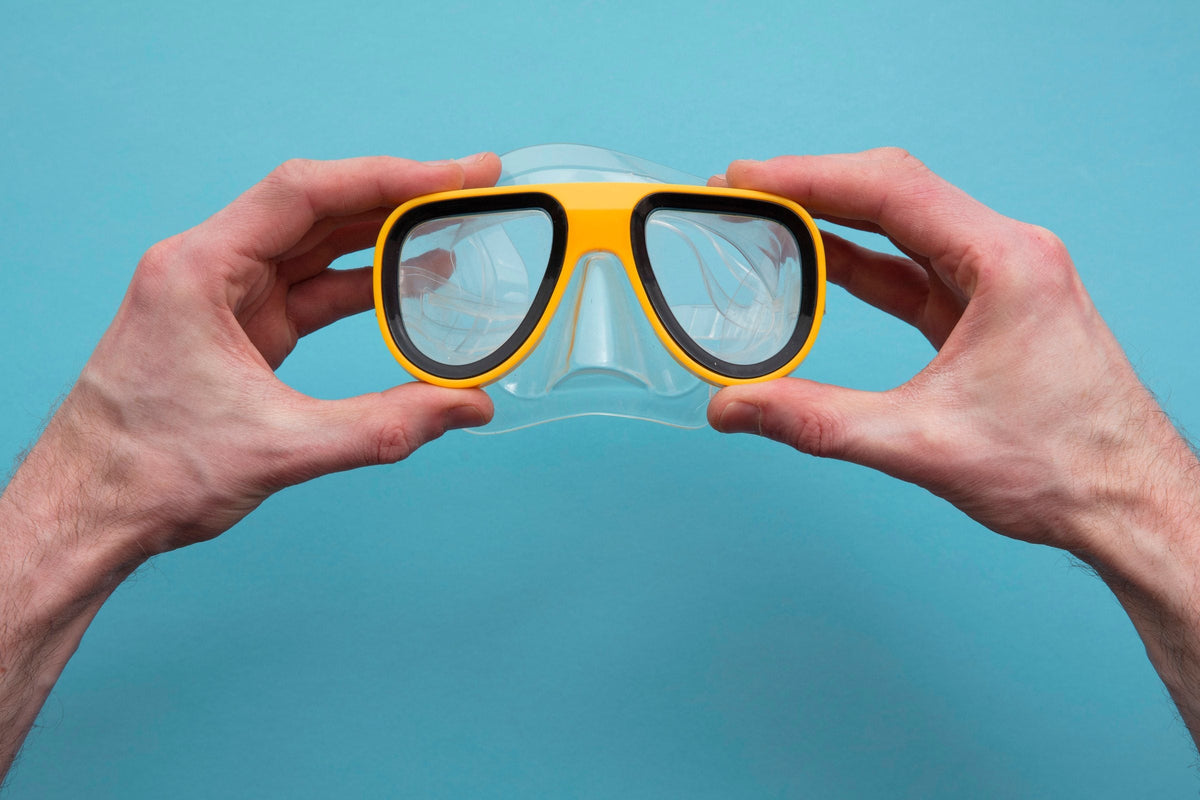
A new mask fogs because the glass is coated. PADI puts it plainly: during the manufacturing process the lenses of the mask are coated in a fine layer of silicone. Silicone repels water, so your breath condenses into thousands of separate droplets instead of spreading into a clear sheet. Scrub that film off properly once and it is gone for the life of the mask. Everything you do after that, spit included, is a per-dive treatment, and it has a different job.
Why does a brand new mask fog up?
Two things are happening at the same time, and people tend to blame the wrong one. The first is condensation, and no mask escapes it. Your face is warm and damp, the glass sits against water that is colder, and water vapour turns liquid on the cold surface. That part is physics and it happens on a spotless lens too.
The second is the film, and that is the part you control. On clean glass the condensation spreads into an even layer you can see straight through. On a lens with a water-repellent residue on it, the same condensation pulls itself into beads, and every bead bends light in its own direction. The result is the frosted look you are squinting through. The residue comes off the mould during manufacture, and it sits on the inside of the lens from the day the mask is boxed.
Does toothpaste work on a dive mask?
It does, and PADI describes the method. A bead of toothpaste on the inside and outside of the lenses, worked over the glass with a fingertip, scrubbed hard, then rinsed. Repeat it two or three times on a stubborn mask. The mild abrasive in the paste takes the silicone off mechanically, which is what a liquid cannot do.
Three limits go with it, and skipping them is how masks get ruined.
- Glass lenses only. The abrasive is for the tempered glass. Keep it off the silicone skirt, off the frame and away from the buckles.
- Plain white paste. Whitening and tartar-control pastes carry harsher abrasives, and a harsher abrasive on a lens can leave fine scratches you will look through for years. A basic paste with no bleaching agents and no crystals does the job.
- Fingers, not scourers. PADI's warning is direct: do not use a textured sponge or steel wool to scrub, as this will scratch the glass.
Corrective lenses deserve a pause. Bonded or prescription optics may carry coatings that abrasives attack, so check the maker's instruction before touching them. The same caution goes for any mirrored or anti-reflective lens. If you are weighing a bonded lens against contacts, the trade-offs in diving in glasses or contact lenses come first.
Is burning a dive mask with a lighter safe?
PADI describes the method, so it is not folklore: with a lighter, it is possible to burn away the silicone, with the tip of the flame positioned below the lens. PADI attaches its own warning to it, that extreme care needs to be taken not to burn or melt the silicone skirt at the edges of the lenses.
Set that beside what the manufacturer tells you. The Scubapro mask manual gives a first-use routine that contains no flame anywhere in it. Its instruction is to apply anti-fog to the inner surface and rinse the mask thoroughly in the water, repeating the operation three times if the mask is new. The same manual rules out solvents and cleaners such as alcohol, allowing liquid soap. It also lists extreme temperatures among the factors that may damage the product beyond repair. A mask with cracks or cuts in the glass or the silicone frame should be taken out of service and destroyed.
So the honest position is this. The flame method is described by a training agency and carries that agency's own warning about melting the skirt. It is absent from the manufacturer's instructions for the mask, which route you to anti-fog and a rinse instead. A lens with a mirrored or anti-scratch coating on it is a different material again, and no manual here tells you heat is safe on one. Given a method the manufacturer prints and a method it does not mention, use the printed one.
Our own routine starts by asking what the lens is. Plain tempered glass takes the flame, tip held below the glass and kept moving, until the grey film lifts, and then a scrub with plain white toothpaste and a rinse. A mirrored, anti-scratch or prescription lens skips the flame and gets the toothpaste alone, because heat on a coating is a combination no manual here endorses. If you are unsure which you have bought, ask before the first dive, or bring the mask in and we will prep it.
Do spit and baby shampoo work as defog?
Both work, and both work for one dive. PADI lists dish washing soap, shampoo and saliva among the options, and they all do the same thing. A surfactant lowers the surface tension of water, so the condensation cannot bead up and spreads into a film instead. That is what a bought anti-fog does, in a bottle.
Shampoo is the practical version. Dilute it heavily, a few drops in a bottle of water, smear it round the inside of the lens and give it a light rinse. Use something without menthol or strong fragrance, since anything that stings will find your eyes at 18 metres. Spit is free, ends up on the lens either way, and has the advantage of being in your mouth already.
What no surfactant does is remove the factory film. A mask that fogs from new will keep fogging through spit, shampoo and anti-fog alike, because you are treating the symptom on top of the cause. Do the scrub once. Then pick a surfactant for the rest of the mask's life.
Why does a mask fog on the second dive but not the first?
Because the surfactant went into the water on the first one. It is a coating a few molecules thick and it washes off. A mask that has been rinsed, dried in the sun and left in a box has nothing on the glass at all. Treat every dive as a fresh application. Applying it is its own small routine: a drop or two onto a dry lens, spread with a fingertip across the whole inside surface and into the corners, then the briefest dip in the water you are about to dive. A long flooded rinse takes most of it straight back off. Scubapro's own instruction is to apply and then rinse the mask thoroughly, which surprises people who expect to leave the liquid sitting in there.
Two other second-dive effects stack on top. Salt dries on the lens and leaves deposits that hold droplets, so a freshwater rinse between dives earns its keep. And sunscreen transfers off your forehead onto the glass as you push the mask up, which is a hydrophobic film in its own right.
Why does a mask fog more when you are cold?
Condensation depends on the gap between the temperature of the glass and the dew point of the air inside the mask. Colder water pulls the glass further below that dew point, so the vapour coming off your face has an easier surface to condense on. The colder the dive, the harder your prep has to work.
Breathing feeds it as well. You put air out through your nose into the mask on the way down, and you have to, because pressure squeezes a mask against your face. The Scubapro manual puts that at deeper than 2 metres and gives exhaling through the nose as the prevention. That breath is warm and saturated, which is precisely what a cold lens wants. Fogging and squeeze are separate problems with a shared cause, and the same nose-clearing habit sits inside equalising your ears properly.
A heated indoor training pool is where you find out whether the prep took. Better there than on a dive you drove two hours for. Scrub the new mask before it ever gets wet, treat it before each dive, rinse it in fresh water afterwards and dry it out of direct sunlight.
Sources
- PADI, How to Prepare a New Mask for Scuba Diving The silicone film left by manufacture, the toothpaste method, the lighter method and its warning about the skirt, and the instruction not to scrub with a textured sponge or steel wool.
- Scubapro, Mask Owner's Manual The manufacturer's first-use routine of anti-fog applied to the inner surface and rinsed three times on a new mask, the restriction to liquid soap over solvents, mask squeeze deeper than 2 metres and exhaling through the nose, extreme temperatures as a cause of damage beyond repair, and retirement of a mask with cracked glass or frame.
- DAN, Ears and Diving DAN's dive medical reference on barotrauma of the ears and sinuses, the background to equalising on descent.
Frequently Asked Questions
Why does a brand new dive mask fog up?
PADI states that the lenses are coated in a fine layer of silicone during manufacture. That film repels water, so your breath condenses into beads rather than a clear sheet. It has to be scrubbed off once before any defog will work.
Does toothpaste stop a dive mask fogging?
Yes, as a one-off preparation. The mild abrasive removes the factory film from the glass. Use a plain white paste rather than a whitening or tartar-control one, work it with a fingertip, and keep it off the silicone skirt.
Is it safe to burn a dive mask with a lighter?
PADI describes the method and warns against melting the silicone skirt at the edges of the lenses. The Scubapro manual gives anti-fog and a rinse as its first-use routine and mentions no flame, so the manufacturer's printed method is the safer bet.
Does spit work as a defog?
It does, for one dive. Saliva is a surfactant, so it stops condensation beading, which is what a bought anti-fog also does. It has no effect on the factory film underneath.
Can you use toothpaste on a mask with a coated lens?
Check the maker's instructions first. Mirrored, anti-reflective and bonded prescription lenses can carry coatings that an abrasive will take off, and the damage is permanent.
Why does a mask fog on the second dive when the first was fine?
The surfactant layer washes off during the first dive, and salt or sunscreen residue makes the second worse. Reapply before each dive and rinse the mask in fresh water between them.
Reviewed September 2026. Devon Ford runs Scuba Evolution, a PADI 5 Star Dive Centre in Glenvista, Johannesburg.