Glasses do not go under a dive mask. The skirt has to seal on skin, and the arms of a frame break that seal on both sides of the face. That is the one option off the table. The other three are open: soft contact lenses, corrective lenses fitted into the mask, or diving with the vision you already have. Which one suits you comes down to how strong your correction is and how you feel about taking a mask off underwater.
Start with the number that settles it for a lot of people. Refraction at the mask lens makes objects look about one third larger and closer than they are, so mild short sight is partly corrected the moment your face goes in. Where that is not enough, off-the-shelf corrective mask lenses run from 0 to -8.00 and 0 to +4.00 in sphere power, according to DAN. Stronger corrections, or an astigmatism worth naming, move you to custom lenses or contacts.
Are contact lenses safe under a dive mask?
DAN's position is specific about the type. Divers should ask an ophthalmologist or optometrist to prescribe soft lenses. Hard lenses and rigid gas-permeable lenses have been found to cause eye pain and blurred vision during and after dives. The mechanism is gas bubbles forming between the cornea and the back of the lens, where the lens material does not let them pass through. Soft lenses are permeable enough that the gas moves out instead of collecting.
Soft lenses have a second advantage that has nothing to do with gas. They are larger than rigid lenses and sit over more of the eye, so they are likelier to stay put if the mask floods. Daily disposables make the loss of one a minor annoyance rather than an expensive afternoon. Carry rewetting drops as well. Pressure and dry air can leave a soft lens feeling stuck, and drops sort that out on the surface.
The real caution is infection, not optics. A review in the American Journal of Ophthalmology found that 85 percent of Acanthamoeba keratitis cases were in contact lens wearers who had worn their lenses while swimming or diving. Acanthamoeba lives in fresh water, and the infection attacks the cornea. If water gets into your mask during a dive, take the lenses out afterwards and clean them, or bin them if they are dailies. Speak to your optometrist before you dive in lenses at all.
What happens when you flood or remove the mask?
Every entry-level course includes mask flooding, mask clearing, and removing and replacing the mask at depth. Those skills exist because masks flood on real dives. For a lens wearer, the risk is a simple one: opening your eyes inside a flooded mask can wash a lens straight out.
The habit that solves it is small and worth drilling. Close your eyes before you break the mask seal. Keep them closed while the mask is off or flooded, clear it, then open them once the water is out. Practise it in confined water until it happens without deciding to do it. Tell your instructor you wear lenses before the session starts, so the skill gets run with that in mind. The PADI Open Water Diver course covers those skills in the heated indoor pool in Fourways before anyone goes near open water.
How are corrective lenses fitted into a mask?
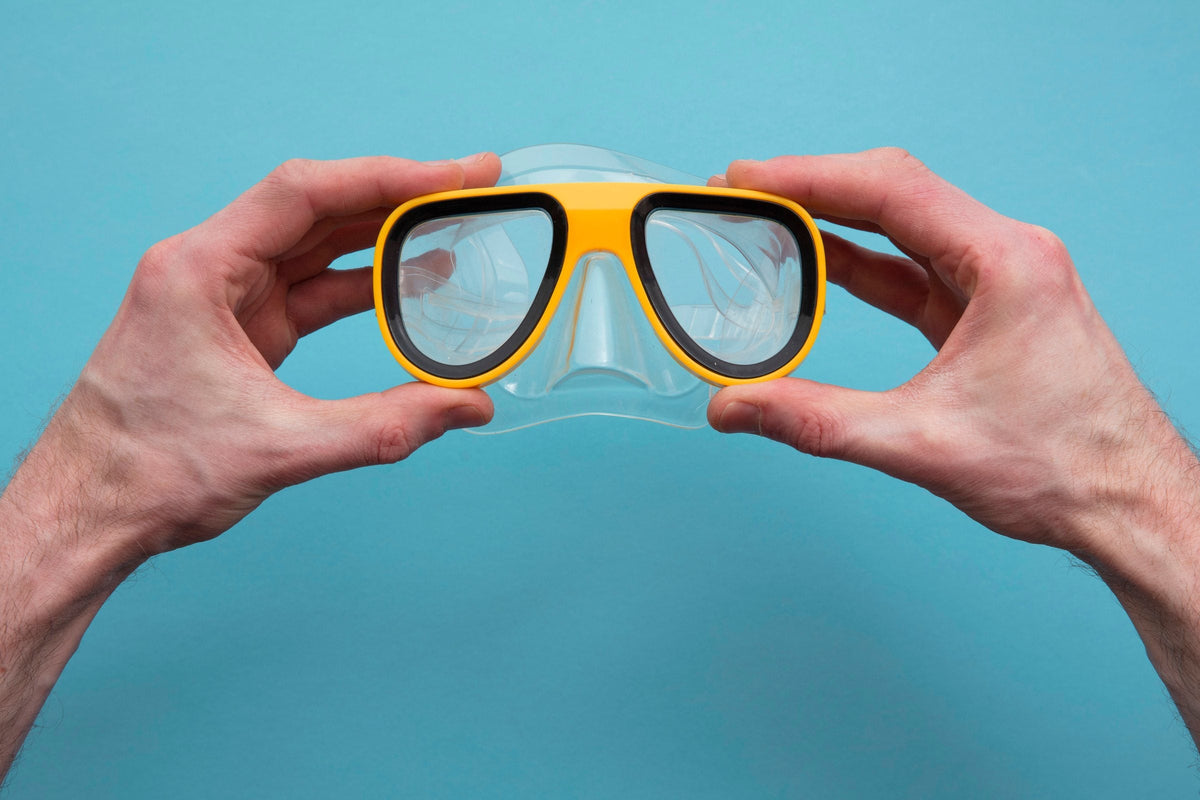
Two routes exist, and they solve different problems. Drop-in lenses are premade in standard dioptre steps and swap into masks built to accept them, which keeps the price down and the turnaround short. Bonded or laminated lenses are made to your exact prescription in a lab and fixed to the mask's own lens. DAN's guidance is that laminated lenses can go onto any dive mask and correct any prescription, including prism lenses for double vision.
- Drop-in stock lenses cover sphere correction in fixed steps, with some ranges including astigmatism. Good for mild astigmatism under 0.75 cylinder, according to DAN.
- Bonded custom lenses match your prescription exactly, handle strong corrections, and use high-index glass to keep thickness and edge distortion down.
- Bifocal segments put reading correction in the lower part of the lens, where your gauges and computer sit in your field of view.
- Stick-on magnifiers are the cheapest way to test whether near correction is what you are missing, before committing to a lens.
Two practical points come out of DAN's article. Dive mask lenses are usually glass, for scratch resistance and optical quality. And while any quality mask can take prescription lenses, not every mask suits every prescription. Lens thickness depends on the strength of the correction, the surface area of the lens, and where your pupil sits relative to the centre of the lens. Strong plus lenses bulge inwards, so a low-volume mask can end up with glass against your eyelashes.
Fit still comes first. A mask that leaks with a perfect prescription in it is a worse dive than a plain mask that seals.
Can you dive with mild uncorrected vision?
This is the option that gets skipped, and for a fair number of divers it is the right one. The water is doing some of the work already. That one third magnification effect, plus the short distance to your gauges, means a mild myope often reads a pressure gauge underwater more easily than a menu on land. Our guide to why everything looks bigger and closer underwater covers the physics.
Two tests settle it at a gear fitting. Can you read the numbers on a pressure gauge and a dive computer at arm's length without correction? Can you make out a hand signal at buddy distance? If both are yes, a standard mask is fine and you have saved yourself a purchase. If you reach for glasses all day rather than for reading alone, you need correction in the water. Refraction does nothing for astigmatism either, so a blur that comes from corneal shape stays a blur at depth.
What is the plan if a lens goes mid-dive?
Losing a lens underwater is not an emergency, and treating it as one is how it becomes one. Close the affected eye, signal your buddy, and end the dive in an orderly way with a normal ascent and safety stop. You will have one working eye and a buddy who knows what happened, which is why telling them beforehand is part of the kit check.
Backups do the rest of the work. Spare lenses in the kit bag cost little. A pair of glasses at the car or on the boat gets you home. If a prescription mask is the only way you see clearly, a second mask with the same correction is the difference between a lost dive and a lost holiday. Divers who dive in contacts should carry glasses for exactly the same reason.
Sources
- DAN Alert Diver: Prescription Dive Masks supports the stock lens ranges of 0 to -8.00 and 0 to +4.00, the 0.75 cylinder limit for stock lenses, drop-in versus laminated construction, lens thickness and decentration, and the Acanthamoeba keratitis figure.
- PADI: Scuba Diving With Contacts or Glasses supports DAN's soft lens guidance and the bubble mechanism behind rigid lenses, the one third magnification effect, rewetting drops, and closing the eyes during mask skills.
- PADI Open Water Diver supports where mask clearing, removal and replacement sit in entry-level training.
Frequently Asked Questions
Can you scuba dive with contact lenses?
Yes, with soft lenses. DAN advises divers to ask an optometrist or ophthalmologist for soft lenses rather than hard or rigid gas-permeable ones. Gas bubbles can form between a rigid lens and the cornea, causing eye pain or blurred vision.
Can you wear glasses under a dive mask?
No. The frame arms pass through the mask skirt on both sides and break the seal. The alternatives are contact lenses, corrective lenses fitted to the mask, or diving without correction if your vision allows it.
What happens if the mask floods while you are wearing lenses?
Close your eyes before the seal breaks and keep them shut until the mask is clear. Soft lenses are larger than rigid ones and tend to stay in place. If water reaches your eyes, remove and clean the lenses after the dive.
How strong a prescription can a dive mask correct?
Premade lenses cover sphere powers from 0 to -8.00 and 0 to +4.00, and suit mild astigmatism under 0.75 cylinder. Beyond that, laminated custom lenses can be made to any prescription and bonded to the mask lens.
Do you need correction if your eyes are only slightly off?
Perhaps not. Refraction makes things look about one third larger and closer underwater. The test is whether you can read a pressure gauge and a dive computer at arm's length and see a hand signal at buddy distance.
What about reading glasses for gauges?
Presbyopia turns up in most divers eventually, and gauges sit close to the face. Options run from stick-on magnifiers to a bifocal segment in the lower part of the mask lens. Progressive lenses are possible but give little benefit underwater.
This is general information, not a substitute for a dive medical or advice from a doctor trained in dive medicine. In an emergency, contact your local emergency services and DAN Southern Africa on +27 82 810 6010.
Reviewed September 2026. Devon Ford runs Scuba Evolution, a PADI 5 Star Dive Centre in Glenvista, Johannesburg.