 Pay Later


Scuba fins vs snorkel fins comes down to blade length: snorkel fins are the shortest, scuba fins are longer and stiffer, and freediving fins are the longest. Swim fins are a fourth group, short training fins for the pool rather than for diving. Foot pocket, blade material and price follow the same order, and this guide sets the four side by side with prices as at 26 November 2026.
Buying scuba fins? Read our buying guide to choosing scuba fins for sizing, open heel against full foot, and what PADI says about each.
What is the difference between snorkel fins and scuba fins?
Snorkel fins are shorter, lighter and simpler. A freediving training site puts travel-length snorkel fins at roughly 15 to 20 inches (38 to 51 cm). Traditional ones run 24 to 26 inches (61 to 66 cm). Scuba fins start where those leave off, at around 25 inches (64 cm), and tend to stay under 30 inches (76 cm).
The shorter blade suits what a snorkeller does: small, easy kicks at the surface, and walking into a boat or onto a beach. The same site adds that short fins make it less likely that you will damage a reef. Scuba fins carry features such as split blades and channels that help with a diver's heavier kit and longer kicking, and they tend to be stiffer and thicker for power.
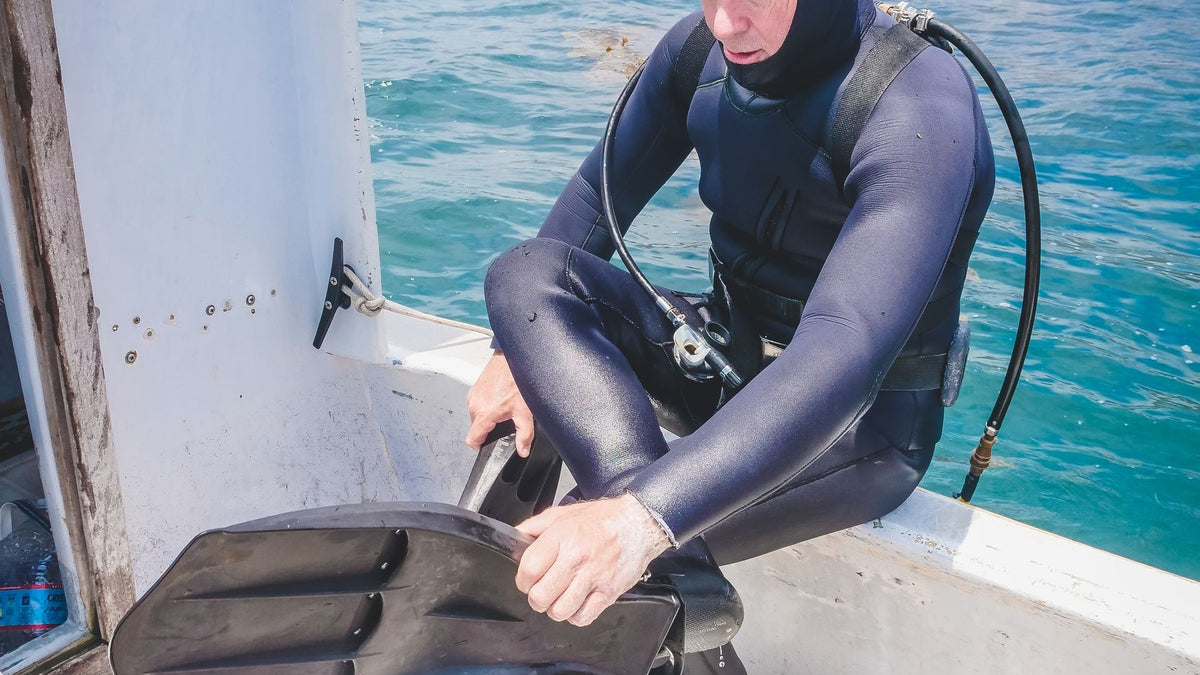
Both come in two foot styles. Full-foot (closed-heel) fins slip on like a shoe over a bare foot or thin sock. Open-heel fins use a strap behind the heel and take a neoprene boot. Our guide to choosing scuba fins covers that choice for scuba, including what PADI says about each.
How do freediving fins differ from scuba fins?
Freediving fins are the longest of the three. The same site says most exceed 30 inches (76 cm) and some reach three feet (91 cm). A breath-hold diver has no gas supply to spend. A long blade moves more water per kick and lets the cadence slow down. DAN's Alert Diver describes long fins as propelling the diver with fewer kicks than regular-length fins.
The foot pocket differs as well. It notes that most freediving fins have full-foot pockets that fit tightly, so the foot cannot slip out at speed. DAN adds that closed-heel pockets are usually worn with 2 mm to 3 mm socks.
Many freediving fins are modular, with the blade clipped or screwed to a separate foot pocket. DAN says this lets a diver swap blades or pack them smaller for travel. Blades come in plastic, fibreglass and carbon, and DAN weighs a pair of carbon blades at about 453 to 680 g each.
On stiffness, the sources do not agree. The training site says freediving fins tend to be on the stiffer side. DAN says early freedivers assumed stiffer blades were better at depth. They then found that too much stiffness strained tired legs on the way up, and that the right stiffness depends on the diver's build. DAN's starting point is a soft blade rated 20 to 25 for a diver under 68 kg. A diver of 79 to 91 kg would typically use a medium 30, and a heavier diver a hard 40. Treat those as a start, not a rule.
How should each type of fin fit?
DAN calls the fit of the foot pocket the most important variable when choosing a freediving fin, and the same applies to every type. A pocket that is too tight cramps the foot, and one that is too loose lets the heel lift. Try snorkel and full-foot fins on the bare foot or thin sock you will wear. Try open-heel fins with the boot you will dive in, because the boot adds thickness.
Fit also decides whether a fin is comfortable for a whole outing. Pressure on the toes or the top of the foot builds up over an hour in the water, and fins that cause it end up in the cupboard.
Where do swim fins fit in?
Swim fins are short fins for lap swimming and pool training, not for diving. The listings in our swimming fins collection are named for that job, such as short training fins and training fins in junior sizes. They are not made to carry a diver with a cylinder or to travel far from shore.
Scuba, snorkel, freediving and swim fins compared
| Type | Typical blade length | Foot pocket | Built for | Prices at Scuba Evolution, 26 November 2026 |
|---|---|---|---|---|
| Snorkel fins | 15 to 20 in (travel) or 24 to 26 in | Mostly full foot, some open heel | Easy surface kicking, boats and beaches | From R139 (Allegra Fins). The collection also lists some scuba fins, so its top price is not a snorkel-fin figure |
| Scuba fins | About 25 to under 30 in | Open heel with boots, or full foot for warm water | Power with dive kit, control, shore entries | Open heel from R199 (one single-size Mares Plana LX listing), up to R5,795 for a Jet Fin with spring strap. Full foot from R499 (Mares Wave Full Foot) |
| Freediving fins | More than 30 in, some to 3 ft | Mostly full foot, snug fit | Efficient long kicks on one breath | R1,050 to R3,499 |
| Swim fins | Short training fins | Varies by model | Pool and open-water swim training | R319 (Energy Swim Fins) to R1,499 (Shuttle Sport Swim Fins) |
Blade lengths come from one freediving site and makers' ranges vary, so use them to compare types, not to pick a model. Each range comes from active listings that day, and the swimming fins collection also lists a few scuba-style fins that cost more. Our range includes brands such as Mares, Cressi, Scubapro, TUSA, Seac and Head. Stock is not tracked, so ask before you travel.
Can you use scuba fins for snorkelling, or freediving fins for scuba?
Scuba fins work for snorkelling. The training site calls the crossover a hesitant yes and says snorkellers used scuba fins for a long time before snorkel-specific fins existed. The cost is size: longer blades are harder to control and take more leg work than short snorkel fins, and they are awkward getting in and out of a boat.
Freediving fins are a poor fit for scuba. A long blade is hard to manage with a cylinder and heavy kit. DAN notes that open-heel long-blade fins appeared in the early 2000s for scuba divers. They suited heavy current and long drift dives. They remain a specialist choice.
Boots change the sizing. Our guide to dive boots and fin pairing explains how to match the two.
Which fins should you buy first?
Buy for the activity you will do most. For a family beach or pool holiday, the snorkelling fins collection is the place to start, and our family snorkel set guide covers sizes for children. For diving, the scuba fins collection lists open-heel and full-foot models. New divers do well to buy fins once the Open Water Diver course begins, with the instructor's input. Breath-hold divers can find long-blade models under freediving fins, and lap swimmers will want the swimming fins and flippers. The foot pocket fit decides comfort in every type, so try them on with the sock or boot you will wear.
Sources
- Freediving training site: Snorkeling Fins vs. Scuba Diving Fins vs. Freediving Fins. Blade lengths, foot pockets and stiffness by fin type.
- DAN Alert Diver (Q4 2023): Freediving Fins Reinvented. Long blades, modular pockets, carbon weights, stiffness guide, closed-heel and open-heel use.
- Freediving training site: Open-Heel vs Full-Foot Scuba Diving Fins. Pressure points of full-foot pockets.
- Scuba Evolution: Choosing Scuba Fins. The PADI summary of open-heel and full-foot fins.
- Prices: scubaevolution.co.za, active listings read 26 November 2026.
Frequently Asked Questions
Are scuba fins different from snorkel fins?
Yes. Snorkel fins are shorter, softer and simpler, with blades of roughly 15 to 26 inches. Scuba fins start around 25 inches, tend to be stiffer and often have split or channelled blades for control with heavier kit.
Can I snorkel with scuba fins?
Yes. Snorkellers used scuba fins for years. They are longer, take more leg effort and are clumsier to walk or board a boat in, so short snorkel fins are easier for casual use.
What is the difference between freediving fins and scuba fins?
Freediving fins are longer, more than 30 inches, and usually have a snug full-foot pocket. Many are modular with carbon or fibreglass blades. Scuba fins are shorter and often open heel to fit boots.
Can you scuba dive with freediving fins?
It is possible but unusual. Long blades are hard to manage with a cylinder, so it is a specialist choice. Open-heel long-blade fins exist for scuba divers in strong current.
How much do swimming fins cost in South Africa?
At Scuba Evolution, swim and training fins were listed from R319 to R1,499 as at 26 November 2026. Check the swimming fins collection for today's prices.
How much do freediving fins cost in South Africa?
Our active freediving fin listings ran from R1,050 to R3,499 as at 26 November 2026. Modular blades and foot pockets can be bought as separate parts for some models.
Reviewed November 2026 by Devon Ford, PADI IDC Staff Instructor. Devon runs Scuba Evolution, a PADI 5-Star Dive Centre in Glenvista, Johannesburg.