
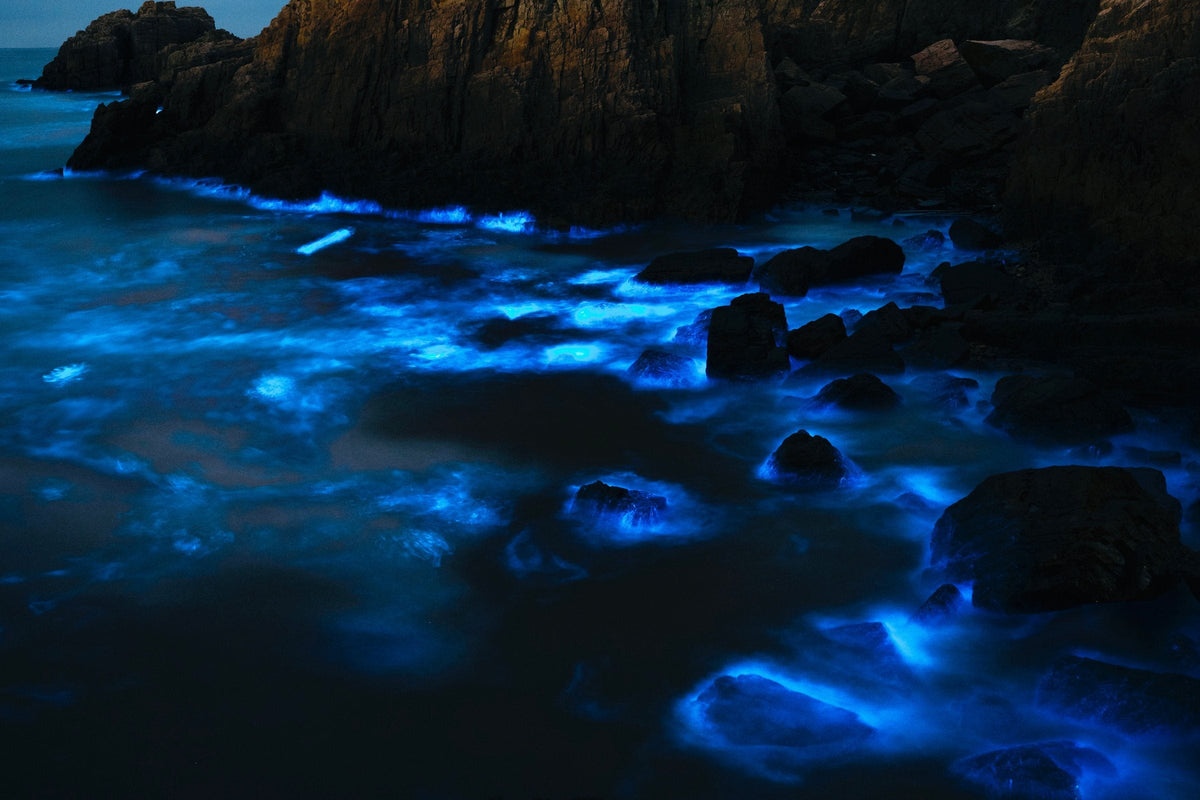
A single dinoflagellate, somewhere between 30 micrometres and 1 millimetre across, can turn a fin kick into a flash of blue light in under 20 milliseconds. That's the sparkle a night diver sees. The ocean glows because living things make light through a chemical reaction between a molecule called luciferin and an enzyme called luciferase. Near the surface, most of that light comes from dinoflagellates, which flash when moving water bends their cells, and mostly after dark.
Deeper down in open water, glowing is the norm rather than the exception. When MBARI researchers counted every animal larger than 1 cm in video from 240 remotely operated vehicle dives off California, 76% of them could make light. It's easy to stretch that into "76% of ocean animals". The count covers animals drifting and swimming in open water, not the seafloor, and the difference is large.
What makes sea creatures glow?
A reaction that needs three ingredients: luciferin, a luciferase enzyme and oxygen. Luciferin is a family name rather than one molecule. Dinoflagellates and krill share one type, while jellyfish, comb jellies, copepods and many shrimps use another called coelenterazine. A third, Cypridina luciferin, turns up only in tiny crustaceans called ostracods and in the midshipman fish that preys on them. Each luciferin and its partner proteins give off a characteristic range of colours, which is why the glow from different animals doesn't match exactly.
The trick keeps being reinvented. A 2013 review repeated the long-standing estimate that bioluminescence evolved independently at least 40 times. A 2021 analysis by Lau and Oakley raised that to at least 94 separate origins, in at least 760 genera. Unrelated animals keep arriving at the same answer to the same problem: how to signal and hunt in the dark.
How many ocean animals make their own light?
More than half in open water, far fewer on the bottom. The 2017 MBARI study logged over 350,000 animals from the surface to about 4,000 m. The proportion that could glow stayed similar at every depth, even though the total number of animals fell as the water got deeper. Jellyfish and comb jellies dominated the glowing animals above 1,500 m, worms took over to 2,250 m, and larvaceans made up about half of those below.
| Animals counted | Share that can glow | Source |
|---|---|---|
| Midwater animals over 1 cm, surface to about 4,000 m | 76% | MBARI, 2017 |
| Animals living between 200 and 1,000 m | 80% | NOAA Ocean Exploration |
| Deep seafloor animals | About 40% | MBARI, 2019 |
The seafloor result changes the headline numbers. In 2019, the same MBARI team applied their method to animals on or near the deep seabed and estimated only about 40% make light. Their suggestion is that open water is clear and three-dimensional, while the seabed is cluttered and often murky, so light signals carry less far there.
Why does the water sparkle when a diver moves?
Because the diver is bending dinoflagellates. The light comes from tiny compartments inside each cell called scintillons, which contain the luciferin and luciferase. When flowing water deforms the cell membrane, it sets off an electrical signal that lets protons flood into the scintillons. Their internal pH drops from about 8 to about 6, a protein releases the luciferin, the luciferase switches on and the cell flashes blue.
It's among the fastest processes a cell performs. The delay from stimulus to light is under 20 milliseconds, according to the Latz Laboratory at Scripps Institution of Oceanography. A flash lasts around 80 milliseconds in Noctiluca scintillans, 130 to 150 milliseconds in Lingulodinium polyedra and 500 milliseconds in Pyrocystis fusiformis. Depending on species, a single cell gives off somewhere between ten million and a billion photons. Once its luciferin is used up, the cell goes dark until it recharges the next day.
Why do dinoflagellates glow at all?
Mostly for defence, and the evidence comes from feeding experiments. Copepods ate fewer dinoflagellates from brightly glowing cultures, and their swimming changed as if the flashes startled them. The better-known idea is the burglar alarm. A flash inside a grazer's feeding current lights up the grazer, which then risks being eaten by something bigger.
That second idea has been tested. In one experiment, bioluminescent dinoflagellates cut their losses to small shrimp-like mysids because fish picked off the mysids feeding on them. Later work found dim species only get this protection at high cell densities, while bright species get it at low densities too. A third hypothesis is that the flash warns predators that some species are toxic. Some dinoflagellate populations are clones of a single cell, so losing a few individuals costs the population little.
Why is bioluminescence only visible at night?
Partly because it's switched off during the day. In photosynthetic dinoflagellates, an internal circadian clock keeps bioluminescence almost undetectable by day and brightest at night. Daylight also suppresses it directly in most species, although Noctiluca scintillans is a reported exception. In daylight, a dense bloom shows up instead as reddish-brown water, the red tide.
People have been recording these displays since at least 500 BC. South Africa has its own recent example. In December 2013, a bloom of Lingulodinium polyedra spread along more than 500 km of coast from Wilderness to East London. It's a well-known glowing species, and it isn't native to South African waters. It lasted about four months, and fish kills were reported around Algoa Bay. East of Cape Agulhas, red tides are more usually caused by Noctiluca scintillans.
How do you see bioluminescence on a night dive?
Take the light away. A torch washes out a glow this faint, so seeing it means planning a lights-out moment in the briefing, with torches kept in hand and switched off. Slow hand or fin movements then set off the plankton around you. Scripps advises beach watchers to wait until at least two hours after sunset during a glowing red tide, which gives some idea of how dark it needs to be.
Two cautions belong in the dive plan. A glowing bay isn't evidence of healthy water, because several bioluminescent bloom species, L. polyedra among them, produce toxins. And the blue itself is physics. It's the colour that travels furthest through seawater, which is also why reds vanish first on a daytime dive, as explained in our guide to why colours disappear underwater.
Sources
- MBARI: New study shows that three quarters of deep-sea animals make their own light
- MBARI: Glowing to the bottom
- NOAA Ocean Exploration: What is bioluminescence?
- Frontiers in Marine Science (2023): A review of mechanically stimulated bioluminescence of marine plankton
- Microorganisms (Valiadi and Iglesias-Rodriguez, 2013): Understanding bioluminescence in dinoflagellates
- Latz Laboratory, Scripps Institution of Oceanography: Dinoflagellate bioluminescence
- Scripps Institution of Oceanography: Red tides and bioluminescence off California
- Science of the Total Environment (Bizani et al., 2023): Responses to a large-scale Lingulodinium polyedra bloom in South Africa
Frequently Asked Questions
Is it true that 90% of deep-sea animals glow?
Not as a general rule. The best quantitative count, from MBARI, found 76% of midwater animals larger than 1 cm could make light. NOAA puts the figure at 80% for animals living between 200 and 1,000 m. On the deep seafloor the estimate drops to about 40%.
Why is most bioluminescence blue?
Blue light travels furthest through seawater, so that's the colour most marine glows use. Dinoflagellates emit at around 471 to 480 nanometres. NOAA notes bioluminescence can range from near violet to green-yellow and occasionally red. MBARI lists deep-sea tomopterid worms among the few animals that glow yellow.
Do deep-sea fish make their own light?
Many do. MBARI's 2019 analysis found that about half of the deep-sea fish and squid species living in open water are known to produce light. Few of the species living on the seafloor can.
What is a red tide?
A red tide is a dense bloom of plankton, often dinoflagellates, that discolours the water. Off Southern California, the usual cause is Lingulodinium polyedra, now renamed Lingulaulax polyedra, whose cells are 35 to 60 micrometres across. Not every red tide glows, and some blooms produce toxins that harm marine life.
Can a dinoflagellate flash more than once?
Yes. Each cell can produce several flashes of around 100 milliseconds until its luciferin runs out. It then rebuilds its light-making chemistry during the following day, ready for the next night.
Is it safe to swim in glowing water?
The glow itself is harmless light, but it says nothing about water quality. Several bioluminescent dinoflagellates form toxic blooms, and Noctiluca scintillans red tides can kill fish by stripping oxygen from the water. Authorities issue advisories during harmful blooms, and those are the reference point, not how bright the water looks.
Reviewed September 2026. Devon Ford runs Scuba Evolution, a PADI 5 Star Dive Centre in Glenvista, Johannesburg.
Header photo: Chasing Lyu on Pexels, used under the Pexels License. View the original photo