
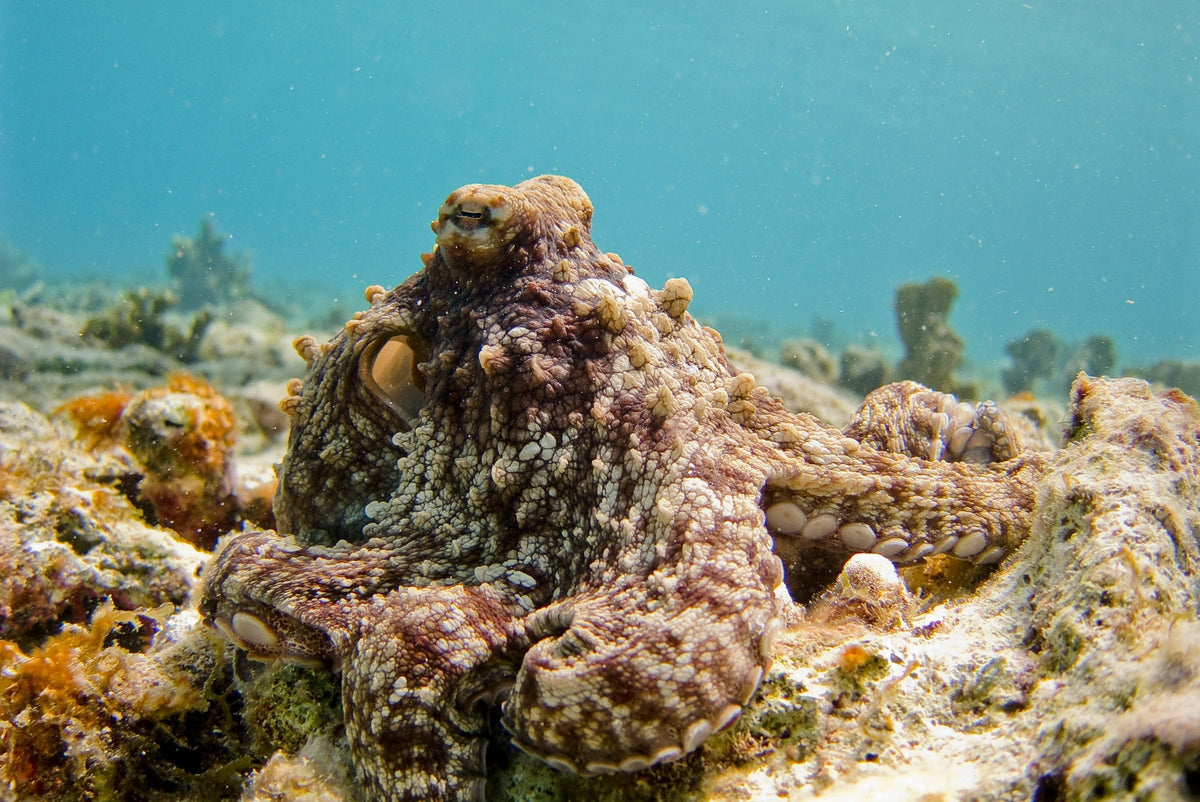
Around 230 colour organs sit in each square millimetre of octopus skin. Each one is a pigment sac pulled open by muscles under direct nerve control. That wiring is why an octopus can change colour in well under a second. The eyes are the strange part. An octopus has a single visual pigment, so by the standard definition it's colourblind. It matches its background on brightness, contrast and texture instead, helped by skin cells that reflect whatever light falls on them.
That's also why a diver can fin past an octopus on a reef and log the dive without knowing it was there. The animal isn't reading the colours of the rock. It's matching how light or dark the rock is and how rough its surface looks, and a diver's eye scanning at fin speed tends to accept the match.
How does an octopus change colour so fast?
The speed comes from nerves, not hormones. In other animals, chromatophores are single cells. In octopuses, squid and cuttlefish they're full neuromuscular organs, as John Messenger set out in a 2001 review. Each one is an elastic pigment sac ringed by 15 to 25 radial muscle fibres. When those muscles contract, the sac stretches from a sphere about 10 micrometres across into a flat disc about 300 micrometres wide. When they relax, the stretched sac springs back by itself.
Measured in living animals, the timing is startling. A 2021 study of longfin inshore squid tracked single chromatophores after a flash of light. They started responding about 50 milliseconds later and finished changing within 217 to 384 milliseconds. The control centre is large as well: in the common octopus, the brain lobes that drive the chromatophores contain more than half a million neurons. That speed lets cephalopods use colour during escapes and contests with rivals, as well as for disguise.
How do octopuses match colours they can't see?
The common octopus has one visual pigment, most sensitive to blue-green light at about 475 nanometres, according to a 2019 review of its eye. One pigment reports brightness, not hue. Behavioural tests going back more than a century have concluded the species is colourblind. The review notes that some older experiments didn't control brightness properly. Two eyes, one channel. The puzzle of colourblind camouflage is still listed as open.
So the skin does a lot of the colour work the eyes can't, starting with pigments in three classes: yellow, red and brown. Beneath them, reflective cells called iridophores bounce back specific wavelengths from thin stacked plates. Together with the pigments, they cover the whole visible spectrum. White reflector cells called leucophores go further, since they reflect whatever light reaches them. They look white in white light and blue in blue light. A pale patch of octopus skin in blue water turns blue with no input from the brain.
A second idea is still being argued over. In 2016, two researchers modelled a way round the problem. A cephalopod lens focuses each wavelength at a slightly different distance, and their off-centre pupils might let a one-pigment eye pull colour information out of that blur. Other vision scientists questioned whether it would work in natural light. For now it's a computer model, not a measurement.
Can octopus skin detect light without the eyes?
It can, but slowly. In 2015, Desmond Ramirez and Todd Oakley at UC Santa Barbara cut pieces of skin from California two-spot octopuses and shone light on them. With no eye or brain attached, the chromatophores expanded anyway. The skin carries r-opsin, the same family of light-sensing protein used in octopus eyes. It reacted fastest to blue light, with peak sensitivity estimated at 480 nanometres.
The catch is timing. In adult skin, chromatophores took an average of 6.5 seconds to reach full expansion, against the fraction of a second the nervous system manages. That's far too slow to explain the flicker of pattern a diver sees when an octopus shifts. The authors suggest this dispersed light sense might contribute to patterning, but how much it adds hasn't been shown. Older accounts that call it the solution to colourblind camouflage run ahead of the evidence.
How does an octopus change its skin texture?
Colour alone would leave a smooth octopus sitting on a rough rock. Octopuses and cuttlefish fix that with papillae, bumps in the skin that can rise and flatten again. Papillae work as muscular hydrostats, meaning the muscles that raise a bump also give it its structure, with no skeleton involved. Raised, they break up the body's outline and copy the fine texture of whatever the animal is sitting on.
A 2018 study on cuttlefish traced the nerves and chemical signals that raise and lower papillae, and found the system is fast in both directions. It also found something thriftier. A mix of smooth and striated muscle lets cuttlefish keep papillae raised through sustained tension, without constant nerve input. The researchers point to a catch-like mechanism that would cut the energy needed to keep a disguise up for long periods.
What does camouflage cost an octopus?
Far more than expected. A 2024 study in PNAS measured oxygen use in skin from the East Pacific red octopus as its chromatophores expanded and relaxed. The team then scaled the result to whole animals. For a 100 g octopus, the fully activated colour system uses an estimated 219 micromoles of oxygen an hour. The same octopus at rest uses about 237. Full camouflage runs at nearly the cost of everything else a resting octopus does.
The authors link that cost to octopus habits. Dens are close to universal among shallow-water octopuses, and an animal tucked into a crevice needs less active disguise. Many species are also partly or strongly nocturnal. In several deep-sea octopus families, where visual predators and prey are scarcer, the chromatophore system has been reduced again and again. With no shell and no spines, a shallow-water octopus in the open has almost no margin for being seen, so the expense is the price of staying alive.
What does octopus camouflage mean for divers?
Colour is a poor clue to finding an octopus, and it fades with depth anyway. Red is the first part of sunlight that water absorbs, so a red-brown animal can look dull at depth and brighten under a torch. The physics sits in our guide to why colours disappear underwater. A torch restores the colour. It does nothing about the brightness and texture match.
Slow, controlled buoyancy does most of the rest. A diver who can hover off the reef without touching it gets time to look properly. That diver also doesn't land on an animal whose whole strategy depends on being overlooked. Buoyancy is the most misunderstood skill in recreational diving, and the card is where learning it starts, not where it ends. South Africa has an Oscar-winning record of that kind of patience. My Octopus Teacher followed a wild common octopus in a South African kelp forest for a year, and won Best Documentary Feature in 2021.
Sources
- Biological Reviews (Messenger, 2001): Cephalopod chromatophores, neurobiology and natural history
- Frontiers in Physiology (2021): Quantifying the speed of chromatophore activity in living squid
- Frontiers in Physiology (Hanke and Kelber, 2019): The eye of the common octopus
- Journal of the Royal Society Interface (Mäthger et al., 2009): Structural coloration in cephalopods
- Journal of Experimental Biology (Ramirez and Oakley, 2015): Light-activated chromatophore expansion in octopus skin
- iScience (Gonzalez-Bellido et al., 2018): Neural control of 3D skin papillae for cuttlefish camouflage
- PNAS (Sonner and Onthank, 2024): High energetic cost of color change in octopuses
- Realscreen: My Octopus Teacher wins Best Documentary Feature
Frequently Asked Questions
Are squid and cuttlefish colourblind too?
Most cephalopods studied so far appear to be colourblind, with a single visual pigment most sensitive in the blue-green. The known exception is the firefly squid, which has three visual pigments, the classic starting point for colour vision. Squid also tend to lack the white leucophores that octopuses and cuttlefish use.
If an octopus can't see colour, what can it see?
Brightness and contrast, plus the polarisation of light. The regular, criss-cross arrangement of photoreceptors in the octopus retina underpins its sensitivity to polarised light. Reflective cells in cephalopod skin can bounce polarised light out through the pigment layer, which may give these animals a discrete signalling channel.
How quickly can an octopus switch its colour off?
In the one species measured cell by cell, faster than it switches it on. Retraction doesn't need muscle work, because the stretched pigment sac springs back once the muscles relax. In the 2021 squid study, retraction finished within about 217 to 267 milliseconds depending on the body region.
Why does the blue-ringed octopus flash its rings?
The rings are a signal, and the animal behind them is known for a potentially deadly bite. Each ring is built from iridophores packed with up to about 30 reflective plates, which produce the blue by interference rather than pigment. When the octopus is camouflaged the rings look muted, and they turn bright when it flashes them.
Do octopuses use colour change to communicate?
Yes. Signalling between members of the same species is well documented in several inshore cephalopods, and signalling to other species using old, conserved patterns is widespread. Because the chromatophores are neurally controlled, those signals can be finely graded and changed in moments.
Why do deep-sea octopuses have fewer colour cells?
Running the chromatophore system is expensive, so it tends to disappear where it earns little. Several deep-sea octopus families have independently reduced theirs, which fits the idea that dim water with fewer visual predators removes the payoff for costly camouflage.
Reviewed September 2026. Devon Ford runs Scuba Evolution, a PADI 5 Star Dive Centre in Glenvista, Johannesburg.
Header photo: Vlad Tchompalov on Unsplash, used under the Unsplash License. View the original photo