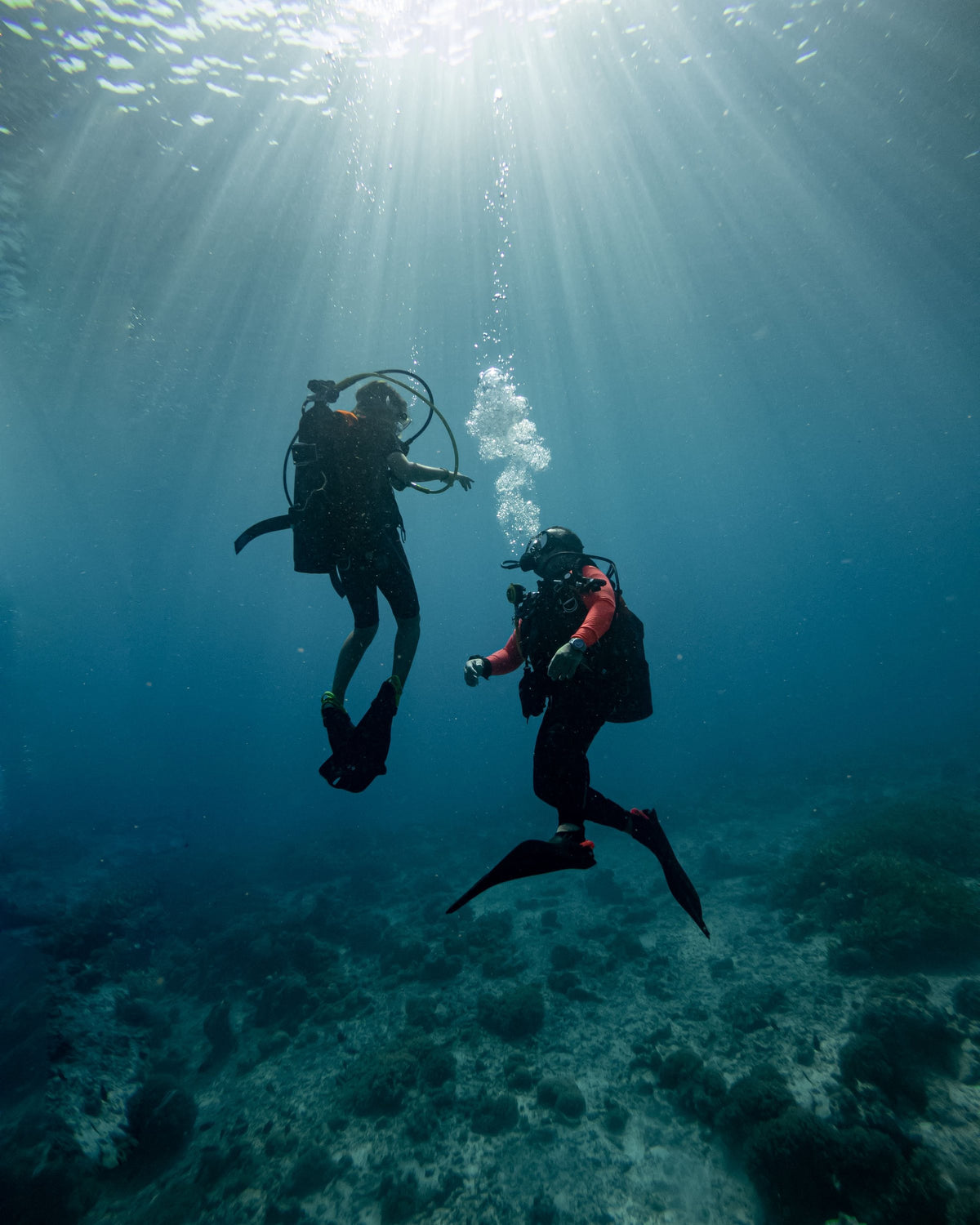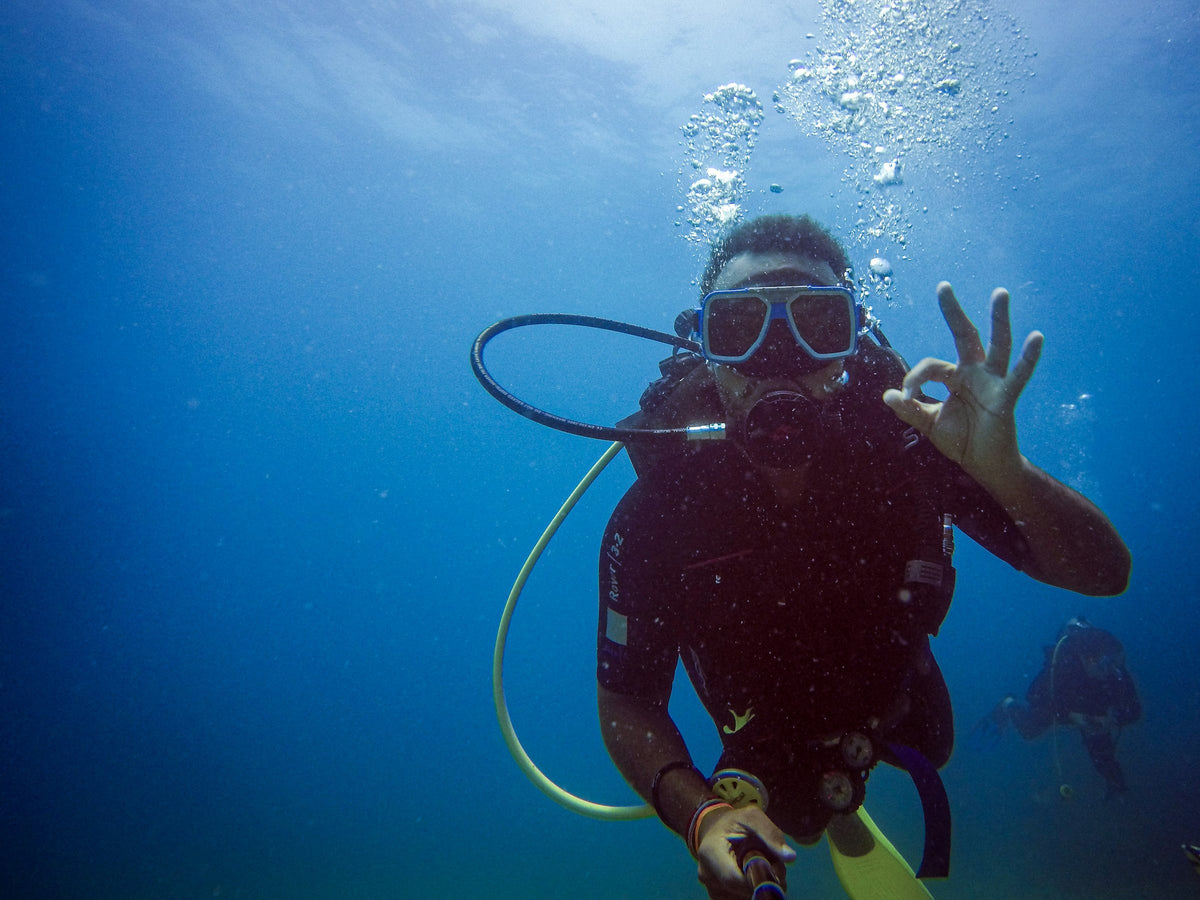
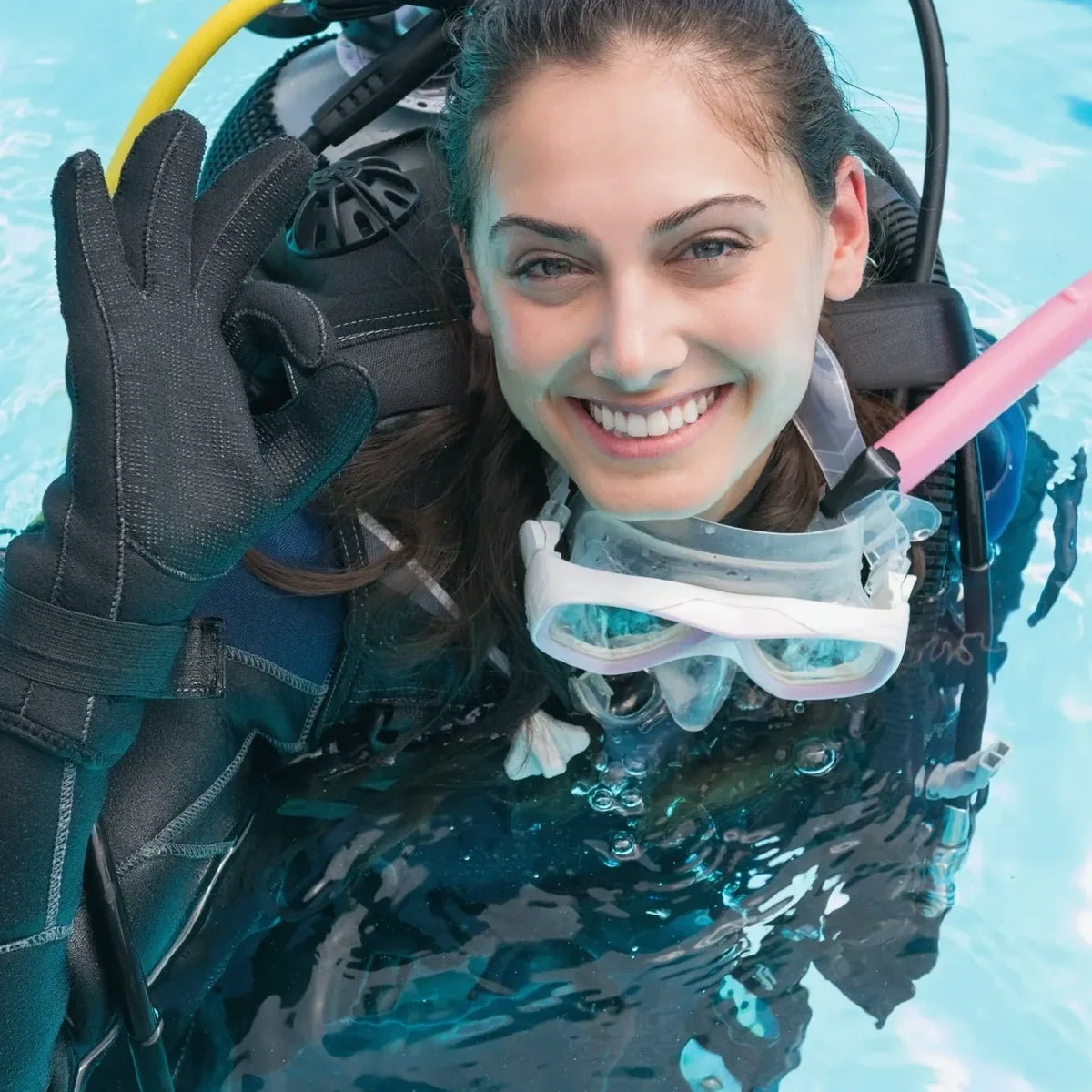
A positive test, a calendar counted backwards, and a weekend of diving sitting inside the dates. DAN points out that most women find out they're pregnant weeks or months after conception, and some only after they've dived. So the question comes in two parts: can you carry on, and what about the dives already done?
No, you shouldn't scuba dive while pregnant, at any stage, or while trying to conceive. DAN, the UK Diving Medical Committee and the dive medical form all say so, because nobody can measure the risk to the baby, and it can't be ruled out. A dive before you knew is a reason to tell your doctor, not to panic.
Why can't you scuba dive while pregnant?
Because a baby's circulation can't filter bubbles the way yours does. Nitrogen dissolves into your tissues on every dive, and on the way up some can form small bubbles in the veins, often without symptoms. In an adult, working lungs filter them out. In the fetus, DAN explains, most blood bypasses the lungs through two shunts, and gas exchange happens at the placenta. With no filter, DAN says, the risk of arterial gas embolism may rise. Our guide to decompression sickness covers how those bubbles form.
Most of the evidence comes from sheep, whose placenta resembles ours. In DAN's summary, fetal sheep formed bubbles even when their mothers showed no signs of decompression sickness. Some lambs born to ewes dived late in pregnancy had limb weakness and spinal defects. The Diving Medical Guidance used by doctors says those venous bubbles have been "proven to be potentially detrimental to fetus health".
Pregnancy changes the diver too. DAN lists swollen sinus linings that make ears harder to clear, nausea, and a growing bump that makes a wetsuit, BCD and weight belt harder to fit. DAN Southern Africa adds that morning sickness and a rocking boat make a poor pair, and that any recompression treatment would expose the baby too.
What happens if you scuba dive while pregnant?
Nobody can say for certain, and that's the core of the advice. Ethics rule out experiments on pregnant women, so the human evidence is a handful of surveys. DAN concludes that the effect may be small, but the risk to the fetus does rise, and no single dive's risk can be calculated:
- Bolton, 1980. A mailed survey of 208 women divers, 136 of whom dived while pregnant. Birth defects were significantly more common after pregnancies with diving, though within the range for the general population. DAN's summary gives 5.5 percent against none, from group sizes that differ from the abstract quoted here.
- St Leger Dowse and colleagues, 2006. 129 women reported 157 pregnancies over 1,465 dives. Too few dives per pregnancy to show a link either way.
- A 2016 survey. DAN Europe reports that it suggested a strong association between fetal malformations and diving in early pregnancy.
- Reid and Lorenzo, 2018. A review in the Canadian obstetrics journal found the human data generally reassuring but of poor quality.
No depth counts as safe, either. The UK Diving Medical Committee says no animal or human study has determined safe depths, limits or timing for a dive while pregnant. It adds that even shallow diving can cause lung barotrauma and gas embolism, which might need recompression treatment.
Can you scuba dive in the first trimester or while trying to get pregnant?
No. The advice covers every stage and the months of trying. The Diver Medical Participant Questionnaire, version 2026-01-01, doesn't ask a yes-or-no question about pregnancy. It prints one line: "Note to women: If you are pregnant, or attempting to become pregnant, do not dive". There's no box to tick and no route to a doctor's sign-off. Our guide to the dive medical form explains how the other questions work.
The guidance doctors use with the form lists pregnancy as a severe risk, the category its authors would generally discourage from diving. Its wording: diving "is therefore not recommended during any stage of pregnancy or for women actively seeking to become pregnant."
The first trimester gets no exemption. In Bolton's survey, 24 women reported first-trimester dives deeper than 99 feet, about 30 metres. The UK committee describes some evidence, albeit poor, that dives deeper than 30 metres may be linked to foetal abnormalities.
What if you dived before you knew you were pregnant?
Stop diving from today, tell your doctor or midwife, and leave the guilt out of it. The same sources that advise against diving are reassuring here. The guidance notes that a pregnancy discovered after diving "is not considered grounds for termination". DAN points to reports of women who dived repeatedly in pregnancy without complication, and finds "certainly insufficient evidence to warrant termination of a pregnancy". The 2018 review agrees, and a 2014 review found the outcome is usually normal.
The UK committee adds that ultrasound and other checks may help, either to ease a mother's worries or to help her doctors plan care. Your dive computer or logbook has the details worth taking along:
- Dates. When each dive happened, against the first day of your last period.
- Depths and times. Include repeat dives on the same day and any decompression stops, the two patterns the UK committee singles out.
- Symptoms. Anything unusual after a dive. Signs of decompression sickness mean calling DAN Southern Africa on +27 82 810 6010.
Can you snorkel or freedive while pregnant?
Snorkelling at the surface is treated differently. A 1996 review in Seminars in Perinatology concluded that snorkelling can still be practised during pregnancy, while scuba should wait until after the birth.
Freediving is where the sources part ways. The medical form counts freediving as diving, so its note to women applies. DAN Europe, drawing on Japan's ama and Korea's haenyo divers, says conservative freediving may be considered safe for relaxation when mother and baby are healthy, though it isn't ideal exercise. With two positions on the table, that's a question for your doctor or midwife, not the dive centre.
How soon after giving birth can you scuba dive?
Usually three to four weeks after an uncomplicated vaginal birth and at least eight weeks after a caesarean, with your doctor's go-ahead. The DAN sources agree on the shape and differ at the edges:
| Delivery | DAN and DAN Southern Africa FAQ | DAN Southern Africa, 2021 | DAN Europe |
|---|---|---|---|
| Uncomplicated vaginal birth | At least 3 to 4 weeks (21 days minimum) | 4 weeks as a rule of thumb | About 21 days |
| Uncomplicated caesarean | At least 8 weeks | At least 8 weeks | 8 to 12 weeks |
| Complications or bed rest | 12 weeks | Medical screening and clearance first | More than 12 weeks |
The 21 days let the cervix close, which lowers the risk of infection. After a caesarean, the wound has to heal and lost fitness come back before you carry a cylinder. A caesarean is also surgery, and question 5 asks about surgery within the last 12 months. For a year, that answer is yes, which means a doctor's evaluation before diving. Gestational diabetes within the last 12 months sits in Box F, with the same result.
DAN Southern Africa notes that newborn care, with its poor sleep and fatigue, gets in the way of rebuilding strength. The form's question 3 asks whether moderate exercise is a struggle; our guide to how fit you need to be to dive sets out the yardsticks.
Can you scuba dive while breastfeeding?
Yes. DAN considers diving safe for breastfeeding mothers and says there's no risk of the baby absorbing the nitrogen from your dive. DAN Europe adds that nitrogen doesn't accumulate in breast milk. Two cautions come with it. Diving can dehydrate you and may interfere with milk production, so take extra care to stay hydrated. DAN also advises against diving while the breasts are inflamed or infected. If you're on a prescribed medicine, question 10 of the form asks about it, so ask your doctor or pharmacist first.
Getting back in the water after the baby
The order runs doctor first, then pool, then open water. Your own doctor or obstetrician clears the recovery. For the diving question itself, see a doctor trained in dive medicine; SAUHMA lists dive medical examiners in South Africa. Your certification hasn't lapsed in the meantime. PADI ReActivate (R1,800) is a refresher for certified divers after a break. The fee covers the eLearning, a pool session with an instructor, all scuba equipment and the ReActivate eCard.
Sources
- Diver Medical Screen Committee, Diver Medical Participant Questionnaire (version 2026-01-01), hosted by UHMS. The note to women, the freediving definition, questions 3, 5 and 10, and Box F. Also the Diving Medical Guidance to the Physician (version 2023-05-31): pregnancy as a severe risk.
- DAN, Pregnancy and Diving (Held and Pollock). Fetal circulation, the sheep studies, the survey summary and the conclusion. Also DAN's Scuba Diving and Pregnancy: Is Another Study Justified?
- DAN Southern Africa, Pregnancy and Diving and 6 Common Questions About Women's Health and Scuba Diving. Return after birth and breastfeeding.
- DAN Europe, Alert Diver: Women and diving, health considerations. The 2016 survey, freediving, return after birth and breast milk.
- UK Diving Medical Committee, Pregnancy. Safe limits, deep and repeat dives, and ultrasound after an unknowing dive.
- Reid RL, Lorenzo M. SCUBA Diving in Pregnancy. J Obstet Gynaecol Can 2018;40(11):1490-1496. Also Bolton ME, Undersea Biomed Res 1980;7(3):183-9 (PubMed 7423656); St Leger Dowse M et al, J Obstet Gynaecol 2006;26(6):509-13 (PubMed 17000494); Conger J, Magann EF, Obstet Gynecol Surv 2014;69(9):551-6 (PubMed 25229824).
- Camporesi EM. Diving and pregnancy. Semin Perinatol 1996;20(4):292-302. Snorkelling in pregnancy.
- SAUHMA, Dive Medical Examiner Listing.
Frequently Asked Questions
Can you scuba dive in the first trimester?
No. The Diving Medical Guidance says diving is not recommended during any stage of pregnancy. DAN Europe reports a 2016 survey linking fetal malformations with diving in early pregnancy.
How deep can you scuba dive while pregnant?
No depth has been shown to be safe. The UK Diving Medical Committee says no study has determined safe depths, limits or timing for diving while pregnant.
Can you scuba dive while trying to get pregnant?
No. The dive medical form's note reads: "If you are pregnant, or attempting to become pregnant, do not dive." DAN gives the same advice.
What if you went scuba diving before you knew you were pregnant?
Stop diving and tell your doctor or midwife the dates, depths and times. The Diving Medical Guidance says it isn't grounds for termination, and DAN notes reports of women who dived in pregnancy without complication.
How long after a C-section can you scuba dive?
DAN and DAN Southern Africa advise at least eight weeks after an uncomplicated caesarean, and DAN Europe gives eight to 12. For 12 months, the form's surgery question means a doctor's evaluation first.
Can you scuba dive while breastfeeding?
Yes, DAN considers it safe. The baby can't absorb nitrogen from your dive. Stay well hydrated, and don't dive while the breasts are inflamed or infected.
General information only, not a substitute for advice from your doctor, midwife or a doctor trained in dive medicine. In a diving emergency, call the DAN Southern Africa 24-hour hotline on +27 82 810 6010.
Reviewed October 2026. Devon Ford runs Scuba Evolution, a PADI 5 Star Dive Centre in Glenvista, Johannesburg.