
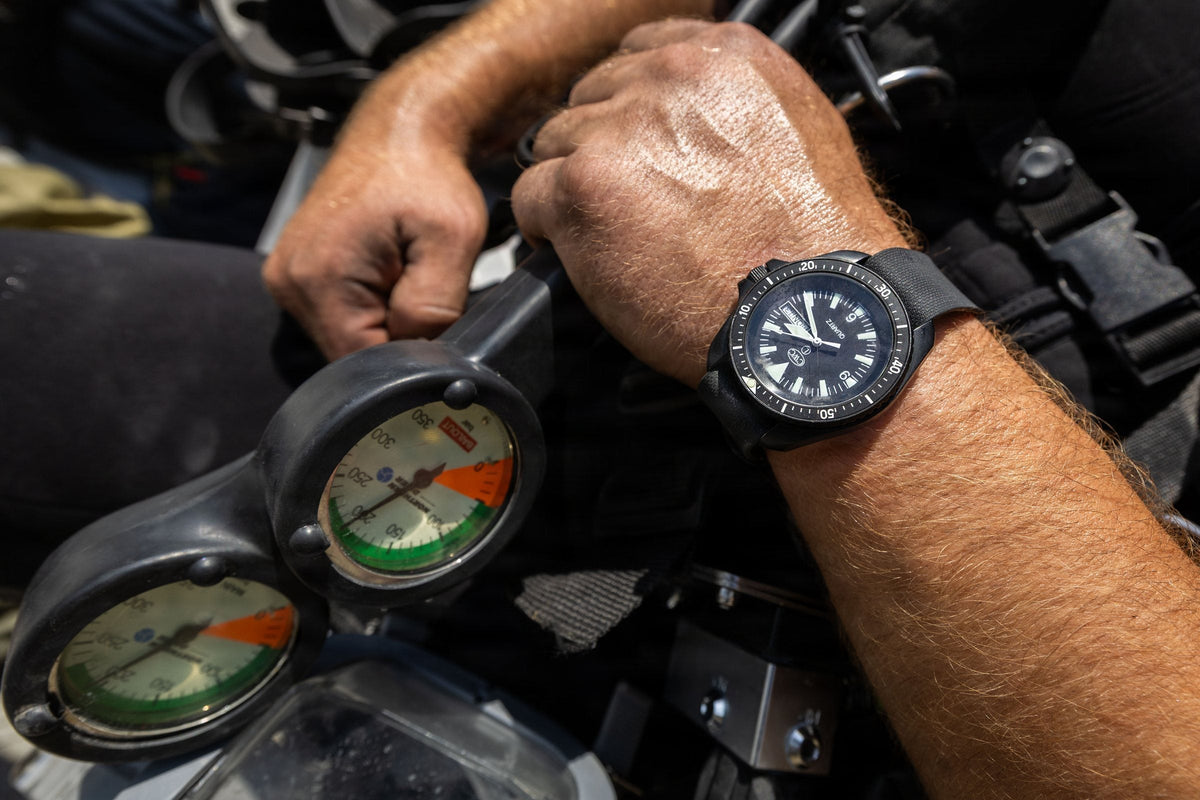
A 2018 study checked four dive computer algorithms against US Navy dive trials with known decompression sickness outcomes, using a Suunto Zoop Novo and a Shearwater Perdix as wrist units. None of the four passed every test on factory settings. Two of them, Bühlmann ZHL-16C and Suunto's RGBM, passed once their conservatism was adjusted. That's the short answer to the price question. Budget and premium computers mostly run the same families of maths, and your margin depends on the default the maker chose and whether you change it.
The model inside a computer doesn't reliably track its price. A compact Mares and a Shearwater can run the same Bühlmann maths, while Suunto has openly moved one of its algorithms in a less conservative direction. The settings menu has the bigger say, and independent tests show why.
What does a dive computer algorithm calculate?
It estimates how much nitrogen your body has absorbed, using depth, time and the gas you've told it you're breathing. The idea dates to 1908, when John Scott Haldane modelled the body as five notional tissues that absorb gas at different speeds. Swiss physiologist Albert Bühlmann later proposed rules for 16 compartments, and his model is arguably the most widely used in dive computers today. The computer tracks each compartment and warns you before any of them passes its supersaturation limit. Past that limit, bubbles become likely, which is the process behind decompression sickness.
What it can't see is you. DAN's medical reference points out that models reflect an average diver and know nothing about your temperature, workload or fitness. A 2024 review describes every table and computer limit as a point on a continuum of risk the designer considered acceptable. It also cites US Navy data showing the same diver producing markedly different bubble counts after identical, tightly controlled dives. The number on your wrist is a planning figure. Not a clearance.
Bühlmann or RGBM: what's the difference?
Both families track gas uptake the same way; they part company on the way up. Bühlmann is a dissolved-gas model that caps how far each compartment can exceed the surrounding pressure. Bubble models such as RGBM and VPM try to predict and control bubble growth, and typically call for deeper first stops. Suunto has developed its RGBM versions with Dr Bruce Wienke for well over a decade. By the early 2000s bubble models had become almost universal in technical diving, with almost no outcome data behind them.
The data arrived later and didn't favour deep stops. In a US Navy Experimental Diving Unit trial, air dives with identical total decompression time produced more DCS on the deeper-stop schedule. Re-analysis showed the slow tissues kept absorbing gas during the deep stops and surfaced more loaded. Both families are on sale today, including at the simple end of the range.
| Computer | Algorithm | How you adjust conservatism |
|---|---|---|
| Mares Puck 4 | Bühlmann ZH-L16C | Customisable gradient factors |
| Suunto Zoop Novo | Suunto RGBM | Setting of 0, +1 or +2 |
| Shearwater Peregrine | Bühlmann ZHL-16C with gradient factors | Presets 45/95, 40/85 or 35/75, or custom |
Do cheap dive computers use worse algorithms?
Not in the way the price gap suggests. Mares' compact Puck 4 runs Bühlmann ZH-L16C with customisable gradient factors, the same model family as the Shearwater Peregrine. The Zoop Novo runs Suunto RGBM, and the 2018 study found that algorithm prescribed conservative no-stop times at shallower depths. The genuine limits at the simple end are practical. The Zoop Novo's planner only handles no-decompression dives, and its conservatism comes as three steps rather than gradient factors you can read.
Newer doesn't automatically mean more conservative, either. Suunto says it adjusted its Fused RGBM "to a less conservative direction" based on customer feedback. The resulting Fused RGBM 2 allows shorter ascent times on deep air dives and repeat dives, and shortens no-fly times. Same brand, same name on the box, a different margin underneath.
What do gradient factors change?
Gradient factors scale Bühlmann's limits down to a percentage. GF Low sets how much supersaturation is allowed when the first decompression stop is triggered, so a lower number means a deeper first stop. GF High sets how much is allowed on arrival at the surface, so a lower number means longer shallow stops. A no-stop dive has no first stop, which makes GF High the setting that shapes your no-decompression time. Shearwater ships the Peregrine on 40/85, with 45/95 and 35/75 as the lighter and heavier presets.
Lower isn't automatically safer. In 2023, Belgian military researchers compared the Shearwater Perdix's default of 30/70 against US Navy and Canadian air decompression tables. They found no evidence it made air decompression safer and concluded the opposite was more likely, because the deep first stops raised supersaturation in the slow tissues. Belgian Navy divers were advised to use symmetrical settings between 75/75 and 95/95 instead. Those were decompression dives as deep as 60 metres, not recreational no-stop dives. The lesson still carries over: a setting is only as useful as your understanding of what it moves.
Are factory settings conservative enough?
Sometimes, and the answer varies more between brands than most divers assume. Earlier comparisons found no-stop and total decompression times differing by up to a factor of two between computers on the same dive. A 2016 study of seven models from four manufacturers found some computers on default settings gave more conservative dives than others that had been adjusted. Changing Suunto's RGBM setting produced few differences in those tests, and some units locked out partway through a repeat-dive series.
DAN adds two traps. A computer can set conservative limits for the first dive and liberal ones for repeats, and buddies on different models can get widely different answers from the same profile. DAN's reference suggests buddies use similar models and settings and follow the most conservative reading when they disagree. Swapping computers partway through a trip creates its own problem, because a model is only valid if it started tracking you with no leftover nitrogen.
What should you check on your own dive computer?
Most of this sits in the manual, and ten minutes with it tells you more than the price tag did. These are the checks worth making before the next trip:
- The algorithm: the manual names it, and firmware updates can change it.
- The conservatism setting: what it's on now, and what the other options do to your no-decompression time.
- The gas setting: set for air while breathing nitrox adds margin, but the reverse removes it.
- Altitude handling: the Peregrine reads surface pressure over the 10 minutes before you switch it on, which counts at highveld sites around Johannesburg.
- The safety stop: switched on.
A computer clearing you to ascend isn't clearance to skip the stop. The PADI Enriched Air Diver course covers analysing a cylinder and setting a computer for the blend you're breathing.
Sources
- Diving and Hyperbaric Medicine: Validation of Algorithms Used in Commercial Off-the-Shelf Dive Computers (Fraedrich, 2018)
- Diving and Hyperbaric Medicine: User Settings on Dive Computers, Reliability in Aiding Conservative Diving (Sayer et al., 2016)
- Diving and Hyperbaric Medicine: Selecting Optimal Air Diving Gradient Factors for Belgian Military Divers (De Ridder et al., 2023)
- Diving and Hyperbaric Medicine: Decompression Illness, a Comprehensive Overview (Mitchell, 2024)
- DAN: Decompression Sickness (Health & Diving Reference Series)
- Suunto: RGBM Dive Algorithms
- Shearwater: Peregrine Operating Instructions
- Mares: Puck 4
Frequently Asked Questions
Is RGBM more conservative than Bühlmann?
There's no simple ranking, because settings move both. In the 2018 validation study, Suunto's RGBM gave conservative no-stop times at shallower depths. Bühlmann ZHL-16C with no gradient factors still gave acceptably short no-stop times, but needed a GF High of 70 or lower to pass the decompression-dive test.
What gradient factor setting should a recreational diver use?
Start with the manufacturer's presets and learn what each one changes before trying custom values. Shearwater's manual warns that custom gradient factors used without understanding can cause unexpected increases or decreases in decompression. Lowering GF High shortens your no-decompression time and lengthens shallow stops.
Does a dive computer adjust for cold water or hard finning?
Most algorithms work from depth, time and gas. DAN notes that a water temperature reading tells the computer nothing about your thermal stress, since you could be in a thin wetsuit or a drysuit. Being cold on the ascent and working hard at depth both raise DCS risk, so that margin is yours to add. The guide to biometric dive computers covers the few models that log heart rate.
Is diving nitrox with the computer set to air a good way to add margin?
It reduces nitrogen uptake compared with what the computer assumes, which DAN describes as a safety buffer. The 2016 study found nitrox alone may not add enough on its own, and some computers' conservative settings added bigger penalties than nitrox did, especially below a PO2 of 1.4.
Should you replace an old dive computer?
Age alone isn't the reason. Check that the manufacturer still offers firmware updates, that the battery and sensor are sound, and that its settings suit your diving. An older unit on a sensible setting can give more margin than a new one left on its most liberal option.
Can buddies dive with different computers?
Yes, with a plan. DAN warns that substantially different models can break down the buddy system when each diver follows their own device. Agreeing at the briefing to follow the tighter numbers avoids a split at the safety stop.
Reviewed September 2026. Devon Ford runs Scuba Evolution, a PADI 5 Star Dive Centre in Glenvista, Johannesburg.
Header photo: U.S. Navy, via Wikimedia Commons. Public domain. View the original photo