
Ten questions sit on page one of the Diver Medical Participant Questionnaire, and none of them asks for your weight. The PADI certification FAQ, the questionnaire and the UHMS Diving Medical Guidance each set a performance requirement or list conditions, and none sets a weight or BMI limit. What decides whether you need a doctor is how you answer the ten questions, not what the scale says.
Here is what each document says about body weight, where the form does and doesn't ask about it, and when a doctor's signature is needed. It's general information, not advice on anyone's health.
Is there a weight limit for scuba diving?
PADI's certification FAQ, the questionnaire and the UHMS guidance set none. Each source below sets a different kind of test, and none of them is a number on a scale.
| Source | What it says about weight |
|---|---|
| PADI certification FAQ | A 200 metre swim, or 300 metres in mask, fins and snorkel, with no time limit, then a 10 minute float or tread. Anyone who meets the course's performance requirements qualifies. |
| Diver Medical Participant Questionnaire | No weight, height or BMI question. It screens for exercise capacity and for listed conditions. |
| UHMS Diving Medical Guidance (for doctors) | Lists obesity as a relative risk condition, which a doctor judges for the individual. It sets no cut-off. |
| Individual operators | Boat and dive operators can set their own rules, and Undercurrent reported some that do. These are business policies, not agency standards. |
The gap between the third and fourth rows is where most of the confusion lives. A doctor weighs a person's health. An operator weighs a boat and a crew's lifting. Neither is a training standard.
Does the dive medical form ask about weight or BMI?
No. Question 3 comes closest, and it asks about function. It asks whether you struggle with moderate exercise, using 1.6 kilometres walked in 14 minutes or 200 metres swum without resting as the examples. It also asks whether fitness or health stopped you joining a normal physical activity in the past 12 months. That's a test of function, not of size.
Weight appears once, indirectly. Box G asks about bariatric surgery within the last 12 months, the same kind of recent-surgery question as spinal surgery in box F. The other lines people ask about are conditions, not sizes:
- Question 2 and box B. If you're over 45, the box asks about smoking or nicotine, high cholesterol, high blood pressure and a family history of early heart disease.
- Box F. Diabetes, drug or diet controlled, and recurrent back problems that limit everyday activity.
- Box G. Frequent heartburn, regurgitation or reflux, and bariatric surgery in the last 12 months.
- Question 10. Any prescription medication, apart from birth control, menopausal hormone replacement and most antimalarials.
The form also tells you what to do with a worry it doesn't cover. If you have concerns about your diving fitness that aren't on the form, it says to consult a physician before diving. Our guide to what a yes on the medical form means walks through the routing line by line.
What do doctors read about obesity and diving?
The UHMS Diving Medical Guidance is the peer reference doctors use with the questionnaire. Its metabolic section says obesity may predispose a diver to decompression sickness, can impair exercise tolerance and is a risk factor for coronary artery disease. It lists obesity under Relative Risk conditions, and sleep apnoea sits beside it in the pulmonary list.
The guidance defines that category plainly. Relative Risk is a moderate increase in risk that may, in some instances, be acceptable, so physicians base the decision on an assessment of the individual. It adds that experience and physiology allow only a qualitative view of relative risk. There's no BMI figure to find because the document doesn't use one.
The cardiac section explains why exercise capacity gets so much attention. The guidance notes that almost 30% of recreational diving fatalities have a cardiac event as the disabling injury. For candidates being assessed for heart conditions, it calls the capacity to sustain 6 METs, six times resting metabolic rate, a pragmatic expectation for a recreational diver. That's a doctor's yardstick for a doctor's appointment. It isn't a test a dive centre sets or applies.
Does body weight raise the risk of decompression sickness?
The evidence is mixed, and the best recent summary comes from DAN Europe's Alert Diver. Klaus Stiefel's article of 6 November 2025 reviews the studies and headlines its conclusion as "no extra risk at low to moderate body fat, but beware of severe obesity".
- BMI is a blunt tool. The article points out that BMI uses only weight and height, so it can't tell muscle from fat.
- The DAN database signal is small. In a 39,099 dive database, BMI caused a weakly significant increase in bubble formation, mostly in female divers. Divers who developed decompression illness had a slightly lower average BMI, and the difference wasn't statistically significant.
- Other studies disagree. A separate study of Mexican fishermen-divers found a significant link between BMI and decompression illness, though those were much riskier compressor dives.
- Severe obesity brings company. Breathing problems, heart problems, high blood pressure and diabetes can be worse underwater, so the risk isn't only decompression.
- Body fat keeps you warmer. The article says fat undoubtedly insulates, and adds that this is no reason for anyone to gain weight.
Put together, the article separates two questions that searches blur. A larger body on its own isn't what it flags. Severe obesity and the conditions that come with it are, and those are exactly what the questionnaire and a doctor are there to sort out.
When does a doctor have to sign off?
When the form says so, and only then. A yes to question 3, 5 or 10, or to anything in boxes A to G, means all three pages go to a physician. A no to all ten means no evaluation is required. The form sets the trigger, and it's the same at any body size.
- What goes to the appointment. The participant questionnaire and the physician's evaluation form, all three pages, so the doctor can see which line you ticked.
- What the doctor decides. Approved or not approved, based on the Diving Medical Guidance and the individual. A dive centre can't make that call in either direction.
- Who to see. A doctor trained in dive medicine reads the guidance as it was written. SAUHMA lists dive medical examiners in South Africa, and DAN Southern Africa runs a Find a Dive Doctor directory.
- Medicines. A weight-loss injection is a prescription medicine and a yes on question 10. Our guide to diving on Ozempic or Mounjaro covers what to raise with the doctor.
- Blood pressure. It's a box B line for over-45s, and the guide to high blood pressure and diving sets out what gets asked.
Nothing here says a doctor will or won't sign. That's the doctor's call, and the signature belongs to them. How much exercise the sport asks of you is covered in the guide to how fit you need to be to scuba dive.
Do boats and gear have weight limits?
Gear and boats have practical limits, and they're set by makers and operators rather than by PADI or the medical form. A wetsuit, BCD or fin comes in a size range, and the range differs by brand and model. Check the maker's size chart before you buy, or bring the measurements to the shop and ask what's available in the size run.
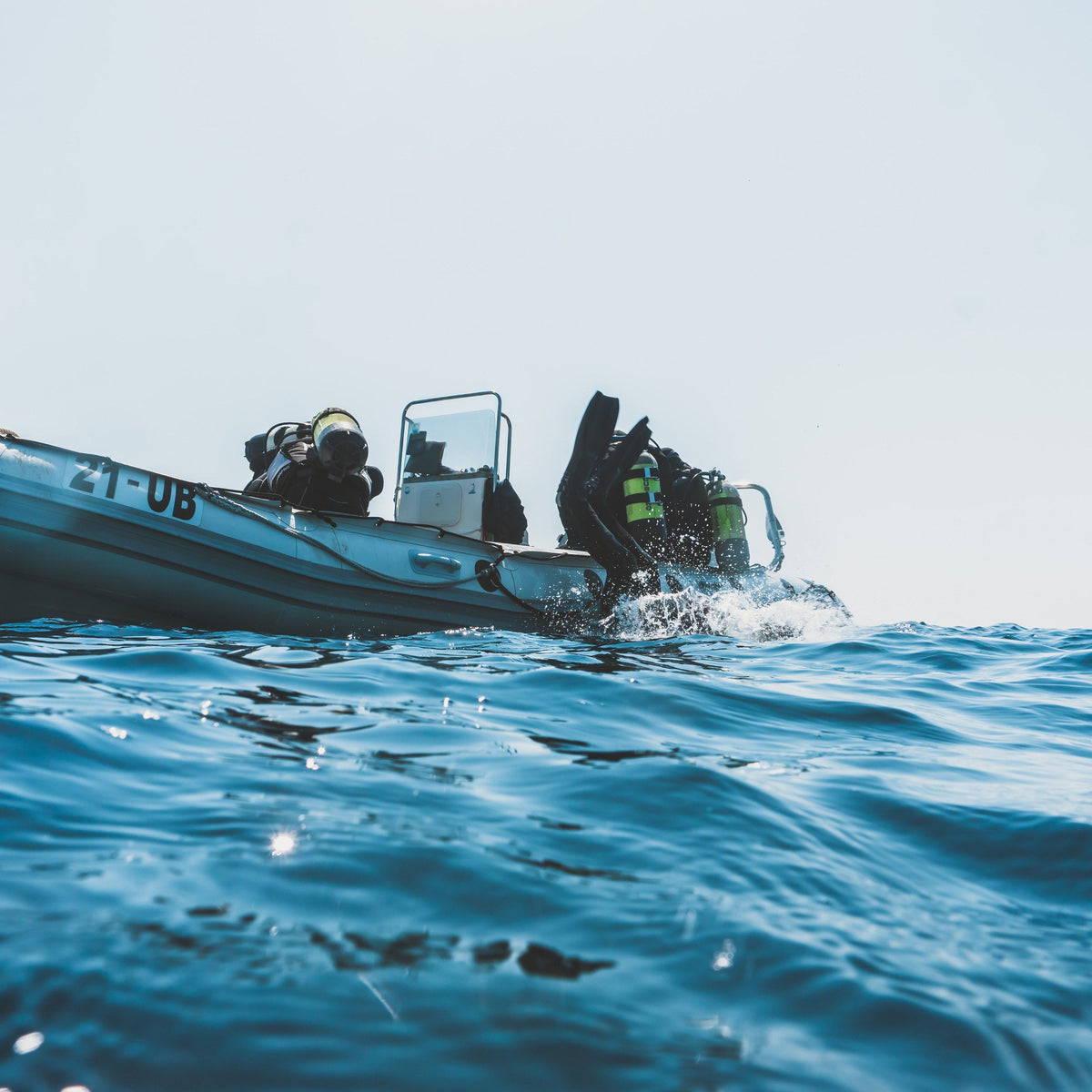
Boats are the other practical question. Undercurrent's March 2020 report quoted one operator's booking page, which warned that divers over a stated weight might not be accommodated, and the operator's manager said heavier divers were handled case by case. Ladders, lifts and crew numbers differ between boats. Asking the operator before you book is a two-minute email, and it settles the point.
Do you mean the weight you wear, not your own?
Some searches for a scuba weight limit mean the lead on the belt. How much weight goes on the belt or in the BCD pockets depends on your body, your suit, your cylinder and the water, and it changes if your body changes. Too little lead is why divers float off the stop, and too much makes buoyancy harder to control. The guide to how much weight you need for scuba diving shows how to find your own number.
How can you find out before you commit?
Read the questionnaire first, because the answers cost nothing and decide whether there's a conversation to have. If all ten answers are no, the paperwork ends there. If any is yes, book the doctor before the course, not after.
A Discover Scuba Diving session is the gentlest way to try the kit and the pool, with a PADI Professional beside you. It's screened with the same questionnaire. The Open Water Diver course builds on the same pool skills.
Sources
- PADI: Scuba Certification FAQ: the medical questionnaire, the water-skills assessment and the performance-based standard.
- Diver Medical Participant Questionnaire, version 2026-01-01 (UHMS): the ten questions, boxes A to G and what triggers a medical evaluation.
- Diving Medical Guidance to the Physician, version 2023-05-31 (UHMS): obesity as a Relative Risk condition, the definitions of risk categories and the cardiac exercise-capacity expectation.
- DAN Southern Africa: Dive Medical Forms: the Recreational Diving Medical Screening System and the bodies that endorse it.
- Stiefel KM, Body Fat Underwater, Alert Diver Europe (6 November 2025): BMI, body fat and decompression risk, and the caution on severe obesity.
- Richardson V, Undercurrent (March 2020): operator policies on diver weight, reported as business rules rather than training standards.
Frequently Asked Questions
Is there a weight limit for scuba diving?
PADI's certification FAQ, the questionnaire and the UHMS guidance set none. PADI sets performance requirements, the Diver Medical Participant Questionnaire asks about exercise capacity and listed conditions, and the UHMS guidance leaves obesity to a doctor's judgement of the individual. Boat operators can set their own rules.
Is there a BMI limit for scuba diving?
Not in the PADI certification FAQ, the questionnaire or the UHMS guidance. BMI isn't asked for, and DAN Europe's Alert Diver points out that BMI can't separate muscle from fat. Individual operators may set their own weight rules.
Can overweight people scuba dive?
Weight alone isn't a question on the form. The questionnaire screens by function and by condition, not by size. Where a yes sends someone to a doctor, the UHMS guidance treats obesity as a relative risk that the physician assesses for that person.
Does the dive medical form ask your weight?
No. Question 3 asks about moderate exercise, using 1.6 kilometres in 14 minutes or 200 metres swum without resting as examples. Box G asks about bariatric surgery in the last 12 months. Neither asks for a weight.
Do you need a doctor's note to scuba dive if you carry extra weight?
Weight on its own isn't a trigger on the form. A doctor's evaluation is needed when you answer yes to question 3, 5 or 10, or to any line in boxes A to G, whatever your size.
How much weight do you wear scuba diving?
That's the lead you carry, and it depends on your body, your suit, your cylinder and the water. There's no single figure, and it changes if your body does. The how-much-weight guide shows how to find your own number.
This is general information, not a substitute for a dive medical or advice from a doctor trained in dive medicine, and it says nothing about any one person's health or readiness to dive. In an emergency, contact your local emergency services and DAN Southern Africa on +27 82 810 6010.
Reviewed November 2026 by Devon Ford, PADI IDC Staff Instructor. Devon Ford, PADI IDC Staff Instructor, runs Scuba Evolution, a PADI 5 Star Dive Centre in Glenvista, Johannesburg.