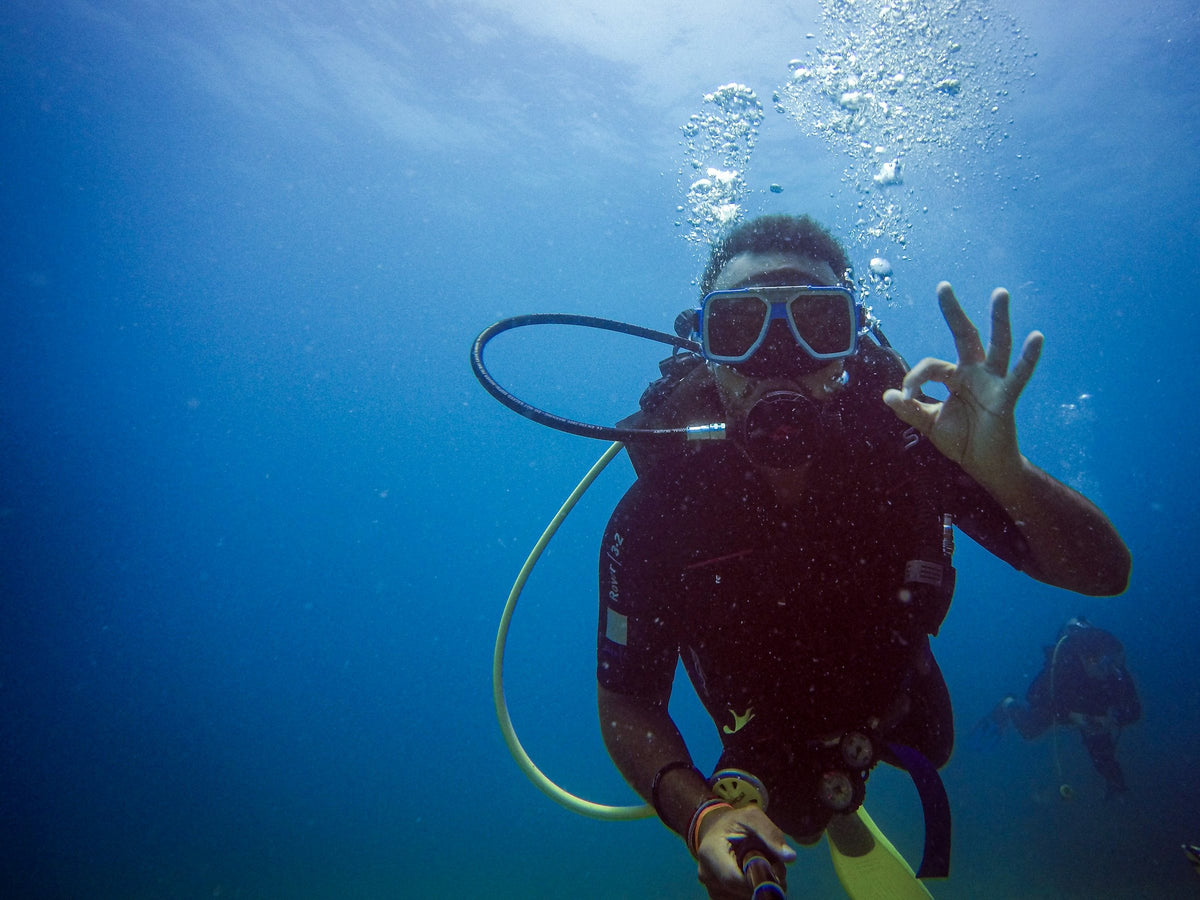

In 1826 a French physician named Colladon rode a diving bell down to 20 metres and described feeling as if he'd been drinking. The explanation is now clear in outline: nitrogen breathed under pressure acts on the brain like an anaesthetic. A 2015 physiology review says it affects all divers breathing air beyond 30 metres, and careful tests pick up changes shallower than that. Ascending a few metres usually clears the feeling within minutes. One DAN Europe study, though, found a measure of brain function still depressed 30 minutes after surfacing.
Divers call it the martini effect. DAN Europe's version of Martini's law says that once narcosis starts, each further 10 to 15 metres adds another martini on an empty stomach. It's a teaching line rather than a measurement. The narcosis itself rarely injures anyone, but the decisions made under it can.
What causes nitrogen narcosis?
Pressure pushes more nitrogen into the brain. Air is about 78% nitrogen, and its partial pressure climbs from 0.78 bar at the surface to about 3.1 bar at 30 metres. In 1935 Albert Behnke and colleagues identified nitrogen as the likely cause, after earlier reports had blamed impurities in the air. The classic Meyer-Overton hypothesis links a gas's narcotic strength to how readily it dissolves in fat. Newer work points to nitrogen acting on proteins in nerve cells, including GABA-A receptors that anaesthetic drugs also target.
The same logic explains why some gases hit harder. The 2015 review, by King's College London physiologist James Clark, rates xenon at about 25 times nitrogen's narcotic potency. DAN Europe notes that xenon is used as a medical anaesthetic. Argon rates 2.3 times nitrogen and helium only 0.2, which is why deep technical divers swap nitrogen for helium. Carbon dioxide rates 20 times nitrogen. A diver breathing hard against a heavy workload is topping up the narcosis from the inside.
At what depth does nitrogen narcosis start?
Earlier than most divers notice. Clark's review cites card-sorting tests showing slower performance on unpractised tasks at 10 to 20 metres. On air beyond 30 metres, no diver escapes it. PADI says some divers feel it at 30 metres and others not until the 40-metre recreational limit, which says more about self-awareness than about nitrogen. DAN Europe points out that divers have proved unreliable at judging their own symptoms.
| Depth on air | Nitrogen partial pressure | Typical effects |
|---|---|---|
| 10 to 30 metres | 1.6 to 3.2 bar | Mild impairment of unpractised tasks, weaker reasoning |
| 30 to 50 metres | 3.2 to 4.7 bar | Slower responses, calculation errors, mild amnesia, overconfidence, fixation |
| 50 to 70 metres | 4.7 to 6.3 bar | Confusion, poor judgement, hallucinations |
| 70 to 90 metres | 6.3 to 7.9 bar | Severe confusion, memory loss, stupor |
Susceptibility shifts between divers and from one day to the next. Clark lists fatigue, hard work, cold, carbon dioxide build-up, alcohol and anxiety as factors that make narcosis worse. DAN Europe adds descent rate and medication. A 30-metre plan after a late night and a cold, hard swim runs on a thinner margin than the same plan on a calm morning.
What does nitrogen narcosis feel like?
At first, not much that a diver would flag. PADI's article, drawing on DAN, lists impaired judgement, difficulty concentrating, drowsiness, overconfidence, euphoria and fear as the common symptoms. Reasoning clouds first, and a diver drifting along with no decisions to make may not register any change. Some divers feel cheerful. Others turn anxious. Clark notes that memory suffers between 30 and 50 metres, so a narced diver may struggle to recall what happened at depth.
A less obvious effect is on comfort. Clark cites studies in which narcosis dulled pain and made divers feel less uncomfortable in cold water, even though their sense of temperature didn't change. That raises the risk of hypothermia on a deep, cold dive, where water already pulls heat from the body fast. A diver who feels fine may be the last to notice they aren't.
Why is narcosis dangerous if it wears off?
Because the dive carries on while the brain lags. Clark's review puts narcosis as a direct contributor in up to 6% of diving deaths, and likely an indirect one in other incidents at depth. In British Sub-Aqua Club records, dives deeper than 30 metres carried 3.5 times as many incidents known to involve narcosis. Those dives made up only about 30% of the total. DAN Europe's point is simple: narcosis isn't life-threatening in itself, but a narced diver's response to a problem can be.
The effect also outlasts the depth. In a 2012 DAN Europe study, 20 divers made a 20-minute dive to 33 metres of fresh water. Their critical flicker fusion frequency, a measure of brain arousal, rose slightly on arrival and then fell to 93.5% of baseline. It was still low 30 minutes after surfacing. Fifteen minutes on oxygen brought it back. The safety stop and the first half hour on the boat may be less clear-headed than they feel.
Can you build a tolerance, or dive it away with nitrox?
Not in any way that shows up in objective tests. DAN Europe's summary is that divers don't develop a tolerance to narcosis, though they can learn to cope with it. Clark separates habituation, where practised tasks get easier, from true physiological adaptation, which studies haven't shown. Plenty of divers feel sharper after a run of deep dives. The measured data suggest that feeling runs ahead of reality. A logbook full of deep dives shows a diver can cope, not that they're immune.
Nitrox is a closer call. NOAA's 2002 diving manual first proposed counting oxygen as narcotic too, and PADI's position is that enriched air doesn't reduce narcosis. A later DAN Europe study at 4 atmospheres found less late-dive and post-dive impairment on a 40% nitrox mix than on air. Until the evidence settles, plan a nitrox dive as if it's as narcotic as air, as covered in what nitrox does and doesn't change. Helium is the gas that largely removes the problem, which takes the dive into technical training.
What should you do if you or your buddy is narced?
Go shallower. PADI's advice is to recognise the symptoms, ascend slowly until the diver feels normal again, and not descend again on that dive. Symptoms usually ease within a few minutes. If they don't, end the dive and get medical advice, because something other than narcosis may be going on. DAN Europe calls an alert buddy the best protection, since the narced diver tends to be the last to spot it.
Planning does most of the work before anyone gets wet. PADI Open Water Divers are trained to 18 metres. The Advanced Open Water Diver course includes a Deep Adventure Dive, after which the limit becomes 30 metres. PADI's Deep Diver specialty extends that to 40 metres. It includes a task at 18 metres or deeper, timed against the same task on the surface. Settling the maximum depth, turn pressure and ascent signal in the briefing beats relying on judgement at depth. Judgement is the first thing to go.
Sources
- Extreme Physiology and Medicine: Moving in extreme environments, inert gas narcosis and underwater activities (Clark, 2015)
- Alert Diver (DAN Europe): Measuring Inert Gas Narcosis
- Alert Diver (DAN Europe): Physiological responses to high pressure during immersion
- European Journal of Applied Physiology: Persistence of critical flicker fusion frequency impairment after a 33 mfw scuba dive (Balestra et al., 2012)
- PADI: Nitrogen Narcosis, What Divers Need To Know
- PADI: How Deep Can Open Water Divers vs. Advanced Open Water Divers Go?
- DAN Southern Africa: Nitrogen Narcosis at Shallow Depths
Frequently Asked Questions
Is nitrogen narcosis the same as the bends?
No. Narcosis is a reversible effect of nitrogen on the brain while you're at depth, and it eases as you ascend. Decompression sickness comes from dissolved gas forming bubbles during and after the ascent. PADI describes the two as separate conditions.
Can you get nitrogen narcosis at 6 metres?
Unlikely. DAN Southern Africa answered a question about a student who felt strange after a dive to about 6 metres. Its expert said nitrogen isn't elevated enough there to cause narcosis. Hyperventilation, medication, a medical condition or a gear problem were the more likely causes, and a dive medical was the recommended next step.
Can freedivers get nitrogen narcosis?
Yes, though it takes far more depth. PADI quotes freediving instructor Akim Ladhari saying narcosis can happen to freedivers and is more common below 70 metres.
Does drinking the night before make narcosis worse?
It can. DAN Europe lists alcohol the evening before a dive, stress, overwork and anxiety as factors that multiply the narcotic effect or trigger it more easily. Clark's review also lists intoxication among the risk factors.
Why is nitrogen narcosis called rapture of the deep?
Jacques Cousteau popularised the phrase in 1953, in French as l'ivresse des grandes profondeurs. It captures the euphoria some divers feel. It leaves out the anxiety and poor judgement that others experience at the same depth.
This is general information, not a substitute for a dive medical, dive training or advice from a doctor trained in dive medicine. Diving beyond your training limits needs proper training first. In an emergency, contact DAN Southern Africa on its 24-hour hotline, +27 82 810 6010.
Reviewed September 2026. Devon Ford runs Scuba Evolution, a PADI 5 Star Dive Centre in Glenvista, Johannesburg.
Header photo: Ekaterina Zlotnikova on Unsplash, used under the Unsplash License. View the original photo