 Pay Later
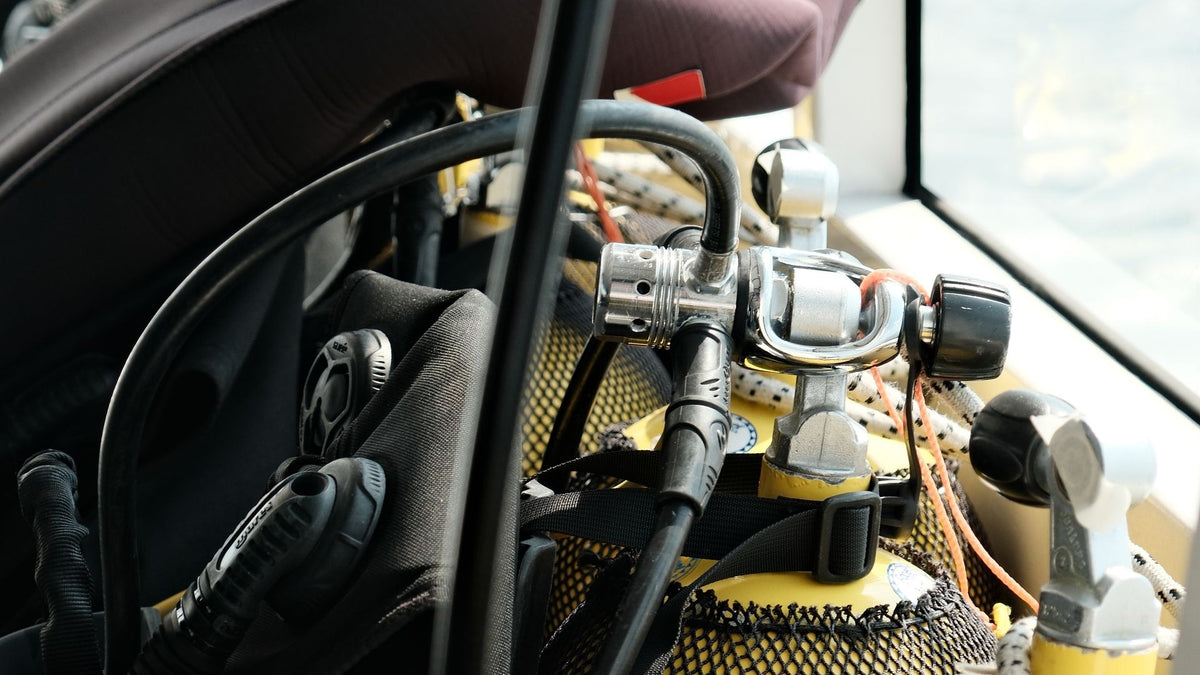
A regulator set is listed online for half the price of a new one, with a note saying it was serviced "recently". Nothing on the photo shows when, or by whom. That note is the whole decision.
Second-hand scuba gear can be bought safely, but only if the seller can prove the service and test dates. DANSA, the South African arm of DAN, goes further and advises against buying used life-support gear at all. If you do buy, the regulator, the cylinder and the dive computer need the most checking. The rest of this article is the checklist, and the sums that show when a new set wins.
Is it safe to buy second-hand scuba gear?
It depends on the item. Your regulator delivers your gas, your cylinder stores it, and your computer tracks your limits. A fault in any of the three can end a dive. A used mask or pair of fins carries a much smaller risk, because nothing depends on them working at depth.
DANSA's article on second-hand dive gear says it plainly: "don't buy second-hand gear." It then lists what to check for readers who buy anyway, and most of that list is about proof. A regulator that was "serviced" needs a service record. A cylinder needs test stamps in date. A computer needs a working depth sensor, and that can only be tested in water under pressure.
We sell new gear, so read this with that in mind. The checks below apply wherever the equipment comes from.
What should you check on a used regulator?
Start with paperwork, then move to the metal. Ask for the service record before you travel to see the regulator. DANSA's advice is blunt: if the seller says it was serviced, ask for proof, and if there is none, walk away.
- Service history: a dated invoice from an agent for that brand, not a verbal "last year".
- Parts support: manufacturers tend to require a certified technician trained on the brand, and an older model may have no service kit left. Ask the agent before you pay the seller.
- Hoses: the date of manufacture is printed on them. DANSA gives five years as the typical life, and one major maker's manual sets five years at the latest for its flexible hose. A hose can leak under its protector, so look past the sleeve.
- Second stage: broken faceplates, cracked housings and missing exhaust covers each add to the repair bill.
- Test breathing: connect it to a full cylinder and breathe from it. It tells you something, and it does not replace the service.
Our article on how long a scuba regulator lasts explains why the service record counts for more than the age on the box.
How do you check a second-hand scuba cylinder?
Read the stamps first. In South Africa, SANS 10019 sets a visual inspection every 24 months and a hydrostatic test every four years. A cylinder outside either date will be refused at a fill station, so a cylinder with a lapsed date is a cylinder you cannot use until it is tested.
Put the test cost into the price. A cylinder that is in test with time left is worth more than one due next month. Our guide to cylinder testing in South Africa covers what each test looks for and how we book them with an accredited test station.
Look at the valve too. DANSA points out that visual and hydro testing do not include a valve service, and that valves on used cylinders are usually neglected or damaged. Turn the knob, check the o-ring seat, and ask when the valve was last stripped.
Is a used dive computer worth it?
Seldom for the first one. DANSA's list of problems is long. Depth sensors can fail and can only be proved in water under pressure. Batteries and straps need replacing, and some battery changes mean sending the computer abroad. Older models may also need download software that no longer runs on current Windows, Apple or Linux systems.
A computer is also where algorithm updates show up. Older units miss them. If you buy used, ask for the model number and check that the maker still supports it before you hand over money.
When does new gear cost less than a bargain?
When the repairs close the gap. Take an example: a seller asks R4,000 for a regulator set. DANSA put the service of a complete set at R1,200 upwards in 2022. That is R5,200 before any hose or part is replaced, and there is no warranty behind it. A set with a hose past five years or a cracked exhaust cover costs more again.
On 23 November 2026 the scuba regulator sets in our shop start at R8,590 for a compact set with an octopus. A BCD in our range starts at R4,899. Prices change, so check the regulator combos and the BCD range for today's figures. The used set only wins if the service record is clean and the model has parts support.
Before you buy anything, work out the whole budget. Our full scuba kit cost guide shows where each item sits. The Open Water Diver course is a sensible step before you spend on kit, because the instructor can tell you what fits and what you will use.
What is safer to buy used?
Items that do not carry your gas or your depth. A mask, fins or a snorkel fall in that group. With all three, fit counts for more than age: a mask that leaks on your face or fins that cramp your calves are no bargain at any price. A second-hand BCD sits in the middle. DANSA's gear maintenance guidance notes that BCDs are commonly left out when a regulator is serviced, so ask whether the inflator and dump valves were ever checked.
If the rest of the kit is new, a used cylinder with current stamps is a reasonable place to save, provided the valve is sound.
Sources
- DANSA: Second-Hand Dive Gear (4 December 2022). Used regulators, hoses, computers, cylinders and valves; service price from R1,200 in 2022.
- DANSA: Gear Maintenance. Annual regulator overhaul, and BCDs left out of the service.
- SANS 10019 intervals as set out in our cylinder testing guide, and the maker's hose limit as cited in our gear servicing guide.
Frequently Asked Questions
Is it safe to buy second-hand scuba gear?
It can be, with proof. DANSA advises against buying used life-support gear. If you do, the regulator needs a dated service record, the cylinder needs in-date test stamps, and a computer needs a depth sensor that has been tested under pressure.
What should I check when buying a second-hand regulator?
Ask for the service invoice, check the hose date marks (five years is the typical life), look for cracked housings and missing exhaust covers, and ask the agent whether the model still has service kits. If there is no proof of service, walk away.
How old can a scuba cylinder be?
The age on the shoulder matters less than the test dates. SANS 10019 sets a visual inspection every 24 months and a hydrostatic test every four years. A cylinder outside either date will not be filled until it has been tested.
Is a second-hand dive computer a good idea?
Seldom for a first computer. Depth sensors can fail without warning, batteries and straps cost extra, and older models may lose software support. Check that the maker still supports the model before you buy.
How much does it cost to service a second-hand regulator?
DANSA put a complete regulator set service at R1,200 upwards in 2022, depending on brand, kits and labour. Hoses and damaged parts cost extra, so ask the agent for a quote before you pay the seller.
What is safe to buy second-hand for scuba diving?
Items that do not carry gas or depth information carry the smallest risk: a mask, fins or a snorkel. Choose by fit, not price. Regulators, cylinders and computers need the full set of checks first.
Reviewed November 2026 by Devon Ford, PADI IDC Staff Instructor. Devon Ford, PADI IDC Staff Instructor, runs Scuba Evolution, a PADI 5 Star Dive Centre in Glenvista, Johannesburg.
This guide is general information, not a substitute for the manual that came with your equipment or advice from a qualified technician.