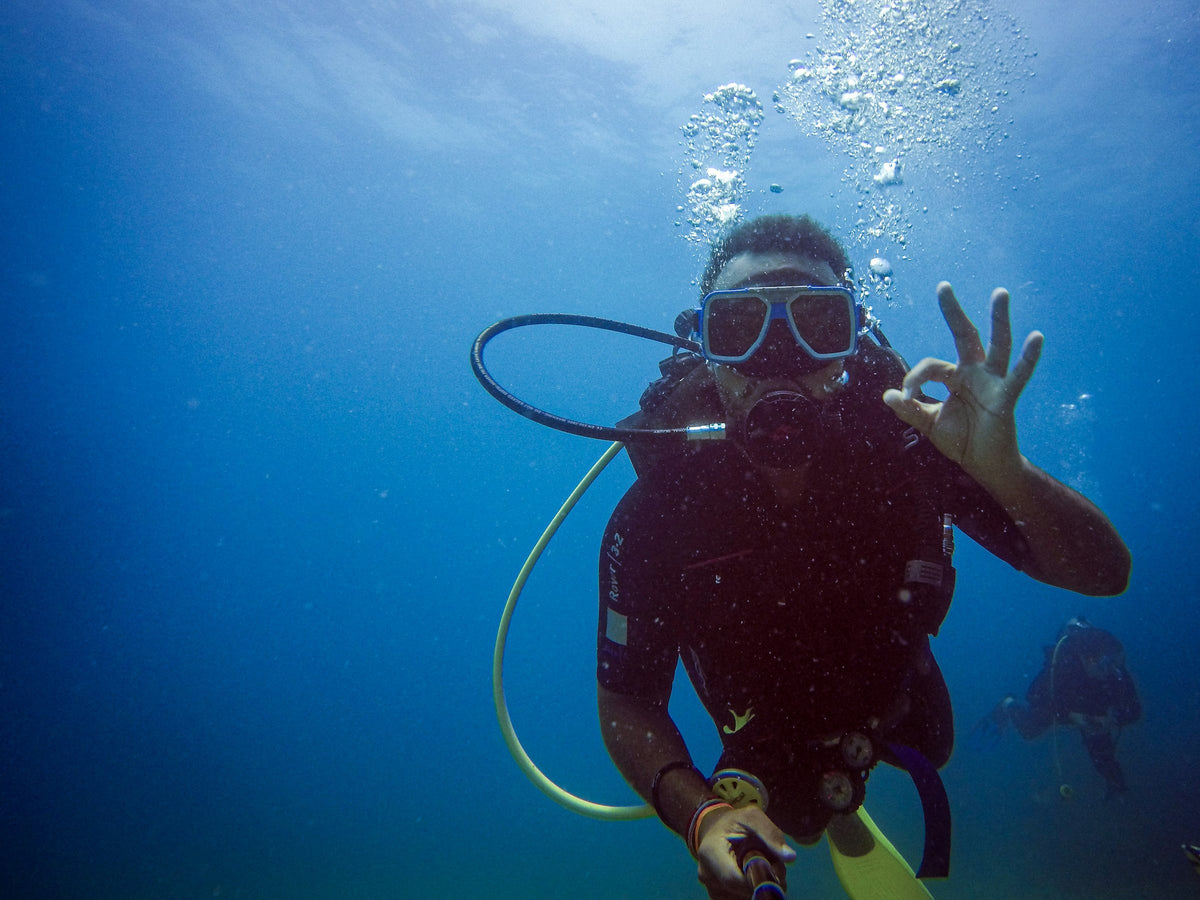

Buying scuba masks in South Africa starts with fit: press a mask to your face without the strap, breathe in gently through your nose, and pick the one that stays on and seals. Lens style, volume, skirt, strap and price come after that.
The mask fit test
PADI describes the test in four steps:
- Hold the mask gently against your face with the strap looped in front, out of the way.
- Breathe in lightly through your nose. If the mask stays there and no air leaks in, it should seal for you.
- Check that the skirt rests evenly along its whole edge, then put the strap on and confirm the mask is comfortable.
- Try it with a snorkel or a regulator mouthpiece in, pinch your nose, and look up, down and to each side for blind spots.
DAN gives the same standard in its advice on preventing mask squeeze: a well-fitting mask seals when you gently inhale through your nose and stays on without the strap. Compare several masks, and do not trade fit or comfort for a lower price, as PADI advises.
Single lens or twin lens
One Divernet buying guide describes single-lens masks as giving an open front view with room above the nose. It describes twin-lens masks as sturdier, because the centre frame stops a large single piece of glass from twisting or bending. That is one guide's view, and either shape can suit you.
Browse the single-lens masks and the twin-lens masks side by side, then try them on.
Low volume and high volume
Volume is the air space between the lens and your face. PADI says low volume or low-profile masks sit closer to your face and can be cleared of water quickly. It says high-volume masks feel more open and widen peripheral vision, but take more effort to clear.
Whichever you choose, equalise the mask on the way down by blowing small amounts of air through your nose, as DAN advises.
The skirt
The skirt is the soft silicone that touches your face. PADI says it should wrap around your eye area without any gaps and enclose your nose, so you can equalise the air space on descent.
- Clear silicone lets in more light. PADI suggests it for beginners who want an open feel and wider peripheral vision. Divernet adds that clear skirts can discolour and grow mould if they are not cleaned well.
- Black silicone hides mould and discolouring, according to Divernet, though it says some divers find black skirts claustrophobic. PADI says underwater photographers often choose dark silicone because it reduces glare.
If a closed-in feeling worries you, read can you scuba dive if you are claustrophobic.
The strap
PADI says most divers find a neoprene strap more comfortable, particularly with long hair, and recommends silicone for divers without much hair or whose strap slips. Divernet points out that some masks use buckles that only accept their own replacement straps, so check that before you buy.
Lens options
- Glass: PADI says scuba masks need strong tempered glass to withstand the pressure.
- Tints and coatings: PADI lists coloured lenses and anti-reflective coatings as optional features. Divernet lists UV treatments, treatments that cut some green wavelengths for green water, and rose tints, and calls them nice rather than essential.
- Prescription: PADI says some masks are designed for prescription lenses and to ask a dive professional. The PADI page quoting DAN says any quality dive mask can have prescription lenses, that lens thickness depends on the prescription, and that stick-on magnifying lenses exist for divers who only need reading correction.
See our prescription masks, or read scuba diving with glasses or contact lenses.
How much does a scuba mask cost
PADI, DAN and Divernet give no price to expect. Divernet says masks with bigger price tags are not necessarily better, and PADI says not to give up fit for a lower price. So set a rough budget, then filter by the fit test.
For a local picture, on 14 November 2026 the in-stock masks on our site ranged as follows.
- Single-lens masks: R75 (a child's mask) to R4,315.50.
- Twin-lens masks: R445 to R4,695.
- Prescription masks: R899 to R4,315.50.
How long does a scuba mask last
PADI, DAN and Divernet give no number of years. PADI gives signs to watch for instead. The strap is typically the first part to wear out, and the skirt is next. Test your seal out of the water, and if the mask no longer sticks to your face, PADI says it is likely time to replace it. A cracked lens, even a small crack, makes the mask unusable.
Prepare a new mask properly with how to prepare a new dive mask, and read why your dive mask keeps fogging and why put toothpaste on a scuba mask. A snorkel mask is not the same thing, as explained in scuba mask vs snorkel mask.
Try it in the shop
A fit test is easier with a person beside you. Visit us at Shop U44, Glenvista Shopping Centre, Johannesburg, and we will help you fit a mask. Start online at the scuba masks collection.
Frequently asked questions
How do I choose a scuba mask?
Choose for fit first. Press the mask to your face without the strap, breathe in gently through your nose, and check that it stays put. Compare lens style, volume, skirt and strap after that.
How do I do the mask fit test?
Hold the mask gently against your face with the strap out of the way. Breathe in lightly through your nose. If the mask stays there with no air leaking in, it should seal for you. Then put the strap on and check comfort.
Should I choose a single lens or twin lens mask?
Neither shape suits all faces. Divernet describes single-lens masks as giving an open front view and room above the nose, and twin-lens masks as sturdier because of the centre frame. Fit decides.
How much should a scuba mask cost?
PADI, DAN and Divernet give no fixed price. On our site, in-stock single-lens masks run from R75 to R4,315.50 and twin-lens masks from R445 to R4,695 as at 14 November 2026.
How long should a scuba mask last?
PADI, DAN and Divernet give no number of years. PADI says the strap is usually the first part to wear out and then the skirt. Replace it if it no longer sticks to your face in the seal test, or if a lens is cracked.
Is there one right scuba mask for everyone?
No. Faces differ, so the right mask is the one that passes the fit test on your face.
Can I get a scuba mask with prescription lenses?
Yes. The PADI page that quotes DAN says any quality dive mask can have prescription lenses installed, and that options include drop-in or laminated lenses. Ask in the shop before you buy.
What is mask squeeze and how do I avoid it?
DAN says mask squeeze happens when you fail to equalise the mask by adding air to its space, which you do by exhaling through your nose. To prevent it, keep your nasal passages open on descent by blowing small amounts of air through your nose, and use a mask that seals and stays on without the strap.
Sources
- PADI, Masks: the fit test steps, lens types, tints, skirt and strap options.
- PADI Blog, Beginners Guide to Buying a Dive Mask: fit before colour, skirt, volume, strap and lens glass.
- PADI Blog, How to Know When to Replace Your Dive Gear: strap and skirt wear, the seal test and cracked lenses.
- PADI Blog, Scuba Diving With Contacts or Glasses: prescription masks, drop-in lenses, stick-on lenses.
- DAN, Mask Squeeze: causes and prevention, and the seal standard.
- Divernet, Scuba Mask Buying Guide: Top 10 Tips: single and twin lenses, skirt colour, straps, lens treatments and price.
- Scuba Evolution mask collections: the price ranges quoted, read on 14 November 2026.
Reviewed November 2026. Devon Ford, PADI IDC Staff Instructor, runs Scuba Evolution, a PADI 5 Star Dive Centre in Glenvista, Johannesburg.
This guide is general information, not medical advice. If you have eye pain, blurred vision or other symptoms after diving, see a doctor.